


An ulcer in your mouth that does not heal, a persistent neck lump, or unexplained changes in voice are minor symptoms which can be caused by something serious like head and neck cancer. Head and neck cancers are malignancies of the mouth, throat, tongue, larynx, and surrounding structures. Early recognition of these symptoms will play an important role, as early diagnosis may lead to better results in treatment and preservation of essential functions.
Dr. Sandeep Nayak shares, “Early detection of head and neck cancer is essential. Early recognition of disease may need less extensive treatment and improve treatment outcomes, as well as maintain essential functions. Persistent symptoms which do not go away for 2 weeks have to be medically investigated, not ignored.”
Dr. Sandeep Nayak is the leading surgical oncologist in Bangalore with over 20 years of experience in treating various cancer diseases through surgery. Dr. Nayak is a founder of MACS Clinic, where he specializes in advanced laparoscopic, robotic, and minimally invasive cancer surgeries. He also performs Minimally Invasive Neck Dissection (MIND) for selected patients with head and neck cancers.
What Is Head & Neck Cancer?
Head & neck cancer refers to malignant tumours that develop in the tissues of the mouth, tongue, gums, throat, larynx, nasal cavity, and salivary glands.
The majority of the cancers of the mucous membranes of these parts are squamous cell carcinoma.
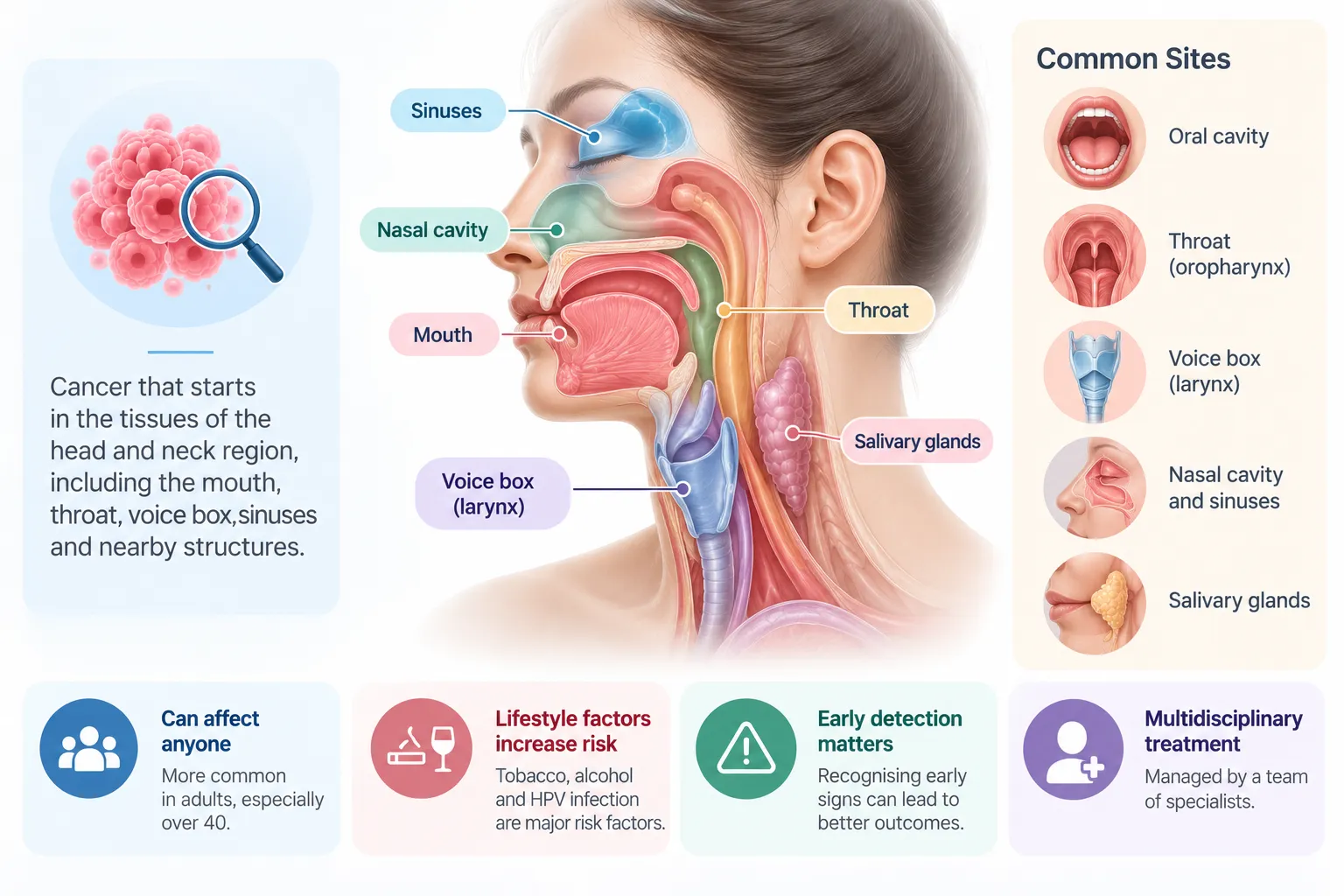
Some of the common risk factors are tobacco chewing, smoking, excessive drinking, and infection with certain types of HPV.
Symptoms vary depending on the tumour’s location and stage. Accurate diagnosis requires clinical examination, imaging, and sometimes a biopsy.
Which symptoms could indicate an underlying head and neck tumour? Let’s understand why recognising early changes matters.
Why Is Early Detection Important in Head & Neck Cancer?
Cancer may be discovered before it has spread far to the tissues or lymph nodes around it.
A patient might be eligible for less extensive surgery or radiation treatment at an earlier stage of diagnosis.
There is a possibility that treatment at an early stage might enhance chances of preserving normal speech, swallowing and facial appearance.
Nevertheless, treatment outcomes depend on factors like tumour location, biological behavior, the patient’s health status and stage of tumour.
Patients exploring head & neck cancer treatment in Bangalore should seek appropriate evaluation when symptoms persist beyond two to three weeks.
Persistent symptoms deserve timely medical assessment. Reach out to explore available head and neck cancer evaluation and treatment options.
How can you recognise symptoms that need further investigation? Let’s examine five important warning signs individually.
5 Warning Signs of Head & Neck Cancer You Should Not Ignore
1. A Mouth Ulcer That Does Not Heal
Mouth ulcers usually heal in a span of one to two weeks. The presence of an ulcer that has not healed after two weeks, especially when it is irregular, firm, or bleeds easily, needs further evaluation.
Oral cancer may occur on the tongue, gums, inner lining of the mouth, or on the floor of the mouth.
White or red patches that last for some time, especially among those who use tobacco products, may also need further investigation.
A clinical examination and biopsy, when indicated, can help establish the diagnosis.

2. A Persistent Lump in the Neck
The presence of an unexplained lump could be caused by inflammation or infection of the glands and also by swollen lymph nodes. Occasionally, it may indicate cancer involving lymph nodes.
A lump that persists, enlarges, or feels unusually firm should be examined.
Some throat cancers, particularly HPV-associated oropharyngeal cancers, may first become noticeable through a neck swelling.
Evaluation may involve ultrasound, imaging, or fine-needle aspiration.

3. Ongoing Hoarseness or Voice Changes
Short-term hoarseness can arise due to infections or from overuse of one’s voice. Nonetheless, voice changes that persist can sometimes be a symptom of cancer in the throat.
Possible signs are a permanently coarse voice, problems in speaking, or any other form of voice change that occurs without an apparent reason.
Hoarseness lasting more than three weeks should be assessed, particularly among individuals with smoking histories.
An ENT specialist may recommend laryngoscopy to examine the vocal cords.

4. Difficulty or Pain While Swallowing
The trouble with swallowing, referred to as dysphagia, is a condition that happens due to abnormalities in the throat or swallowing tract.
A person experiences pain, a sensation of food getting stuck, or increased trouble swallowing solids.
Such symptoms are caused by several non-cancerous conditions like inflammation and reflux.
However, persistent or worsening swallowing difficulties require examination, especially when accompanied by unexplained weight loss.

5. Unexplained Bleeding, Pain, or Numbness
Unexplained bleeding from the mouth or nose, persistent throat pain, earache or facial numbness may occasionally indicate an underlying tumour.
Some patients experience numbness of the tongue or lower lip, whereas some notice unexplained pain for no apparent reason.
These symptoms can be due to dental problems, neurological or inflammatory conditions as well.
A specialist examination helps determine whether further investigations are necessary.

Unexplained symptoms should be evaluated rather than overlooked. Get in touch for comprehensive diagnostic assessment and treatment planning.
What Happens When Head & Neck Cancer Is Found Early?
The early detection allows for the evaluation of the tumor in its early stage and formulation of an appropriate treatment strategy tailored to the patient.
Examination can be done through the use of biopsy, CT or MRI, endoscopy and examination of the lymph nodes.
Depending on the diagnosis, treatment may involve:

At MACS Clinic, Dr. Sandeep Nayak provides oral cancer treatment in Bangalore and offers minimally invasive approaches to neck lymph node surgery for suitable patients.
Conclusion
Recognising the early warning signs of head & neck cancer is an important step towards timely diagnosis. Persistent mouth ulcers, neck lumps, hoarseness, swallowing difficulties, and unexplained bleeding should not be overlooked.
Early assessment may improve treatment opportunities and help preserve essential functions.
At MACS Clinic, Dr. Sandeep Nayak, an ace surgical oncologist in India, focuses on evidence-based surgical planning and appropriate minimally invasive techniques.
FAQs
1. What are the first signs of head and neck cancer?
Common warning signs include persistent mouth ulcers, neck lumps, hoarseness, swallowing difficulties, and unexplained bleeding.
2. Is head and neck cancer curable if detected early?
Head and neck cancers diagnosed at an early stage may be treated effectively. Prognosis depends on cancer type, location, stage, and the patient’s overall health.
3. What causes head and neck cancer?
Use of tobacco and alcohol and some forms of HPV infection are known risk factors for head and neck cancers. In some cases, there are no identifiable risk factors.
References
- National Cancer Institute, Memory or Concentration Problems and Cancer Treatment: https://www.cancer.gov/about-cancer/treatment/side-effects/memory
- American Cancer Society, Chemo Brain: https://www.cancer.org/cancer/managing-cancer/side-effects/changes-in-mood-or-thinking/chemo-brain.html
- Mayo Clinic, Chemo Brain: https://www.mayoclinic.org/diseases-conditions/chemo-brain/symptoms-causes/syc-20351060
Disclaimer
This content is published for educational and informational purposes only and is not a substitute for medical advice. Please speak to your oncologist before changing or stopping any treatment.