

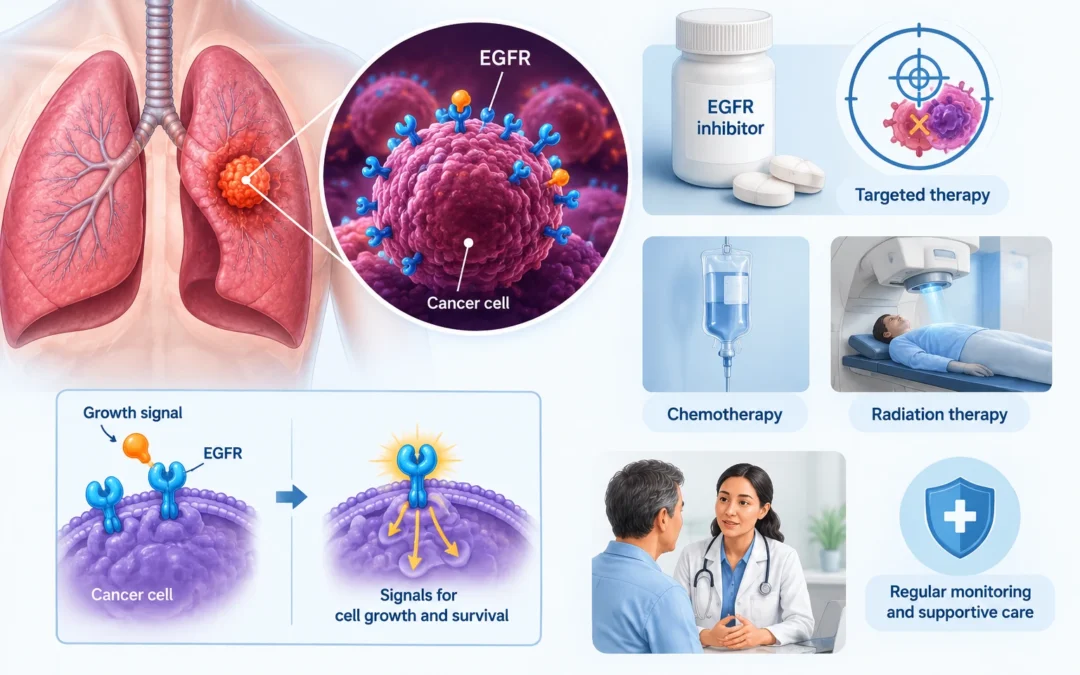
EGFR-positive lung cancer is a type of non-small cell lung cancer driven by a change in the EGFR gene. The change keeps a growth switch stuck on, so the cancer cells keep dividing. The useful part is that it can be found with a test on the tumour, and there are targeted tablets that block it, often working better than chemotherapy would.
According to Dr. Sandeep Nayak, who provides cancer treatment in Bangalore, says lung cancer in someone who has never smoked surprises people, and often an EGFR change is why. “I tell patients this is one of the cancers where a test genuinely changes the treatment. Before anyone starts chemo, the tumour should be tested for EGFR and the other drivers. If it’s positive, the plan is usually a targeted tablet, and many people do well on it for a long time. It isn’t a cure, though, and it can stop working, so we keep watching and keep testing.”
Just been told you have lung cancer and want to know about testing?
EGFR-Mutated Lung Cancer: Who Gets It and How It’s Found
It helps to know where this comes from, and how doctors look for it:
- It’s a change in the tumour’s DNA, not something you inherit. The mutation arises in the cancer cells themselves, so it isn’t usually passed on to your family.
- It’s more common than many people think, particularly in India. It’s more frequent in people who’ve never smoked, in women and in many Asian populations, and studies from India report it in roughly a quarter to nearly half of lung cancers.
- There are common and uncommon types. The usual ones are called exon 19 deletions and L858R, and they respond well to the standard tablets. Others, such as exon 20 insertions, behave differently and need different treatment.
- Testing happens before treatment starts. A sample from the tumour is tested, and if tissue isn’t enough, a blood test (a liquid biopsy) can pick up the change. Our lung cancer treatment in Bangalore page and our precision oncology service cover this testing.
EGFR Lung Cancer Treatment: What Is Used and What to Expect?
The treatment picture has changed a lot, and it’s mostly tablets:
- Targeted tablets are the main treatment for advanced disease. They’re called EGFR inhibitors. Osimertinib is now the preferred first choice, because in the main trial it controlled the cancer for longer and improved survival compared with the older tablets, gefitinib and erlotinib. It also works well when the cancer has spread to the brain. Combinations with chemotherapy or other drugs are also being used.
- Early-stage cancer can be treated with surgery, and sometimes a tablet afterwards. After complete removal of an early EGFR-positive cancer, a year or more of osimertinib has been shown to lower the chance of it coming back. Our robotic surgery page explains how the operation is done.
- Side effects are real but usually manageable. An acne-like rash, dry skin, diarrhoea, nail problems and mouth sores are the common ones. A rare but serious one is lung inflammation, so a new cough, breathlessness or fever needs a call to your team straight away.
- It can stop working, and that’s expected. With the older tablets, resistance often develops after nine to fifteen months. With osimertinib the reasons are more varied. Testing again at that point, with a repeat biopsy or a blood test, shows what’s happened and guides the next step, which may be chemotherapy, a different drug or a trial.
What Determines the Right Treatment Approach For EGFR Lung Treatment?
Two people with EGFR-positive lung cancer can be offered quite different plans. A few things decide it:
- The stage. Early disease may mean surgery, sometimes with a tablet afterwards. Advanced disease means a targeted tablet, with other treatments added as needed.
- The exact EGFR change, and anything else in the tumour. Common and uncommon mutations are treated differently, and other gene changes can matter too.
- Where the cancer has spread. Spread to the brain affects the choice of drug, and sometimes radiation is added.
- Your health and what you can tolerate. Your lungs, your other medicines and how you handle side effects all count.
- What’s happened so far. How long the first drug worked, and what repeat testing shows when it stops, shape the next move. It’s also worth asking about access and cost, since options differ.
Key Takeaways
- EGFR-positive lung cancer is driven by a change in the EGFR gene, and it’s found by testing the tumour or the blood.
- It’s more common in never-smokers, women and Asian populations, and studies from India report it in roughly a quarter to nearly half of lung cancers.
- The main treatment for advanced disease is a targeted tablet, with osimertinib now the preferred first choice.
- It can stop working, so repeat testing at that point guides what comes next.
- For questions about your own situation, you can contact the clinic at +91 9482202240.
FAQs
Is EGFR-positive lung cancer curable?
In the early stages, surgery can cure it, sometimes with a tablet afterwards to lower the chance of it returning. When it has spread, it usually can’t be cured, but targeted tablets can control it, and many people live well on treatment for a long time.
Can non-smokers get EGFR-positive lung cancer?
Yes, and it’s more common in people who’ve never smoked. That’s one reason a lung cancer diagnosis in a non-smoker should always lead to testing for EGFR and other gene changes.
How long do EGFR targeted tablets keep working?
It varies. With the older tablets, resistance often appears after nine to fifteen months. Osimertinib tends to control the cancer for longer. When one stops working, repeat testing shows why and points to the next step.
Do I still need chemotherapy if I have an EGFR mutation?
Not usually at the start. A targeted tablet is normally the first choice, since it tends to work better and is easier to tolerate. Chemotherapy may be used later, or alongside the tablet in some cases.
References
- The Role of Osimertinib in Epidermal Growth Factor Receptor (EGFR)-Mutant Non-Small Cell Lung Cancer, Journal of Thoracic Disease
- Real-World Experience of First-Line Osimertinib in EGFR Mutated Non-Small Cell Lung Cancers From a Tertiary Cancer Center, India, South Asian Journal of Cancer
- A Real-World Study of Patient Characteristics and Clinical Outcomes in EGFR Mutated Lung Cancer Treated With First-Line Osimertinib, Cancers, PubMed Central
Desclaimer:
This content is published for educational and informational purposes only and is not a substitute for medical advice. Please speak to your oncologist before changing or stopping any treatment.