

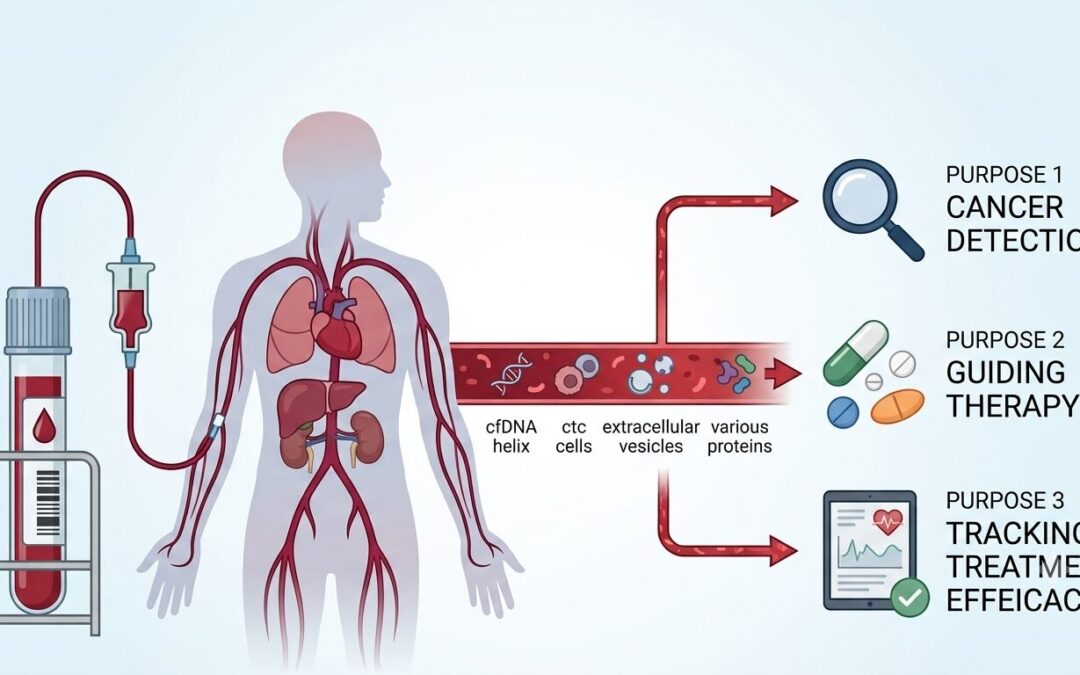
A surgeon or radiologist would take a piece of tissue, send it to a lab, and wait. That’s still how most cancer diagnoses are confirmed and it works. But it has real limitations. Some tumours are in places that are hard to reach. Some patients are too unwell for an invasive procedure. And a single tissue sample only tells you what one part of the tumour looks like at one point in time.Liquid biopsy is different. It’s a blood test.Tumours shed fragments of their DNA into the bloodstream constantly. A liquid biopsy picks up those fragments called circulating tumour DNA, or ctDNA and analyses them. No needle into the tumour. No surgical procedure. Just a blood draw, the kind anyone gets at a routine check.
Dr. Sandeep Nayak, Best Cancer Treatment in Bangalore, explains it this way: “Liquid biopsy has changed what’s possible in cancer monitoring. We can detect mutations, track how a tumour is responding to treatment, and pick up signs of recurrence all from a blood sample. For patients who can’t safely undergo repeated tissue biopsies, it’s not just convenient. It’s what makes continued monitoring possible at all.”
Wondering whether liquid biopsy is relevant to your diagnosis or treatment?
What Does a Liquid Biopsy Pick Up?
Liquid biopsy isn’t just one test; what it looks for depends on the clinical question being asked.
Circulating Tumour DNA (ctDNA): As cancer cells die or divide, they release tiny DNA fragments into the blood. These fragments carry the tumour’s mutations. Finding them in a blood sample gives doctors the same mutation information a tissue biopsy would without touching the tumour itself. This is exactly what makes it valuable in precision oncology, where treatment decisions are built around the tumour’s specific genetic profile.
Circulating Tumour Cells (CTCs): Sometimes whole cancer cells break off and travel through the bloodstream. Catching them tells doctors something about how the cancer behaves whether it’s sitting still or moving, how aggressive it is, whether spread is likely.
RNA and Proteins: Some tests go even further RNA fragments and proteins that tumour cells release into the blood. Not just which mutations are present, but how the tumour is actually functioning. It adds detail that DNA alone doesn’t always show.
One blood draw covers all of this. And unlike a tissue biopsy, it can be repeated three months later, six months later, whenever the clinical picture needs updating. The tumour changes. The test can keep up with it. For lung cancer specifically, where repeat tissue biopsies carry real risk, this is covered in more detail on the Lung Cancer Treatment page.
When Do Doctors Actually Use It?
Think of liquid biopsy as a companion to tissue biopsy not a replacement. There are specific moments in a patient’s journey where it genuinely changes what’s possible.
When Getting Tissue Isn’t Safe: Some tumours are in locations nobody wants to put a needle near wrapped around blood vessels, sitting deep in the lung, close to the brain. In those cases, a blood draw becomes the only practical way to get molecular information about what the cancer is doing. The Lung Cancer Treatment page goes into how this applies specifically to lung cancer cases.
Checking If Treatment Is Working: Once a patient starts treatment, someone needs to know if it’s actually doing anything. Liquid biopsy tracks ctDNA levels in the blood falling levels usually mean the treatment is hitting its target. If those levels stop falling or start climbing again, that’s a warning sign. Often weeks before a scan would show anything.
Watching for Cancer Coming Back: After treatment ends, the worry doesn’t always end with it. Regular liquid biopsy testing can catch early signs of recurrence sometimes months ahead of imaging picking anything up. That head start matters for what comes next.
Finding Resistance Mutations: Cancers adapt. A drug that worked brilliantly at the start can stop working because the tumour has quietly developed a new mutation. Liquid biopsy can catch that shift without putting the patient through another invasive biopsy and that’s where precision oncology comes back into the picture, adjusting treatment to match what the cancer looks like now, not what it looked like at diagnosis.
Why Choose MACS Clinic for Liquid Biopsy and Precision Cancer Diagnosis?
Dr. Sandeep Nayak’s team at MACS Clinic uses liquid biopsy as part of a broader precision oncology framework not as a standalone test, but as one layer of a complete molecular picture. For patients where tissue biopsy is difficult, risky, or has already been done and needs updating, liquid biopsy gives the team the information needed to keep treatment decisions grounded in current tumour biology rather than what was found at diagnosis months or years earlier.
Molecular profiling, Next-Generation Sequencing, and liquid biopsy are reviewed together by surgical oncology, medical oncology, and pathology before treatment plans are made or changed. A blood test result doesn’t make a treatment decision on its own. The full clinical picture does. Those who want to understand whether liquid biopsy is relevant to their case can reach the team at +91 9482202240.
FAQs
Is liquid biopsy just a fancy blood test?
It’s a blood draw, yes but what’s being measured is completely different. Normal blood tests check your organs, cells, and proteins. Liquid biopsy hunts specifically for tumour DNA floating in the blood. The lab work behind it is far more specialised than a routine panel.
Can it catch cancer before you feel anything?
In research, ctDNA has shown up before tumours were visible on scans. But liquid biopsy isn’t a screening tool for the general public yet. Right now, it’s mainly used in people already diagnosed to track treatment or watch for cancer coming back.
Is it as reliable as a tissue biopsy?
For the first diagnosis, tissue biopsy still gives a fuller picture. Liquid biopsy is very good at tracking mutations and catching resistance but occasionally misses things a physical sample would catch. They work best together, not instead of each other.
How many times can it be done?
As many times as needed. That’s the whole point. Because it’s just a blood draw, doctors can repeat it regularly every few weeks if needed to see how treatment is going or whether something has changed in the tumour.
Disclaimer: This content is published for educational and informational purposes only.