
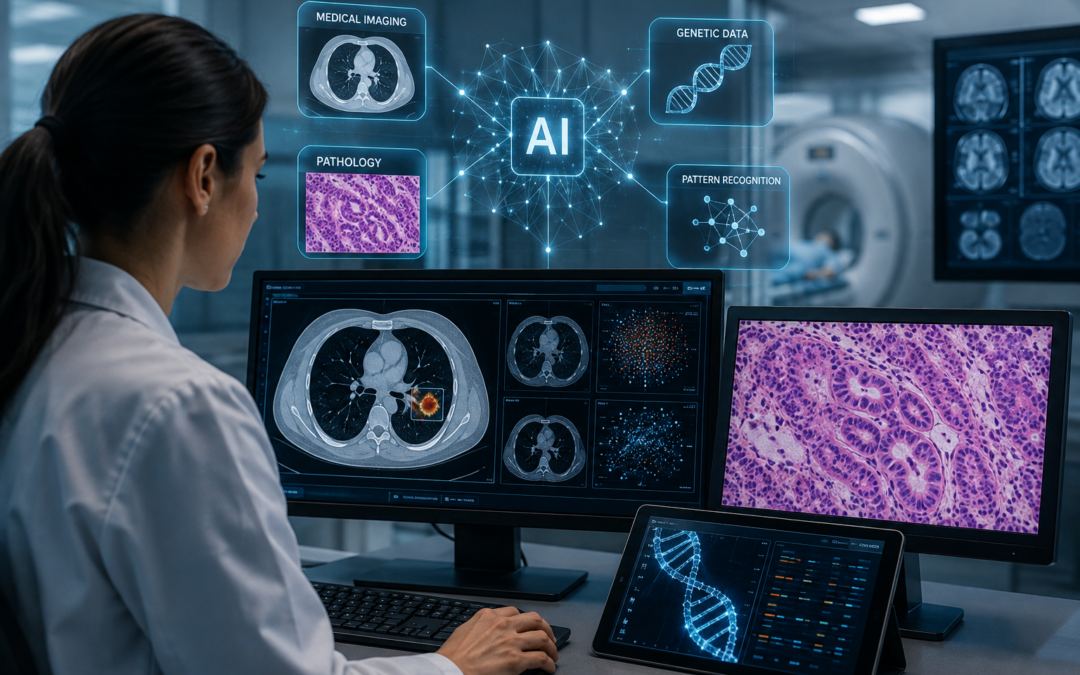
Radiology departments were the first place AI landed in cancer care, and the reason is straightforward. Reading scans is pattern recognition at scale. A radiologist looks at thousands of images, trains their eye over years, and learns to spot subtle density changes or irregular margins that flag something worth investigating. AI does the same thing differently it processes millions of images, learns from every one of them, and spots patterns a human eye can miss because they’re too subtle or too consistent to register consciously.
According to Dr. Sandeep Nayak, Best Cancer Treatment in Bangalore, “AI in cancer diagnosis is most useful where the volume of data is too large for a human to process reliably alone. Reading a mammogram, analysing a genomic sequencing report, flagging a suspicious polyp during colonoscopy. These are areas where AI adds real value today. Replacing the clinical judgement that decides what to do with the finding is a different question entirely, and that’s still firmly in human hands.”
Discover how AI is helping doctors detect cancer earlier and more accurately. Read the full article to learn more
Where AI Is Making a Genuine Difference in Cancer Diagnosis?
Mammography
AI tools reduce both false negatives cancers missed on screening and false positives that send women back for unnecessary biopsies. Multiple AI tools are FDA-cleared for mammogram reading. This is not future technology. It’s in use now.
Colonoscopy
AI-assisted polyp detection flags lesions in real time. A randomised trial in The Lancet showed AI assistance increased adenoma detection rate by 16 percentage points small polyps that an endoscopist’s eye might skip during a long list get flagged automatically, reducing missed colorectal cancers.
Pathology slide analysis
AI systems analysing haematoxylin and eosin stained slides can predict microsatellite instability status, EGFR mutation likelihood, or PD-L1 expression from morphological features alone without additional molecular testing. Not perfect, but accurate enough to triage which patients need expensive molecular tests versus which can be treated based on slide features.
Genomics and precision oncology
Tumour DNA sequencing generates datasets too large for manual analysis. AI identifies driver mutations, predicts which targeted drugs are likely to work, and flags rare molecular subtypes that match clinical trial eligibility. This is where precision oncology and AI converge most directly.
What AI Cannot Do and Where It Still Falls Short?
Training data doesn’t always generalise
AI trained predominantly on Western datasets may perform differently on Indian patients, whose breast tissue density and cancer subtypes differ. Validation in the population where the tool will actually be used is often missing.
AI flags findings — it doesn’t make clinical judgements
A suspicious nodule identified on CT by an AI tool still requires a clinician to decide whether it warrants biopsy, surveillance, or reassurance based on the full clinical picture. What specialists sit in that room and how that decision gets made is covered in the previous blog on What Specialists Make Up a Tumour Board.
Rare subtypes are underrepresented
AI tools are least reliable precisely in the cases where a second opinion is most valuable — rare cancer subtypes that were underrepresented in training sets.
Why Choose MACS Clinic for Cancer Diagnosis and Treatment?
Dr. Sandeep Nayak’s team looks at vaccination history, screening records, and personal risk together, rather than treating each one as a separate box to check off. For families, that often means one conversation covers whether a teenager still needs the vaccine, whether an adult missed their window, and what screening should look like going forward, instead of three separate visits for three separate questions. It’s part of a wider approach to cancer prevention that doesn’t stop once one intervention is done, because vaccination, screening, and follow-up only really work when they’re looked at together.
Have questions about HPV vaccination for yourself or your family? Reach the team at +91 9482202240.
FAQs
Is AI replacing radiologists and pathologists in cancer diagnosis?
No. AI assists them. Clinical judgement about what to do with findings remains with the specialist.
Which cancers benefit most from AI diagnosis tools today?
Breast cancer on mammography, colorectal cancer during colonoscopy, lung nodule detection on CT, and pathology slide analysis have the strongest evidence.
Is AI in cancer diagnosis available in India?
Some tools are in use at specialist centres. Molecular profiling and genomic interpretation with AI components are increasingly available at larger oncology centres.
How accurate is AI at detecting cancer?
Varies significantly by cancer type and tool. In some settings AI matches pathologist performance on specific tasks not on overall diagnostic judgement.
References
- https://www.ncbi.nlm.nih.gov/pmc/articles/PMC7746556/
- https://www.ncbi.nlm.nih.gov/pmc/articles/PMC6582701/
Disclaimer:This content is published for educational and informational purposes only.