

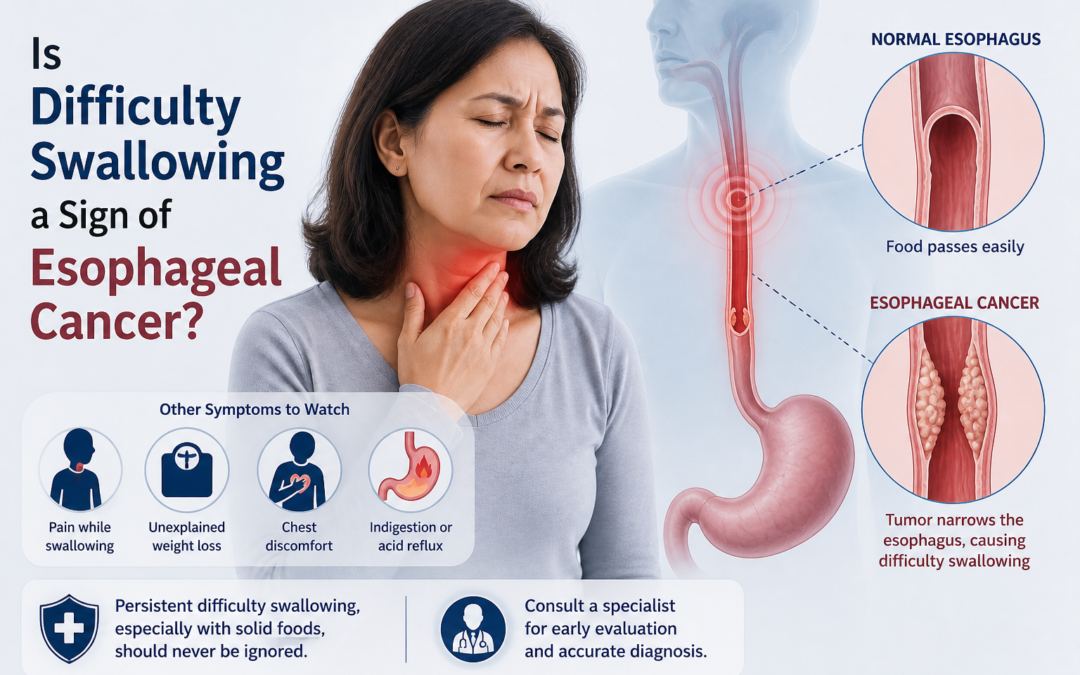
It can be, and it is the most common early clue. Doctors call it dysphagia. With esophageal cancer it usually creeps up. Dry or bulky foods like bread and meat start to catch first, then softer food, and eventually even liquids. Plenty of people quietly change what they eat for months without realising they are doing it. That said, most swallowing trouble turns out to be something else, so the point is not to panic but to get it looked at if it lingers.
Dr. Sandeep Nayak, who provides cancer treatment in Bangalore, says the story patients tell is often the giveaway. “Someone will say they stopped eating rice with a curry that’s too dry, or that they chew everything twice as long now. They don’t call it a symptom, it’s just how they eat. When it keeps getting worse over a few weeks, that’s the pattern we take seriously.”
Experiencing persistent difficulty swallowing? Don’t ignore the warning signs.
Difficulty Swallowing and Esophageal Cancer: What the Pattern Looks Like
The way it develops matters more than the swallowing alone. A food pipe narrowed by a growing tumour tends to get steadily tighter, so the trouble moves from solids to softer foods to liquids, and it rarely goes away on its own.
Other esophageal cancer symptoms often travel with it: weight loss without trying, pain or a burning feeling when food goes down, pressure behind the breastbone, a hoarse voice or a cough that won’t settle, and sometimes black stools from slow bleeding. Not all appear together, and early on there may only be the swallowing.
Our blog on early signs of esophageal cancer covers the wider symptom picture.
When Is Swallowing Trouble Not Cancer?
Most of the time. Long-standing acid reflux can inflame or narrow the lower food pipe. Muscle and nerve problems can make swallowing clumsy. Infections, large tablets stuck on the way down, and even anxiety can all cause the feeling of food catching.
The difference is usually in the course. Trouble that comes and goes, or follows a cold or a particular tablet, is less worrying than trouble that steadily worsens. Our blog on whether trouble swallowing always means cancer goes through the common non-cancer causes in more detail.
What Determines the Right Treatment Approach?
If cancer is found, the plan depends on several things the team reviews together.
Stage and exact location. How deep the tumour goes and whether nodes are involved.
Tumour type. Squamous and adenocarcinoma are treated a little differently.
Overall health and nutrition. Many patients arrive underweight, which affects what is safe.
Whether chemotherapy or radiation comes first. Many plans start with these before surgery.
Molecular testing. Precision oncology results can open options in some cases.
Your preferences. Eating and quality of life matter, and should be said out loud.
Surgical, medical and radiation oncology usually agree the plan together after endoscopy, a biopsy and scans.
Key Takeaways
- Difficulty swallowing is the most common sign of esophageal cancer, but most swallowing trouble is not cancer.
- The warning pattern is trouble that keeps worsening, from solids to softer foods to liquids.
- Weight loss, pain on swallowing, chest pressure and a hoarse voice add to the concern.
- Swallowing trouble lasting more than two or three weeks is worth getting checked.
- Endoscopy with a biopsy gives the answer.
- Questions about your own situation? The clinic’s number is +91 9482202240.
FAQs
How long is too long to wait?
If it lasts more than two to three weeks, or keeps getting worse, get it checked.
What test is done?
Usually an endoscopy, a thin camera passed down the food pipe, with a small biopsy if anything looks wrong.
Does it hurt?
Swallowing can be painful or just awkward. Many early cases cause no pain at all.
Can reflux lead to esophageal cancer?
Long-standing reflux is a known risk factor for some types. That is a reason to treat and monitor it, not to assume cancer.
References
- National Cancer Institute: Esophageal Cancer Treatment (PDQ)
- American Cancer Society: Signs and Symptoms of Esophageal Cancer
- Cancer Research UK: Oesophageal Cancer Symptoms
Disclaimer
This content is published for educational and informational purposes only and is not a substitute for medical advice. Please speak to your oncologist before changing or stopping any treatment.