

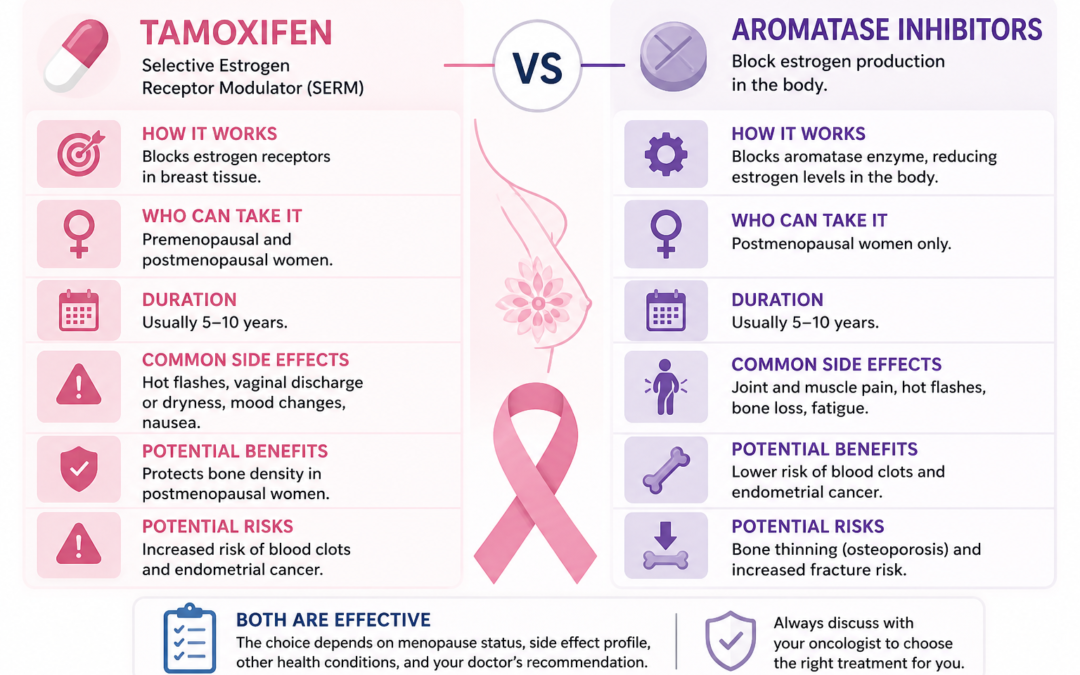
Same cancer, different route. Both are hormone therapy for breast cancers that feed on oestrogen, and both are usually taken as a daily tablet for years. The difference is how they cut that supply. Tamoxifen blocks oestrogen from attaching to the cancer cell. Aromatase inhibitors, or AIs, such as letrozole, anastrozole and exemestane, lower the amount of oestrogen the body makes in the first place. That one difference decides who gets which.
Dr. Sandeep Nayak, who provides Cancer treatment in Bangalore,says the question usually comes down to menopause. “Aromatase inhibitors work by stopping the body converting other hormones into oestrogen. That conversion is the main source after menopause, so AIs suit postmenopausal women. Before menopause the ovaries are still making plenty, so tamoxifen is generally the starting point. Which one a person takes, and for how long, is decided case by case.”
Unsure how long your own course should run?
How Do Tamoxifen and Aromatase Inhibitors Actually Differ?
The difference between tamoxifen and aromatase inhibitors starts with how each one works.
Tamoxifen sits on the oestrogen receptor and stops the hormone from switching the cancer cell on. It can be used before or after menopause, and in some women and in men with breast cancer.
AIs shut down the enzyme that makes oestrogen in fat tissue and elsewhere. They only work properly once the ovaries have stopped, so premenopausal women need ovarian suppression alongside them.
Side effects differ too. Tamoxifen can raise the risk of blood clots and, rarely, of womb lining cancer, and it causes hot flushes. AIs more often cause joint and muscle pain and bone thinning, so bone density is checked. Our blog on what happens to your body after cancer surgery covers recovery more broadly.
Tamoxifen vs Letrozole: Which Is Used When?
People often ask about tamoxifen vs letrozole, because letrozole is one of the most commonly prescribed AIs.
In postmenopausal women, an AI such as letrozole is often preferred, as trials have shown slightly lower recurrence rates than tamoxifen alone. Some women take tamoxifen first and switch, or the reverse, and the total course often runs five years or longer.
In premenopausal women, tamoxifen is the usual choice. An AI can be used if the ovaries are also suppressed. Women who cannot tolerate one drug are often moved to the other.
Whether hormone therapy is needed at all depends on the tumour’s receptor status, which is why testing matters. Our blog on triple negative and HER2 breast cancer shows how receptor type changes treatment.
What Determines the Right Treatment Approach for Hormonal Therapy
The team looks at several things together.
Menopausal status. The most important factor.
Receptor results and stage. Hormone therapy only helps hormone receptor-positive tumours.
Other health conditions. Clot history, bone health and the womb all matter.
Side effects. Someone with weak bones may do better on tamoxifen, and someone with clot risk may do better on an AI.
Treatment already given. Surgery, chemotherapy and radiation shape the plan.
Your own preferences. Tolerability decides whether the tablets are taken for years.
Surgical, medical and radiation oncology usually agree the plan together.
Key Takeaways
- Tamoxifen blocks oestrogen from reaching cancer cells. AIs lower how much oestrogen the body makes.
- AIs are generally for postmenopausal women. Tamoxifen can be used before or after menopause.
- Side effects differ: clots and flushes with tamoxifen, joint pain and bone thinning with AIs.
- Both are usually taken for five years or more, so tolerability matters.
- Menopausal status, receptor results and other health issues guide the choice.
- Questions about your own situation? The clinic’s number is +91 9482202240.
FAQs
Which is more effective?
In postmenopausal women, AIs show slightly better results in many trials. Tamoxifen remains the standard before menopause.
Can I switch between them?
Yes, often. Side effects or a change in menopausal status are common reasons
How long do I take hormone therapy?
Usually at least five years, sometimes longer.
Do I need hormone therapy if my cancer is hormone receptor-negative?
No. It only works on tumours that carry hormone receptors.
References
1. National Cancer Institute (NCI) — Hormone Therapy for Breast Cancer https://www.cancer.gov/types/breast/treatment/hormone-therapy
2. American Cancer Society (ACS) — Hormone Therapy for Breast Cancer https://www.cancer.org/cancer/types/breast-cancer/treatment/hormone-therapy-for-breast-cancer.html
3. Cancer Research UK — Hormone Therapy for Breast Cancer https://www.cancerresearchuk.org/about-cancer/breast-cancer/treatment/hormone-therapy
Disclaimer
This content is published for educational and informational purposes only and is not a substitute for medical advice. Please speak to your oncologist before changing or stopping any treatment.