
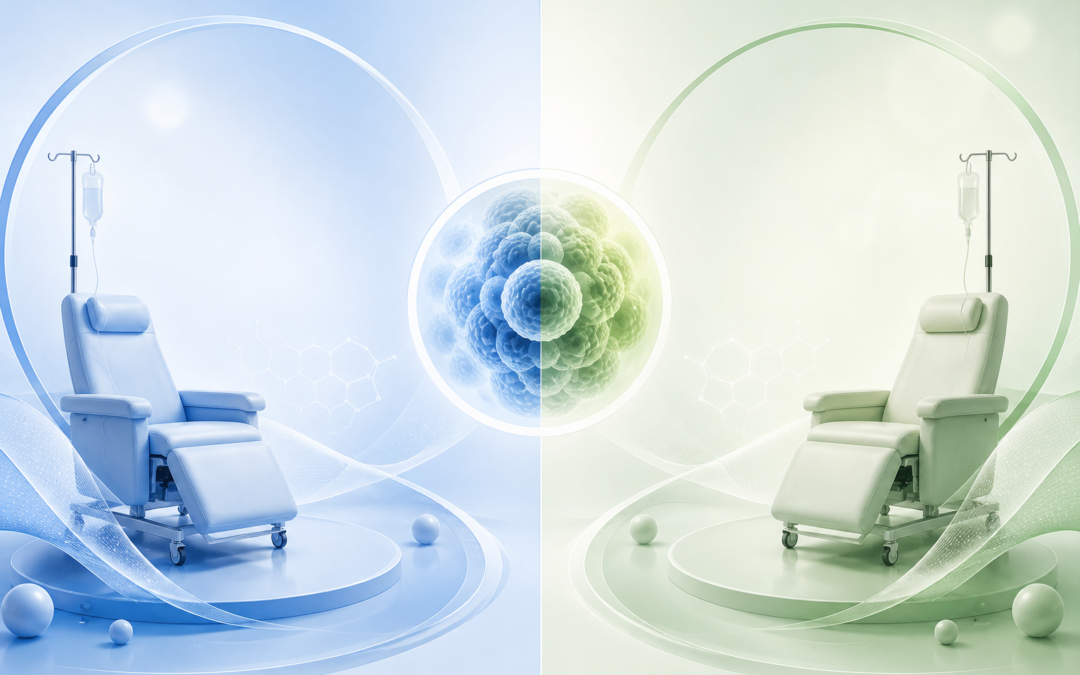
The main difference is where the stem cells come from. In an autologous transplant, they’re your own, collected before high-dose treatment and given back afterwards. In an allogeneic transplant, they come from a healthy donor, and the donor’s immune cells arrive with them. That one difference changes the risks, the recovery, and which diseases each one is used for.
Dr. Sandeep Nayak, who provides cancer treatment in Bangalore, says patients ask which is better, as if one beats the other. “They do different jobs. An autologous transplant is a rescue. We give the cancer very strong treatment, then give your own cells back so your blood can recover. An allogeneic transplant does more, because the donor’s immune system can keep fighting the disease afterwards, but it also carries risks your own cells never do. Which fits depends on the disease, not on which sounds stronger. And the decision belongs to the haematology and transplant team, who see these cases every week.”
Trying to understand which kind of transplant applies to you?
Autologous vs Allogeneic Stem Cell Transplant: Side-by-Side Comparison
|
Factor |
Autologous stem cell transplant |
Allogeneic stem cell transplant |
|
Where the cells come from |
Your own cells, collected and frozen beforehand |
A healthy donor: a matched sibling, a registry donor or a partly matched family member |
|
Donor needed |
No |
Yes |
|
How it works |
The high-dose treatment does the work, and your cells are given back to rescue the marrow |
The donor’s immune cells can also attack leftover cancer, known as the graft-versus-tumour effect |
|
Cancer cells in the graft |
The collected cells may carry traces of disease |
The graft is free of your cancer cells |
|
Graft-versus-host disease |
Doesn’t happen |
A real risk, acute or chronic |
|
Risk of relapse |
Usually higher, since there’s no immune effect |
Usually lower |
|
Early risks of the transplant itself |
Lower |
Higher, including organ toxicity, infection and graft failure |
|
Immune system recovery |
Usually faster |
Slower, and it often takes a year or longer |
|
Medicines afterwards |
Usually none long term |
Often immune-suppressing drugs for a time |
|
Commonly used for |
Multiple myeloma, lymphoma and some solid tumours |
Leukaemias, myelodysplastic syndromes, myelofibrosis, and non-cancer conditions such as aplastic anaemia, thalassaemia and sickle cell disease |
Autologous Stem Cell Transplant vs Allogeneic: Who Gets Which?
The disease and the situation usually point to one or the other:
- An autologous stem cell transplant suits cancers where very high-dose treatment can do most of the work. That’s mainly myeloma, lymphoma and some solid tumours, as long as your own marrow is healthy enough to be given back.
- An allogeneic stem cell transplant is chosen when the marrow itself is the problem, or when the immune effect is needed. That covers leukaemias, myelodysplastic syndromes and myelofibrosis, along with some non-cancer blood conditions. Our earlier blog on what a bone marrow transplant is and who needs one explains the basics.
- Finding a donor is its own step. Options include a matched sibling, a matched unrelated donor from a registry, or a partly matched family member. A donor search takes time, and an autologous transplant skips it entirely.
- Timing and fitness matter. The best results come when a transplant is done early, while the disease still responds to treatment and there’s little of it left. Older or frailer patients may get a gentler, reduced-intensity version of the conditioning for a donor transplant. Our oncology team can help you understand the options.
What Determines the Right Treatment Approach?
Two people can have the same diagnosis and be offered different transplants. A few things decide it:
- The disease and how far it has gone. Some conditions are transplanted early, and others only after relapse or when drugs stop working.
- How well treatment has worked so far. A good response to drugs can delay a transplant, and a poor one can bring it forward.
- What the disease is like genetically. Tests from precision oncology can show high-risk features that favour a donor transplant.
- Your age, fitness and organ health. The conditioning is demanding, so your heart, lungs, liver and kidneys all count, and so does whether a suitable donor exists.
- Your own situation. Recovery needs time, caregivers and regular follow-up. Those practical points are part of the decision.
Key Takeaways
- It comes down to where the cells come from. In an autologous transplant they’re your own, and in an allogeneic one they’re a donor’s.
- An autologous transplant has lower early risk but a higher chance of relapse.
- An allogeneic transplant brings a donor’s immune system into the fight. That helps against the cancer, but it adds risks of its own, graft-versus-host disease among them.
- Myeloma, lymphoma and some solid tumours lean toward autologous. Leukaemias, marrow failure and inherited blood disorders lean toward allogeneic.
- Which one you’re offered depends on the disease, how it has responded, your age and fitness, and whether a donor exists. A haematology and transplant team makes that call.
- If you’d like to talk through your own situation, call the clinic on +91 9482202240.
FAQs
Is one type of transplant riskier than the other?
In the first few weeks, a donor transplant is the riskier one. Graft-versus-host disease, infections and organ damage from the treatment are all more likely. An autologous transplant is gentler at first, but in many diseases the cancer is more likely to come back later. Neither is simply the safer choice.
What is graft-versus-host disease? Can I get it after an autologous transplant?
It’s when donor immune cells turn on your own tissues. Your own cells can’t do that to you, so it only happens after a donor transplant. The acute form usually appears in the first 100 days. Oddly, the same donor immune activity is also what helps keep the disease in check.
Can a person have both an autologous and an allogeneic transplant?
Sometimes. If the disease returns after an autologous transplant, the team may consider a second autologous one or a donor transplant, and what works best varies by disease. In myeloma, for instance, a second autologous transplant often did better than a donor one. Your transplant team will weigh it up.
Do I need a donor for an autologous transplant?
No. The cells are your own, collected beforehand and frozen until they’re needed. That’s one of its practical advantages.
References
- Selection of Autologous or Allogeneic Transplantation, Hematopoietic Stem Cell Transplantation, NCBI Bookshelf
- Autologous vs Allogeneic Stem Cell Transplant: Own Cells or Donor Cells, and Who Gets Which, Acıbadem International
- Allogeneic Versus Autologous Stem Cell Transplantation After Relapse in Multiple Myeloma: A Systematic Review, MDNewsline
- Precision Oncology, MACS Clinic
Disclaimer
This content is published for educational and informational purposes only and is not a substitute for medical advice. Please speak to your haematologist or transplant team about the right option for you.