

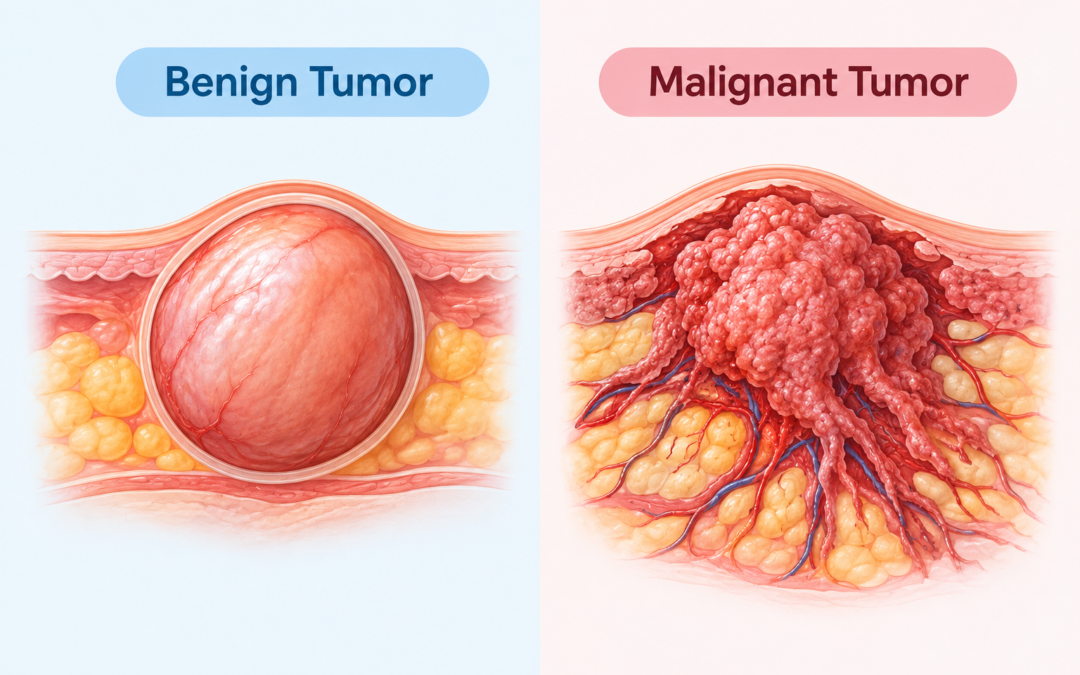
The core difference comes down to behavior, not appearance. Benign tumors are non-cancerous and stay contained where they form, they don’t invade nearby tissue or spread anywhere else in the body. Malignant tumors are cancerous, and they don’t stay put, they invade surrounding tissue directly and can metastasize, breaking off and forming new tumors in distant organs. So if a lump under a microscope can sometimes look similarly abnormal either way, what actually tells a pathologist which one they’re looking at? Cell structure and growth pattern, mainly, along with whether cells in a tissue sample show the disorganized, irregular architecture that signals invasion versus the neat, well-differentiated pattern typical of benign growth.
Dr. Sandeep Nayak, known for the Best Cancer Treatment in Bangalore, sees patients conflate the two constantly, understandably, since the word tumor alone sounds alarming regardless of type. “Finding a tumor and finding cancer aren’t the same sentence. Most lumps people find, a cyst, a fibroma, a lipoma, turn out to be benign. That said, benign doesn’t always mean harmless, a benign tumor in the brain or pressing on a nerve can still cause real problems just by taking up space. The label matters, but so does location.”
Trying to understand a recent finding or diagnosis?
What Actually Separates the Two?
The differences show up across several specific characteristics, and together they’re what a pathologist actually weighs:
| Factor | Benign Tumor | Malignant Tumor |
| Spread | Stays contained, doesn’t invade nearby tissue | Invades surrounding tissue and can metastasize to distant organs |
| Growth rate | Generally slower | Often faster and more unpredictable |
| Cell appearance | Well-differentiated, resembles normal tissue | Poorly differentiated, disorganized architecture |
| Border | Usually smooth, well-defined, often encapsulated | Often irregular, poorly defined |
| Recurrence after removal | Typically doesn’t return | Can return even after removal |
| Life-threatening potential | Usually not, though location can still matter significantly | Generally requires treatment given its potential to spread |
None of these factors work in isolation to confirm a diagnosis. A biopsy examined under a microscope remains the only way to know for certain which category a specific tumor actually falls into.
Why the Distinction Actually Changes What Happens Next?
Why Choose MACS Clinic for Accurate Tumor Diagnosis and Treatment?
Dr. Sandeep Nayak’s team confirms tumor type through proper biopsy and pathology review before recommending a path forward, rather than assuming based on imaging or physical exam alone, since imaging can suggest a likely answer but only tissue examination confirms it. For patients with a confirmed benign finding, that means honest guidance on whether monitoring or removal actually makes sense given the specific tumor’s location and behavior, not a default toward unnecessary surgery. For confirmed malignant findings, treatment planning starts immediately with the full weight of what that diagnosis actually requires, rather than delay while other explanations get ruled out first.
Have a recent finding or diagnosis you want reviewed properly? Reach the team at +91 9482202240.
FAQs
Can a benign tumor eventually turn malignant?
It happens, sometimes, though most benign tumors just stay benign forever. Certain ones, colon polyps being a good example, carry enough of a chance that doctors would rather monitor or remove them than leave it to luck.
Does a benign tumor ever actually need surgery?
Sometimes, yeah. If it’s causing pain, pushing on a nerve or organ, or just getting big enough to be a nuisance, it can come out even with zero cancer risk attached.
Can a scan alone tell you which type you're dealing with?
Not really, no. A scan can point you toward an answer, but a biopsy under the microscope is what actually settles it
Are cancerous tumors all pretty much the same level of serious?
Not at all. It swings a lot based on the type, the stage, and where it is, some are very manageable if caught early, others behave a lot more aggressively.
Reference
- Benign Tumor, Wikipedia
- Difference Between Benign and Malignant Tumors, Healthline
- Can Benign Tumors Become Malignant, Healthline
Disclaimer:This content is published for educational and informational purposes only.