
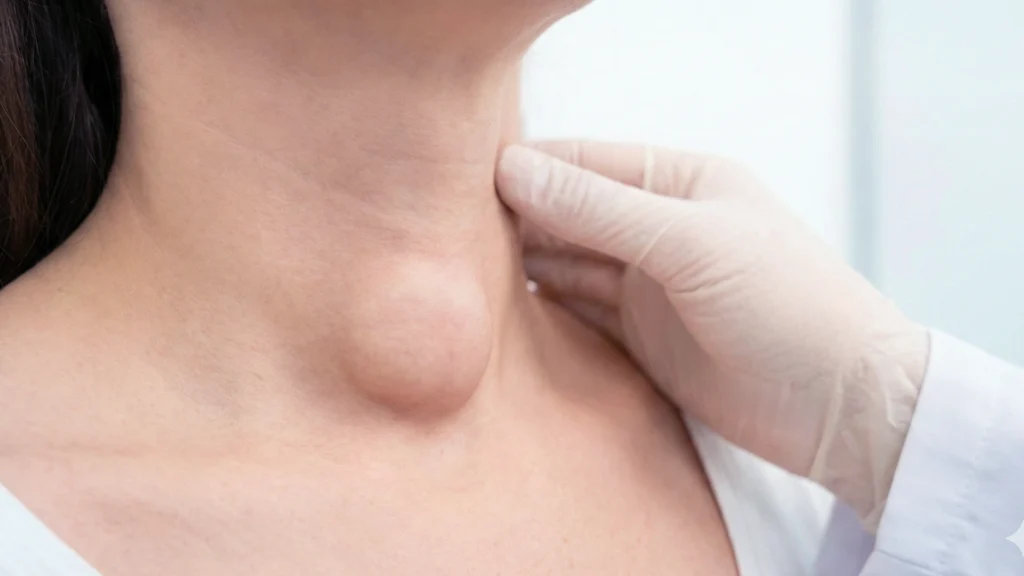
Most thyroid nodules are benign with only 5-15% confirmed as cancerous after biopsy. Suspicious features on ultrasound include solid hypoechoic appearance, microcalcifications, irregular margins, taller-than-wide shape, and increased vascularity. Fine needle aspiration cytology remains the gold standard for confirming malignancy, classified using the six-tier Bethesda reporting system.
According to Dr. Sandeep Nayak, Best cancer treatment in Bangalore, “Patients panic hearing nodule but 85-95% are harmless. Skill is knowing which ones aren’t and acting on those without putting everyone else through unnecessary surgery.”
Don’t wait for pain to tell you something’s wrong
What Features Make a Thyroid Nodule Suspicious?
Radiologist checks specific characteristics on ultrasound and assigns a TIRADS score that tells your surgeon how worried to be.
- Solid hypoechoic: Fluid-filled cystic nodules are almost always harmless. Solid ones appearing darker than surrounding tissue carry higher cancer risk.
- Microcalcifications: Tiny bright white specks inside the nodule, one of the strongest single predictors of papillary thyroid cancer. When your radiologist reports them FNAC follows immediately.
- Irregular margins: Smooth border means the nodule is sitting quietly. Jagged edges mean it’s pushing into surrounding tissue which is how cancers behave.
- Size and growth: Above 1 cm with suspicious features gets biopsied. Rapid growth on serial ultrasound over 6-12 months raises concern regardless of other features.
Your oncologist weighs all features together when evaluating your thyroid tumor before deciding between biopsy and surveillance.
How Is Thyroid Cancer Actually Confirmed?
Ultrasound raises the question. Only cells under a microscope settle it.
- FNAC biopsy: Thin needle goes into the nodule under ultrasound guidance, pulls cells out, pathologist reads them. Ten minutes, no general anesthesia, feels like a blood draw.
- Bethesda results: Category II means benign, go home. Category VI means cancer, plan surgery. Categories III through V are grey zone where molecular testing or diagnostic surgery may be needed.
- Molecular testing: When FNAC lands grey, labs test for BRAF V600E or RAS mutations that strongly suggest malignancy. Positive moves you toward surgery, negative might save you from an operation you never needed.
- Blood work: Suppressed TSH with a hot nodule on scintigraphy is almost never cancer. Normal or elevated TSH with a cold nodule increases suspicion and shapes the next clinical decision.
Same early detection principles that apply to breast cancer work here, catching real threats early while leaving harmless ones alone.
Why Choose MACS Clinic?
Why Choose MACS Clinic
Dr. Sandeep Nayak has performed hundreds of thyroid surgeries including scarless robotic thyroidectomy through axillary and retroauricular approaches. MACS Clinic runs FNAC, molecular testing, and surgical planning under one team so answers come from one place not five.
Nodule that needs surgery gets operated. Nodule that needs watching gets watched. Restraint matters as much as surgical skill here.
FAQs
Are all thyroid nodules cancerous?
No, only 5-15% of thyroid nodules turn out malignant after biopsy.
What is FNAC for thyroid nodules?
Fine needle aspiration that extracts cells for microscopic cancer evaluation.
Can thyroid cancer be detected by blood test alone?
No, blood tests support evaluation but only FNAC biopsy confirms cancer.
What size thyroid nodule needs biopsy?
Above 1 cm with suspicious ultrasound features typically requires FNAC.
References
- Thyroid nodule evaluation guidelines — National Cancer Institute
- Thyroid cancer diagnosis and staging — World Health Organization