

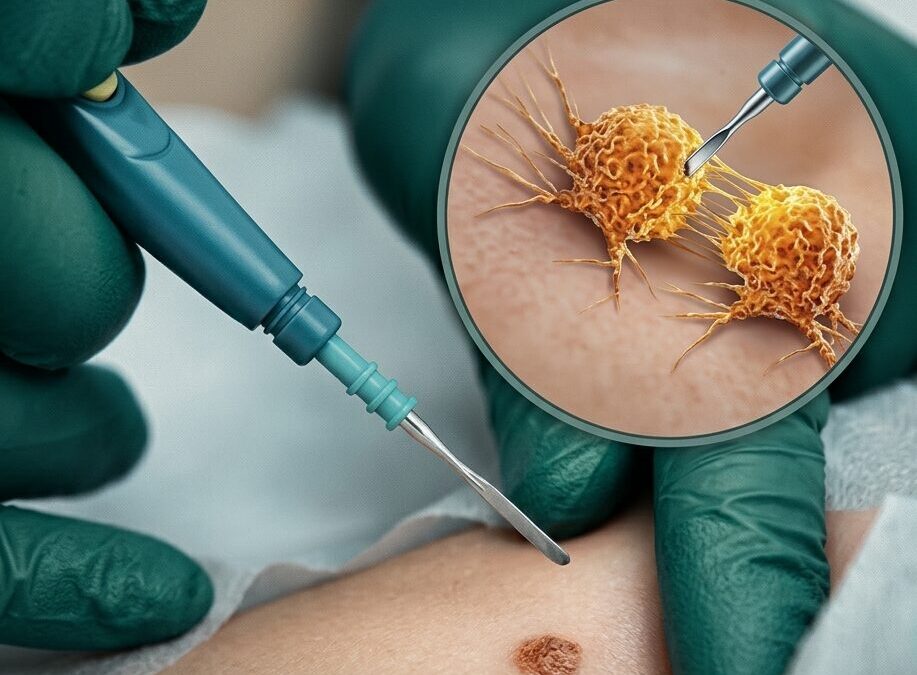
Most patients who come in afraid of a biopsy aren’t afraid of the procedure itself they’re afraid of what it might do to the tumour. What if the needle disturbs it? What if it travels somewhere else? It’s a reasonable fear, and it’s wrong. Tumour seeding cells escaping along the needle tract is documented in fewer than 1 in 10,000 biopsies. The body’s immune response handles stray cells before they settle anywhere new. What actually makes cancer spread is time. And every week spent avoiding a biopsy is a week the tumour has without a treatment plan
Dr. Sandeep Nayak at MACS Clinic is direct about it: “The fear that biopsy spreads cancer stops patients from getting the one test that makes treatment possible. Without a biopsy there is no confirmed diagnosis, no staging, and no treatment plan. The needle doesn’t spread cancer. Avoiding it does.”
Wondering whether a skin biopsy is relevant to your diagnosis or treatment?
What Actually Happens During a Biopsy and Why Seeding Is Not a Real Concern
Needle biopsy passes a thin instrument through tissue to pull out a small sample for the pathologist to examine. The worry patients have is that cells dislodge during that process and travel somewhere they shouldn’t. In practice, the body’s immune response clears stray cells before they can establish anywhere new. Modern coaxial needle systems also withdraw tissue through a protective sheath, which reduces even that already-minimal risk further.
Why Seeding Rarely Happens: The conditions a cancer cell needs to survive outside its original environment are specific and difficult to meet. A handful of displaced cells passing through normal tissue doesn’t have what it needs to implant and grow. The immune system deals with them. This has been studied extensively across breast, lung, liver, and lymph node biopsies and the evidence consistently shows the seeding risk is not clinically meaningful.
The One Genuine Exception: Suspected early ovarian tumours are handled differently. Puncturing the cyst wall with a needle can spill contents into the abdominal cavity, which carries real risk of spreading disease that was previously contained. In those cases surgical staging is used instead of needle biopsy. Every other solid tumour — breast, lung, liver, lymph node — is safely biopsied without this concern applying.
What a Biopsy Actually Tells Doctors and What Happens Without One?
A scan tells you where something is. A biopsy tells you what it is and the difference between those two things determines the entire treatment plan. Cancer type, grade, hormone receptor status, HER2 expression, EGFR mutation, MSI status none of these can be confirmed from imaging alone. Without them, there’s no way to know whether a patient needs surgery alone, surgery plus chemotherapy, targeted therapy, immunotherapy, or something else entirely.
Delaying a biopsy out of fear doesn’t protect the patient it removes the information the team needs to act while the window for curative treatment is still open. For a closer look at how biopsy results feed directly into treatment decisions, the previous blog on How Doctors Decide the Right Cancer Treatment covers the full decision-making process.
Why Choose MACS Clinic for Cancer Diagnosis and Treatment?
Dr. Sandeep Nayak’s team at MACS Clinic doesn’t ask patients to sit with uncertainty while they wait for results to trickle through separate departments. Biopsy, pathology, molecular profiling, and tumour board review happen in sequence and the plan is confirmed before the patient leaves not knowing what comes next.
When a diagnosis is confirmed, staging is completed and treatment planning begins immediately. The window for curative treatment is time-sensitive in most cancers. Waiting out of fear of the biopsy is the one thing that genuinely narrows it. Reach the team at +91 8035740000 or through the contact page.
FAQs
Does a biopsy needle disturb the tumour?
It passes through it to take a sample but “disturbing” it in any way that causes spread isn’t what happens. The body clears stray cells, and modern needle systems are designed to minimise even that. The risk is real only in specific situations like suspected early ovarian tumours, where a different approach is used instead.
What if I just wait and watch instead of getting a biopsy?
Watching without a diagnosis means watching without knowing what you’re watching. If it’s cancer, the stage at which it’s eventually found will be later and stage is the single biggest factor in what treatment is possible and what survival looks like.
Are there any cancers where biopsy is genuinely avoided?
Yes suspected early ovarian tumours. Needle biopsy risks rupturing the cyst wall and spilling contents into the peritoneal cavity, which can worsen staging. In those cases, surgical removal and intraoperative frozen section is used instead of a pre-surgical needle biopsy.
How long does a biopsy result take?
Standard pathology reports are usually ready within three to five days. If molecular profiling receptor status, mutation testing, MSI status is needed alongside, that can take up to two weeks depending on the tests required.
Disclaimer: This content is published for educational and informational purposes only.