

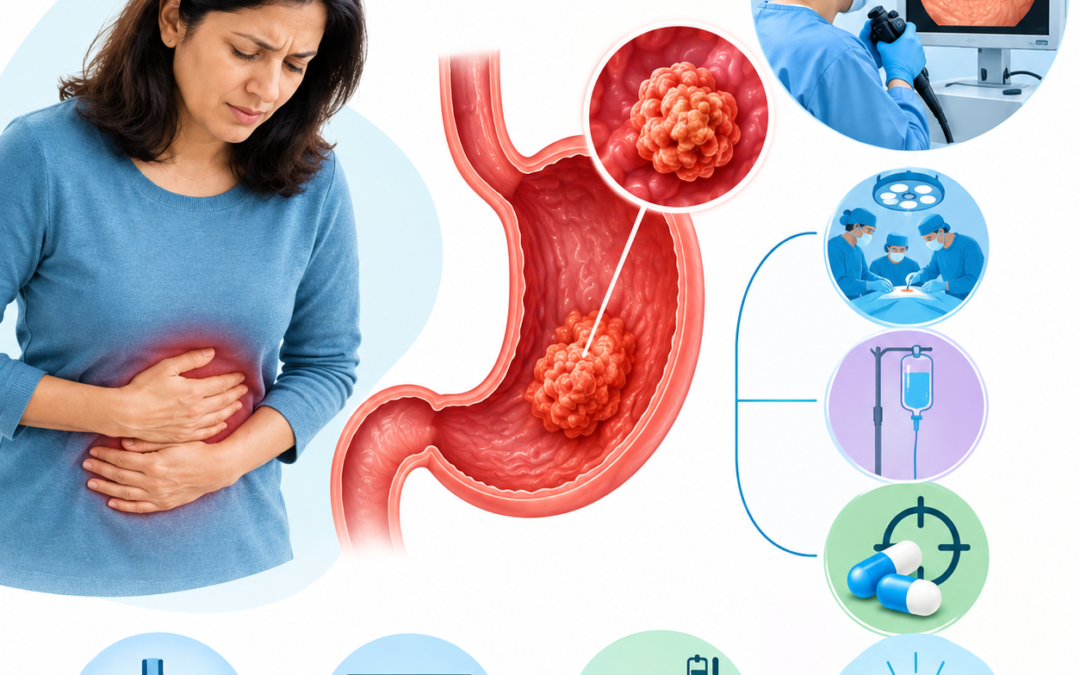
Yes, stomach cancer can often be cured if it’s found early. When it’s caught before it grows beyond the inner layers of the stomach wall, surgery, or sometimes even endoscopic removal, can clear it completely, and survival rates are among the best in cancer care. The catch is that early-stage stomach cancer hardly ever announces itself.
Dr. Sandeep Nayak, who provides the best cancer treatment in Bangalore, says that’s exactly why so many patients arrive late. “Early stomach cancer hides behind symptoms everybody has had. Bloating, a bit of acidity, feeling full too soon. By the time it actually hurts, it has usually moved on. If indigestion lasts more than two or three weeks, or keeps coming back, get an endoscopy. It’s a short test, and it can be the difference between a small operation and a big one.”
Had indigestion that won’t go away?
Early Signs of Stomach Cancer Most People Ignore?
- Acidity that keeps coming back, however many antacids you take. It settles, then a few weeks later you’re reaching for another one. Most people just stop mentioning it to anyone.
- Getting full after three or four bites when you used to finish the plate. Some people also feel a dull ache just under the ribs, nothing sharp, nothing you’d call pain.
- Losing weight without trying. Add nausea, constant tiredness, or stools that turn black and tarry, and it’s time to stop waiting. Slow bleeding inside the stomach is a common reason people become anemic without realizing why.
- Then there’s your background. Years of H. pylori infection, a diet heavy on smoked, salted or pickled food, smoking, a parent or sibling who had stomach cancer: any of these makes persistent symptoms worth a closer look. Our stomach cancer treatment in Bangalore page covers what happens next.
How Early-Stage Stomach Cancer Treatment Works?
Why Choose MACS Clinic for Early-Stage Stomach Cancer Treatment?
Dr. Sandeep Nayak (MBBS, DNB Surgical Oncology, MRCS UK) is the founder and Chief of Surgical Oncology at MACS Clinic, and Executive Director of Surgical Oncology and Robotic Surgery at KIMS Hospital. He was among the pioneers of laparoscopic and robotic cancer surgery in India, and he operates on stomach cancer using minimally invasive and robotic techniques. If you’ve been advised surgery and want a second look first, the Expert Opinion consultation with him and his team gives you a written plan.
Worried about a symptom that won’t go away? Call +91 9482202240
FAQs
Can stomach cancer be cured?
Yes, if it’s caught early. That’s the whole story, honestly. A small cancer in the stomach lining can be taken out completely. Once it’s spread to the liver or other organs, we’re talking about controlling it, not curing it. Treatment can still give people good, useful years.
What are the survival chances for early-stage stomach cancer?
It’s good news. In Japan, where lots of people get scoped as a routine check, more than nine in ten with localized disease are alive five years on. Our numbers in India look worse, but mostly because people reach us late, not because the treatment works less well.
Will my whole stomach have to come out?
Not necessarily. It depends on where the tumor is and how deep it’s gone. A very early one might be removed through the mouth with a scope. Others need a part of the stomach removed. And sometimes, yes, all of it. We’ll know more after the biopsy and scans.
How often will I need an endoscopy after treatment?
Usually every six to twelve months at first, along with blood tests. After that, your surgeon decides, based on what the final pathology report showed. Don’t skip these. They’re how a second, tiny problem gets caught early.
Reference
- Minimally Invasive Treatment of Early GI Cancers, Cleveland Clinic Journal of Medicine
- Early and Long-Term Outcomes of Endoscopic Submucosal Dissection for Early Gastric Cancer in a Large Patient Series, PubMed Central
- Long-Term Clinical Outcomes of Endoscopic Submucosal Dissection in Patients With Early Gastric Cancer, PubMed Central
- Stomach Cancer Treatment in Bangalore, MACS Clinic
Disclaimer:
This content is published for educational and informational purposes only and is not a substitute for medical advice. Please consult your doctor before changing any treatment.