
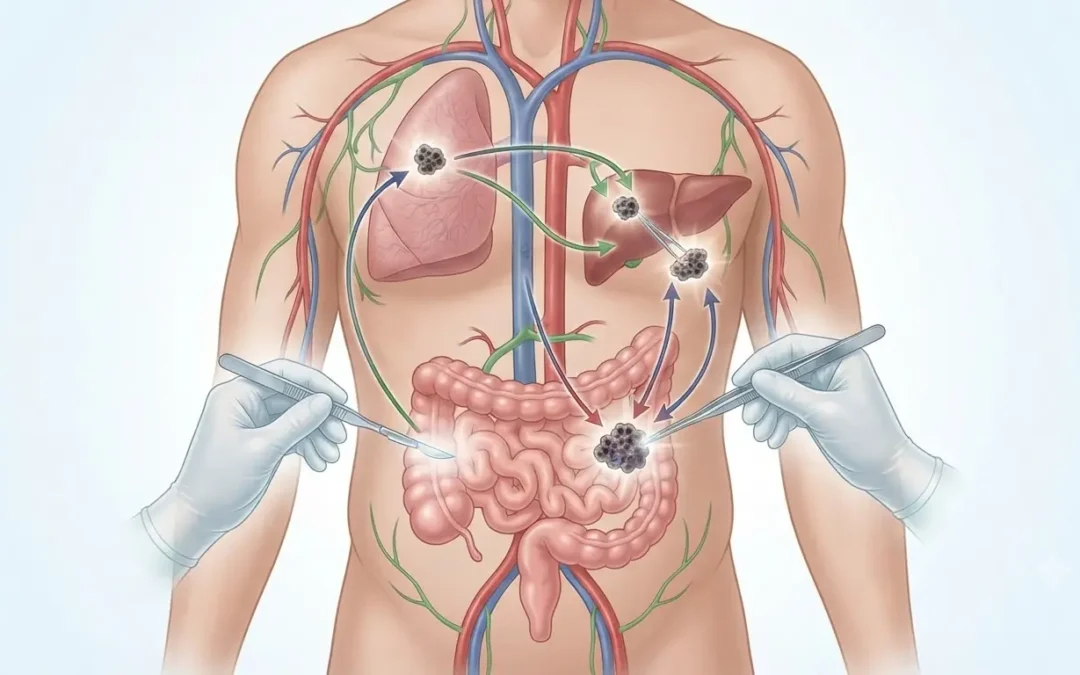
Oligometastatic cancer is cancer that has spread from where it began to only a small number of places, usually one to five spots, rather than all through the body. It sits at the milder end of stage 4. And yes, it can sometimes be treated with surgery, often alongside focused radiation or drug treatment, as long as every spot can be dealt with safely.
Dr. Sandeep Nayak, who provides cancer treatment in Bangalore, at MACS Clinic, says, “The word oligometastatic simply means few. It tells us the cancer hasn’t scattered widely, which is why local treatments such as surgery or focused radiation are worth discussing alongside drugs. Whether they’re right depends on where the spots are, how the cancer has behaved so far and how fit the patient is.”
To understand how cancer travels to other organs in the first place, see what metastatic cancer is and how it spreads.
Learn how surgery may help treat oligometastatic cancer and when it may be an option.
What Does Oligometastatic Cancer Mean?

- A small number of spots. Usually one to five. The exact cut-off varies between cancer types and between doctors, so it works as a guide rather than a hard line.
- Often limited to one or two organs. A couple of deposits in the liver, or a few in the lung, is the typical picture. Spread to many organs at once is a different situation, known as polymetastatic disease.
- Found at diagnosis or later. Some people have it when the cancer is first found. Others develop a few spots months or years after treatment of the original tumour.
- Close cousins. Oligoprogression is when a few spots grow while the rest of the cancer stays controlled on treatment, and the post on what oligoprogression is explains the difference.
- How it’s picked up. Scans such as PET-CT and MRI show how many spots there are and where. A liquid biopsy is sometimes added to learn more about the cancer’s behaviour.
How Is Oligometastatic Cancer Treated, and Where Does Surgery Fit?

- Drugs usually form the backbone. Chemotherapy, targeted therapy, immunotherapy or hormone treatment work on the whole body. For most people, oligometastatic cancer treatment starts here.
- Surgery for selected spots. Surgery for oligometastatic cancer is considered when every spot can be removed and enough healthy organ would be left. Liver and lung deposits are the common examples. The wider question is covered in Can Stage 4 Cancer Be Treated With Surgery?
- Focused radiation or ablation instead. Some spots can be treated without an operation, using precisely aimed radiation therapy or heat to destroy the tumour.
- Lymph nodes. Spread to lymph nodes is handled differently from spread to organs, as the post on whether surgery can treat cancer in lymph nodes explains.
- Drugs first, then local treatment. Doctors often start with drugs to see how the cancer behaves. If it responds and stays limited, surgery or radiation to the remaining spots may follow.
- When surgery isn’t suitable. Too many spots, spots that can’t all be removed, fast-growing disease, or a patient who isn’t fit enough for a big operation usually point toward drug treatment, with surgery kept for relieving symptoms.
For a wider view of how limited growth during treatment is handled, the previous blog on what oligoprogression is is a good next read.
What Determines the Right Treatment Approach?
- How many spots, and where. Scans show whether every spot can be reached, and whether enough healthy organ would remain afterwards.
- How the cancer has behaved. Slow-growing disease that responds to drugs is more suited to local treatment, and precision oncology testing can show which drugs may work.
- Whether the main tumour is controlled. If the original cancer is still growing, that usually has to be dealt with first.
- Fitness and organ reserve. Heart and lung checks and blood tests help judge how well the body will cope.
- Review by the whole team. Surgery, medical oncology, radiation oncology, radiology and pathology looking at the same case before anything is decided.
- Risks and limits. These operations can be long, with risks of bleeding, infection and a slower recovery. Local treatment doesn’t suit everyone, evidence is stronger for some cancers than others, and no approach can promise a cure.
Key Takeaway
Oligometastatic cancer is cancer that has spread to only a few places, and for selected patients, surgery for oligometastatic cancer alongside drugs or focused radiation can be worth considering. Whether it helps depends on the number and position of the spots, how the cancer behaves and the patient’s fitness. Questions about your own scans are best discussed with your treating oncologist.
Frequently Asked Questions
Is oligometastatic cancer curable?
Some people are cured, especially when every spot can be treated. More often it is controlled for years.
How many tumours count as oligometastatic?
Usually one to five. The exact limit varies with the cancer type.
Is oligometastatic cancer the same as stage 4?
It is a form of stage 4 with limited spread, and it is often treated differently from widespread disease.
Does oligometastatic disease always need surgery?
No. Focused radiation or ablation can treat some spots, and drugs remain part of the plan.
Disclaimer
This article is for patient education only. It is not medical advice and does not replace consultation with a qualified doctor. Suitability, risks and outcomes differ for each person.
References:
1. National Cancer Institute. Oligometastatic Cancer: Directly Treating Cancer Metastases