

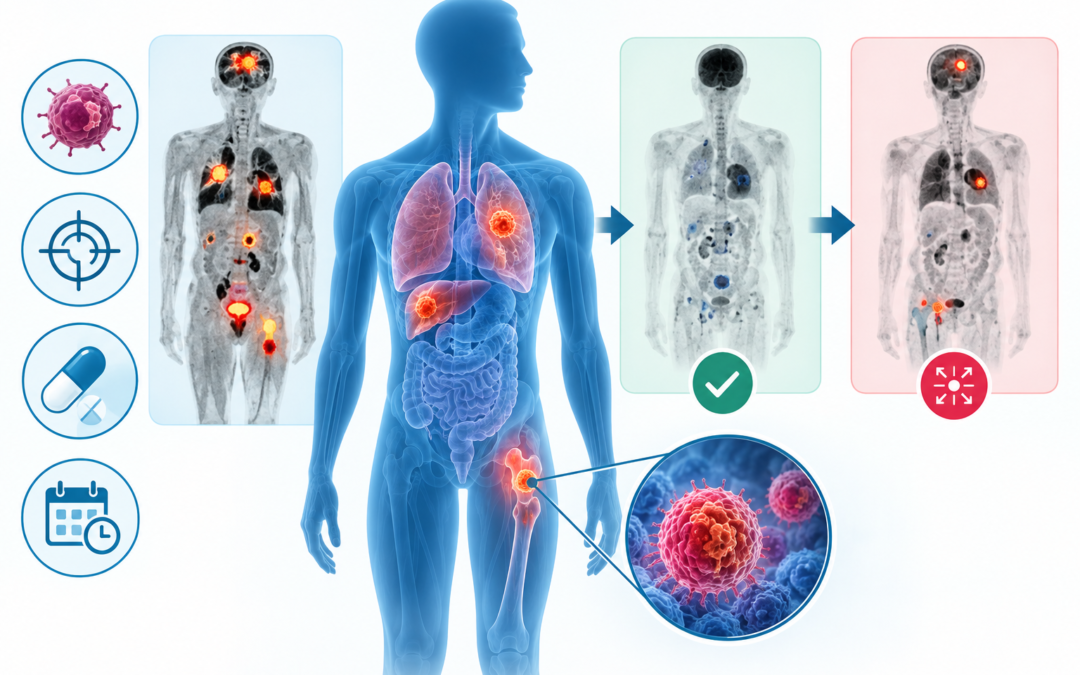
It’s when most of the cancer behaves and a few spots don’t. Someone with metastatic disease is on a drug that’s working. Scans show most tumours stable or shrinking. But one to five sites start growing anyway. That is oligoprogression. The treatment hasn’t failed across the board. A small pocket of cells has simply learned to get around it.
Dr. Sandeep Nayak, who provides Best Cancer Treatment in Bangalore, sees patients react to this news as if everything has collapsed. “Someone hears the word progression and assumes the drug has stopped working altogether. Often it hasn’t. If nearly everything is still under control and only a couple of spots are growing, we don’t have to throw out a treatment that’s doing most of the job. We can deal with those spots directly and carry on.”
Told that one or two spots are growing on your scan?
How Is Oligoprogression Different From Ordinary Cancer Progression?
Cancer progression usually means the disease is growing across the body, and the current drug is no longer holding it. Oligoprogression is narrower than that.
Only a few sites grow. Usually one to five, while the rest of the disease stays stable or keeps shrinking.
The drug is still mostly working. That’s the whole point. Most of the cancer is still responding.
The growing cells are a resistant pocket. A small group has changed in a way the drug no longer reaches. Our blog on what happens if cancer doesn’t respond to chemotherapy covers what it means when the whole disease stops responding, which is a different situation.
It’s judged on scans over time. Doctors look at more than one assessment before deciding which pattern they’re seeing.
What Can Be Done About Oligoprogression?
Why Choose MACS Clinic for Metastatic Cancer Care?
Dr. Sandeep Nayak’s team at MACS Clinic reviews every new growth in context before changing anything. Precision oncology testing helps explain why a few sites escaped, and surgical, medical and radiation oncology look at the case together so a drug that’s still helping isn’t dropped too soon.
Want a second look at a scan that shows a few growing spots? Reach the team at +91 9482202240.
FAQs
Does oligoprogression mean my treatment has failed?
Not necessarily. If most of the disease is still controlled, the treatment is often still doing useful work.
Is oligoprogression the same as cancer progression?
Not exactly. It is a limited form, where only a few sites grow while the rest stays controlled.
Can radiation really delay the need to change drugs?
For some patients, yes. Treating the growing spots can let the current drug continue for longer.
How many tumours count as oligoprogression?
Usually one to five, though doctors use some judgment depending on the cancer and where the spots are
Reference
-
PubMed – Oligoprogression in Cancer: Explains limited cancer progression and treatment approaches. Read research review
-
National Cancer Institute – Oligometastatic Cancer: Discusses local treatment of selected cancer sites. Read here
Disclaimer:This content is published for educational and informational purposes only.