
Thyroid nodules are common growths that develop within the thyroid gland and are often discovered during routine examinations or imaging tests. While most are benign, some may grow, cause difficulty swallowing, create pressure in the neck, or affect thyroid function. Depending on their size, characteristics, and biopsy findings, treatment may involve regular monitoring, surgery, or minimally invasive procedures such as radiofrequency ablation (RFA).
Dr Sandeep Nayak says: “The fact that a nodule has a biopsy proven to be benign doesn’t necessarily mean that it needs to be taken out surgically. If a patient’s benign thyroid nodule is symptomatic or cosmetically unpleasant, radiofrequency ablation could be an alternative to conventional surgery.” Careful evaluation of ultrasound findings, biopsy results, and nodule characteristics is essential to determine whether this approach is appropriate.
Dr. Sandeep Nayak is a surgical oncologist in Bangalore who has years of expertise in the management of thyroid cancers, thyroid surgeries and complicated neck surgeries. At MACS Clinic, he focuses on precise diagnosis and personalized treatment planning, helping patients understand whether monitoring, radiofrequency ablation, or surgery is appropriate for their condition.
Are all thyroid nodules a cause for concern? Let’s understand what these growths mean.
What Are Thyroid Nodules?
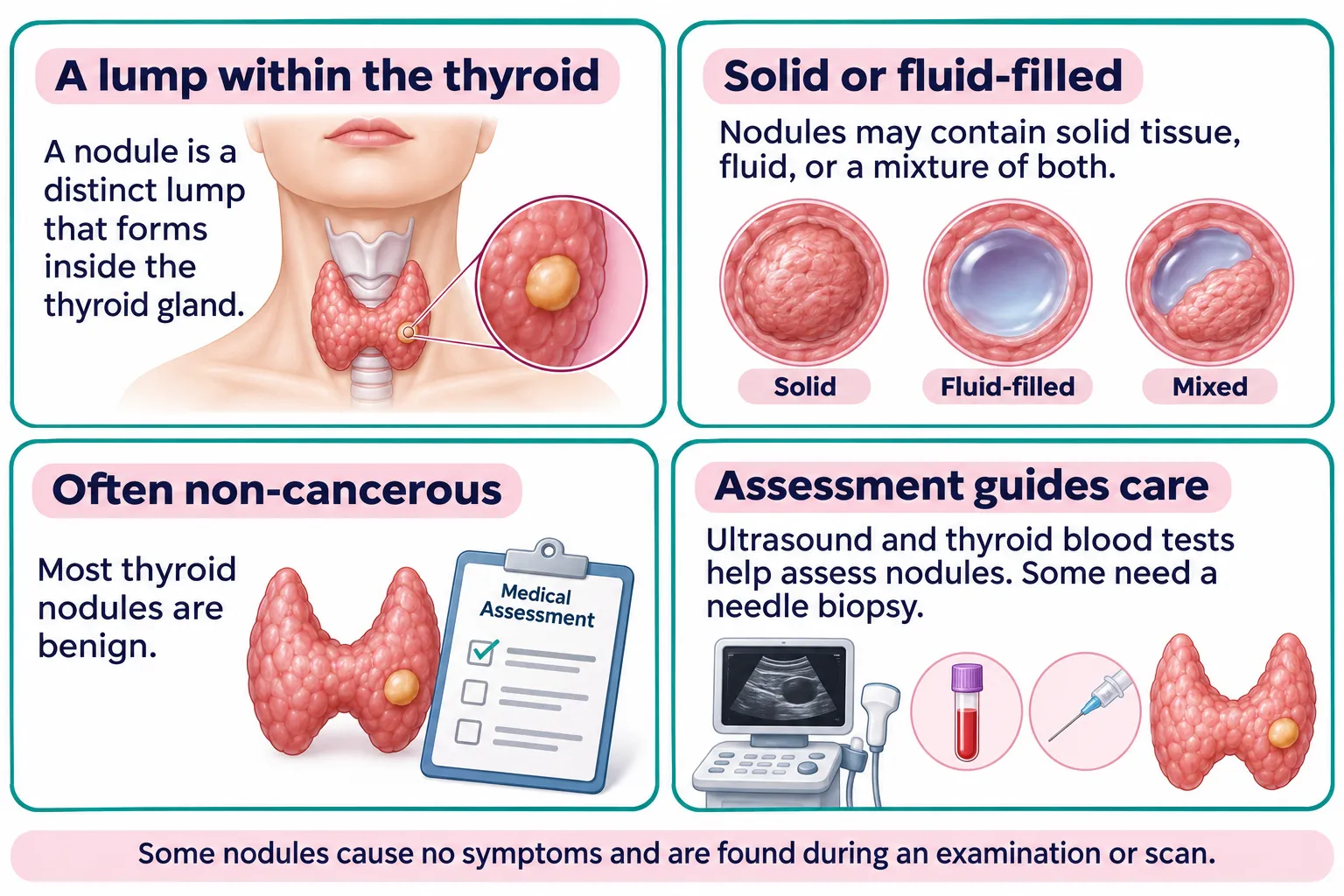
Thyroid nodules are abnormal growths or lumps that develop in the thyroid gland (at the front of the neck). They can be a solid mass, a fluid filled mass (cyst) or a combination of both.
Most thyroid nodules are non-cancerous, but some require further investigation to exclude thyroid cancer.
Common causes and associated conditions include:
- Benign thyroid growths: Such as colloid nodules and adenomas.
- Thyroid cysts: Fluid-filled nodules that may increase in size.
- Thyroid inflammation: Conditions such as thyroiditis may be associated with nodular changes.
- Multinodular goitre: Multiple nodules developing within the thyroid gland.
- Thyroid cancer: A smaller proportion of nodules may contain cancerous cells.
Some nodules do not cause symptoms and are detected incidentally. Larger nodules may cause visible swelling, difficulty swallowing, pressure in the neck, or voice changes. Certain nodules can also produce excess thyroid hormones.
The usual way of assessing nodules includes thyroid ultrasound, thyroid function tests, and fine-needle aspiration biopsy. Determining if the nodule is benign is extremely crucial prior to RFA.
Can a thyroid nodule be reduced without removing the gland? RFA offers one possible approach for selected benign nodules.
What Is Radiofrequency Ablation (RFA) for Thyroid Nodules?
Radiofrequency ablation uses high frequency electrical energy within the thyroid nodule to cause localised heating. This causes damage to the tissues in the nodule. Overtime, the cells of the nodule will be absorbed by the body, meaning that the nodule reduces in size.

A thin electrode is passed through the skin into the nodule under ultrasound guidance. This allows the specialist to target areas within the nodule, while taking care of surrounding structures.
Indications:
- Benign thyroid nodules causing pressure or difficulty swallowing.
- Thyroid nodules, causing swelling of the neck or aesthetic concerns.
- Selected hyperfunctioning thyroid nodules causing symptoms due to excess hormones.
Prior to RFA, patients will generally have had imaging with ultrasound. An adequate sample showing benign pathology (often taken by fine needle aspiration or core needle biopsy) is required, depending on the appearance of the nodule on ultrasound. The number of biopsies required will depend on the characteristics seen on ultrasound and clinical guidelines.
RFA is not an alternative to appropriate cancer management. If there are any suspicious findings or a confirmed malignant nodule, specialist assessment is required to determine the correct management.
Considering treatment for a thyroid nodule without surgery? Connect with a specialist to understand whether radiofrequency ablation is suitable for your diagnosis.
Why do some patients consider RFA instead of surgery? Let’s look at its potential advantages.
Benefits of Radiofrequency Ablation for Thyroid Nodules
Advantages include:
- Minimally invasive
A very small incision with a needle is required rather than a conventional surgical incision. This means that scarring after treatment is usually minimal.
- Maintaining thyroid function
As the thyroid gland is not removed, your thyroid may produce normal amounts of hormones. However, thyroid function should be monitored.
- Reduction in nodule size
Over the subsequent months, the nodule will reduce in size. This can alleviate pressure and improve the appearance of the swelling in the neck.
- Shorter recovery period
RFA is usually faster to recover from than traditional thyroid surgery. It can often be performed as an outpatient procedure.
- Reduced risk of surgical complications
Some risks associated with traditional thyroid surgery are avoided, such as adverse effects of general anaesthesia and damage to thyroid tissue from surgery. However, RFA carries specific risks including temporary changes to your voice, bleeding and injury to nearby tissues due to heat.
The amount by which nodules reduce in size depends on initial nodule size, composition and treatment characteristics. Some patients may need more than one session or regular follow-up.
What happens during an RFA procedure? Let’s walk through the treatment process.
How Is the Radiofrequency Ablation Procedure Performed?
Radiofrequency ablation is usually performed under local anaesthesia with continuous ultrasound guidance.
The procedure generally involves the following steps:
- Pre-procedure assessment: The specialist reviews ultrasound findings, biopsy results, thyroid gland function, and the patient’s symptoms.
- Local anesthesia: The treatment area is cleaned and numbed to minimise discomfort.

- Electrode placement: An electrode for radiofrequency ablation is inserted into the thyroid nodule under ultrasound control.
- Controlled heating: Using radiofrequency energy, heat is produced inside the tissue to destroy the nodule in small sections.
- Post-procedure observation: The patient is monitored briefly for discomfort, swelling or other immediate complications.
The procedure duration depends on the nodule’s size, location, and composition. Most patients can return home on the same day, depending on their clinical condition.
It is necessary to perform ultrasound follow-ups to determine the degree of reduction in the volume of the nodule and to detect any spots that may need additional treatment.
How does RFA compare with conventional thyroid surgery? Both approaches have different indications, benefits, and limitations.
Radiofrequency Ablation vs Thyroid Surgery: Key Differences
| Feature | Radiofrequency Ablation | Thyroid Surgery |
| Approach | Minimally invasive needle-based procedure | Surgical removal of part or all of the thyroid |
| Anaesthesia | Usually local anaesthesia | Usually general anaesthesia |
| Incision | Small needle puncture | Surgical incision |
| Thyroid preservation | Most thyroid tissue is preserved | Depends on the extent of removal |
| Recovery | Generally shorter | Usually requires a longer recovery |
| Main purpose | Reduce selected benign nodules | Remove nodules or treat thyroid disease, including cancer |
| Tissue examination | No complete surgical specimen | Removed tissue can undergo histopathological examination |
Radiofrequency ablation is usually used in cases of specific symptomatic benign nodules, while surgery is indicated for cancerous thyroid tumours or other conditions necessitating the complete removal of a nodule.
This decision depends on the results of a biopsy, ultrasound, symptoms, nodule size, and personal preferences of a patient.
Unsure whether RFA or thyroid surgery is appropriate for your condition? Get a specialist evaluation to understand the benefits and limitations of each approach.
What should patients expect after treatment? Recovery is generally straightforward, but follow-up remains essential.
Recovery After Radiofrequency Ablation for Thyroid Nodules
The majority of patients report having mild pain, tenderness, or temporary swelling in the treated area, which usually settle over a short period.
Recovery may involve:

Nodule reduction is a gradual process and not an immediate one. The follow-up usually takes place after 1, 3, 6, and 12 months, and so on depending on the patient’s response.
Rarely, some side effects like voice changes, bleeding, skin burns or injury to surrounding tissues can happen. It is necessary to inform your doctors about the signs of significant swelling, breathing difficulty, or voice changes.
Conclusion
Thyroid nodules do not always require surgery, particularly when they are benign and do not cause significant symptoms. For selected patients, radiofrequency ablation offers a minimally invasive option to reduce nodule size while preserving thyroid tissue. However, accurate diagnosis and appropriate patient selection remain essential before considering this treatment.
Dr. Sandeep Nayak has years of expertise in complex neck procedures and thyroid cancer treatment in Bangalore, helping patients understand suitable treatment approaches based on their diagnosis.
Patients exploring thyroid surgery in Bangalore can seek specialist guidance to understand whether RFA, surgery, or continued monitoring is appropriate.
FAQs
1. Are thyroid nodules always cancerous?
Most are not cancerous, however an ultrasound can be used to assess the nature of the nodule, and if required a biopsy can be performed.
2. Can thyroid nodules be treated without surgery?
Certain benign thyroid nodules can be managed through observation, radiofrequency ablation or other minimally invasive methods.
3. What is radiofrequency ablation on thyroid nodules?
RFA is a minimally invasive procedure that uses controlled heat to destroy targeted nodule tissue, allowing the nodule to shrink gradually.
4. How effective is RFA on thyroid nodules?
RFA can significantly reduce the volume of selected benign nodules. The degree of shrinkage varies and requires follow-up ultrasound assessment.
5. Can thyroid nodules grow back after RFA?
Nodules can sometimes recur after treatment. Some patients may require further treatment.
6. Does RFA affect thyroid hormone levels?
The surrounding thyroid tissue is usually well preserved, however thyroid hormone levels should be monitored if indicated.
7. Can RFA be used to treat cancerous thyroid nodules?
Radiofrequency ablation is not a standard treatment for most primary thyroid cancers, but there are selected specialist applications. Most operable thyroid cancers are treated with surgery.
References
- American Thyroid Association – Thyroid Nodules
- American Thyroid Association – Thyroid Nodule Ablation
Disclaimer: The information shared on this page is for educational purposes and not for promotional use.