

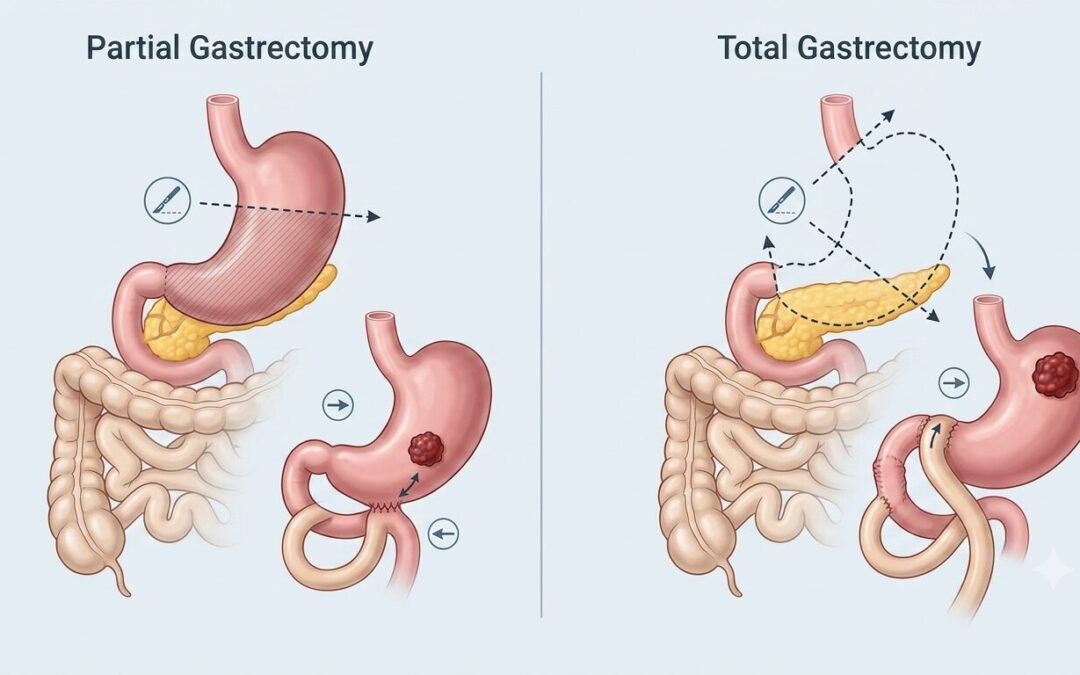
Yes, there’s a real difference between the two and it shapes everything from how digestion works after surgery to how long recovery takes. Partial gastrectomy takes out only the diseased section and leaves the rest of the stomach working. Total gastrectomy removes the whole thing, with the food pipe connecting straight to the small intestine instead. Both treat stomach cancer. Which one gets used comes down to where exactly the tumour is sitting and what the surgeon needs to remove to get clean edges around it.
Dr. Sandeep Nayak, Best Cancer Treatment in Bangalore, puts it plainly: “The goal in every gastrectomy is the same get the cancer out completely with adequate margins. Whether that means part of the stomach or all of it is decided by the tumour’s location and how far it’s spread. A tumour low down in the stomach can often be handled with partial removal. One sitting at the top or spreading across the whole organ doesn’t leave much choice. You do what the anatomy and the cancer require.”
Want to understand which surgery applies to your case?
Partial vs Total Gastrectomy: What's the Difference?
|
Partial Gastrectomy |
Total Gastrectomy |
|
|
What’s Removed |
Diseased portion of stomach only |
Entire stomach |
|
Best For |
Tumours in lower or middle stomach |
Tumours in upper stomach or diffuse disease |
|
Stomach Function |
Partially preserved |
Lost completely |
|
Digestion After |
Altered but manageable |
Significant dietary adjustment needed |
|
Nutritional Risk |
Moderate |
Higher, B12 supplementation lifelong |
|
Recovery |
Generally faster |
Longer, more complex |
|
Reconstruction |
Remaining stomach reconnected |
Oesophagus connected directly to small intestine |
|
Cancer Control |
Equivalent when margins are clear |
Required when partial removal can’t achieve clear margins |
The table covers the clinical differences but the numbers alone don’t make the decision. Tumour location is the single biggest factor, and no amount of preference for partial removal changes the surgical reality when a tumour sits where it sits. More on how stomach cancer is staged and treated is on the Gastric Cancer Treatment page.
What Determines Which Surgery Is Used?
The surgeon doesn’t choose between partial and total based on preference. The tumour makes most of the decision.
Tumour Location: This is the primary driver. Tumours in the antrum or lower body of the stomach are usually treatable with partial gastrectomy. Tumours at the gastroesophageal junction, fundus, or upper stomach almost always require total gastrectomy because there simply isn’t enough stomach left above the tumour to achieve clear margins and still reconnect anything meaningfully. More on how stomach cancer is staged and assessed is on the gastric cancer treatment page.
Tumour Size and Spread: A large tumour that involves most of the stomach leaves partial removal off the table regardless of where it started. If cancer has spread to multiple parts of the stomach wall, total gastrectomy is the only way to take it all out in one procedure.
Surgical Margins: Clear margins are non-negotiable. If a partial gastrectomy can’t achieve them, the surgery gets extended. Leaving positive margins to preserve stomach tissue is never the right trade-off.
Diffuse Histology: Signet ring cell carcinoma and other diffuse-type gastric cancers tend to spread widely through the stomach wall in ways that aren’t always visible on imaging. Total gastrectomy is more commonly used for these subtypes even when the tumour appears localised. This is where precision oncology and molecular profiling help identify tumour biology that changes the surgical approach before the operation.
Lymph Node Clearance: Regardless of which gastrectomy type is performed, D2 lymph node dissection is standard for curative intent surgery. The extent of lymph node removal doesn’t change between partial and total, but the anatomy of the dissection does.
Patient’s Overall Health: A patient with significant nutritional deficiency, compromised organ function, or other serious health conditions may not tolerate the longer, more complex recovery from total gastrectomy as well. Diet counselling at MACS Clinic addresses nutritional optimisation as part of pre-operative preparation for patients where this feeds into surgical planning.
Why Choose MACS Clinic for Gastric Cancer Surgery?
Dr. Sandeep Nayak’s team at MACS Clinic performs both partial and total gastrectomy using minimally invasive laparoscopic and robotic techniques wherever oncologically appropriate. Smaller incisions, less blood loss, shorter hospital stays, and faster return to eating and normal activity compared to open surgery — without compromising the extent of tumour removal or lymph node dissection. Every case is reviewed by surgical, medical, and radiation oncology together before the operative plan is finalised.
For patients with peritoneal involvement alongside gastric cancer, HIPEC is available at MACS Clinic as part of the treatment approach for selected cases. Those who want to discuss their diagnosis and surgical options can reach the team at +91 9482202240.
FAQs
Can someone live normally after total gastrectomy?
Most people get there. Meals need to be smaller and more frequent, B12 injections become routine, and it takes a few months to adjust. But most patients settle into a good quality of life.
Is partial always the better option?
When it can achieve clean margins, yes. But if the tumour’s location makes that impossible, partial removal isn’t really on the table. Keeping some stomach at the cost of incomplete cancer removal is never the right trade.
How long does recovery take?
With laparoscopic or robotic surgery, most people go home within five to seven days. Full nutritional adjustment after total gastrectomy takes closer to three to six months.
Can surgery actually cure stomach cancer?
For early and locally advanced cases without distant spread, yes — surgery with curative intent gives real long-term results. Clear margins and proper lymph node clearance are what determine the outcome.
Disclaimer: This content is published for educational and informational purposes only.