

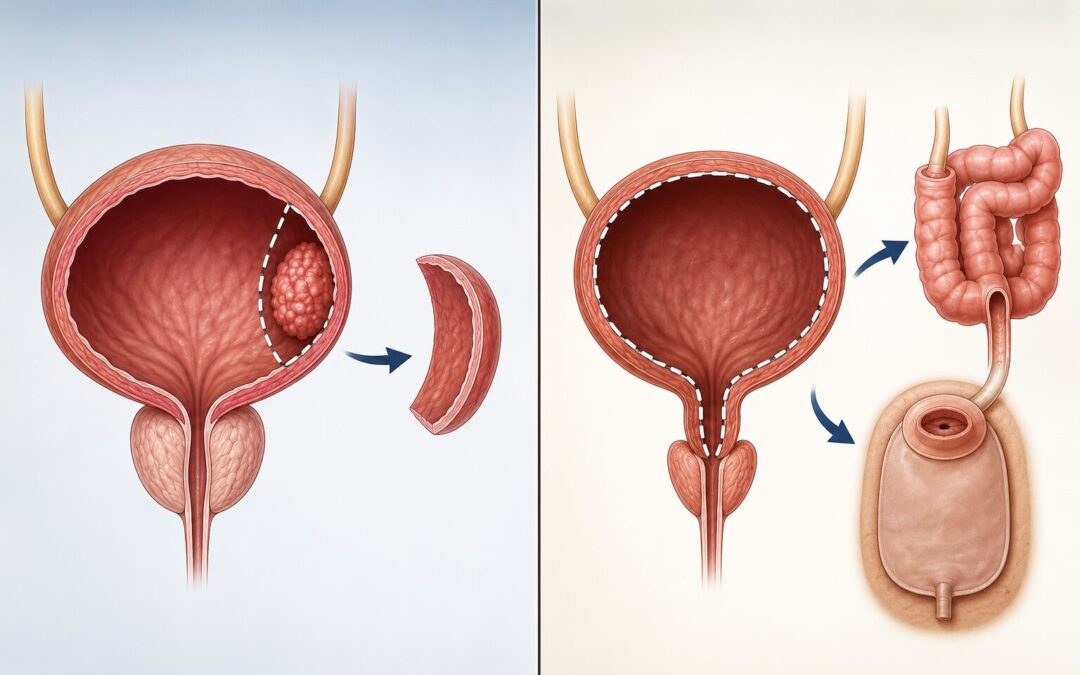
Radical cystectomy is the standard here, not partial, and that surprises a lot of patients who assume keeping more of the organ is always the better goal. A radical cystectomy removes the entire bladder along with nearby lymph nodes, sometimes other organs too depending on how far the cancer has grown, and it requires a urinary diversion afterward since there’s no bladder left to store urine. A partial cystectomy only removes the section containing the tumour, leaving the rest of the bladder intact and functioning. Sounds appealing on paper. But it only works for a narrow slice of patients, somewhere under 10%, because bladder cancer tends to be multifocal or positioned in a spot that makes partial removal risky from a cancer-control standpoint.
Dr. Sandeep Nayak, who provides Best Cancer Treatment in Bangalore, explains why this ratio stays so lopsided: “Most bladder tumours aren’t sitting conveniently in one isolated spot. There’s often microscopic disease elsewhere in the bladder lining that a scan won’t show. Removing just the visible tumour and leaving the rest behind carries real recurrence risk. Radical cystectomy became the standard because it addresses that risk directly, not because surgeons prefer taking more tissue than necessary.”
Diagnosed with bladder cancer and unsure which surgery applies to you?
Partial vs Radical Cystectomy: What's the Difference?
|
Partial Cystectomy |
Radical Cystectomy |
|
|
What’s Removed |
Section of bladder containing the tumour |
Entire bladder, nearby lymph nodes |
|
Bladder Function After |
Preserved, mostly normal |
None, urinary diversion required |
|
Eligible Patients |
Under 5 to 10% of cases |
Standard of care for most patients |
|
Cancer Control |
Higher recurrence risk if not ideal candidate |
Lower recurrence risk, addresses multifocal disease |
|
Recovery |
Shorter, less complex |
Longer, more involved |
|
Urinary Diversion Needed |
No |
Yes, ileal conduit or neobladder |
|
Best Suited For |
Single, small, well-located tumour |
Muscle-invasive or multifocal disease |
The table lays out the mechanics, but the real decision comes down to whether a tumour is genuinely isolated enough to trust a partial approach. Most aren’t. More on how bladder cancer is staged and treated at MACS Clinic is on the urology and bladder cancer page.
Who Actually Qualifies for Partial Cystectomy?
Meeting the criteria for partial removal is harder than it sounds, and most patients don’t clear the bar.
Solitary Tumour Location: The cancer needs to be in one clearly defined spot, away from the bladder neck and ureteral openings, so removing it doesn’t compromise the surrounding structures that make the bladder function properly.
No Evidence of Multifocal Disease: Bladder cancer often shows up in more than one place, sometimes microscopically, sometimes visibly on cystoscopy. If there’s any suggestion of disease elsewhere in the bladder lining, partial removal stops being a safe option.
Adequate Remaining Bladder Capacity: Enough healthy bladder tissue needs to remain after removal for the organ to still hold a reasonable volume of urine. Removing too much defeats the purpose of trying to preserve function in the first place.
Muscle-Invasive but Localized: Some muscle-invasive tumours in a genuinely isolated location can still be candidates, but this gets decided case by case with careful imaging and often a second look during surgery itself.
For a detailed view also can see Our page on Urinary Bladder Cancer.
Why Choose MACS Clinic for Bladder Cancer Surgery?
Dr. Sandeep Nayak’s team at MACS Clinic evaluates every bladder cancer case on its own terms rather than defaulting to whichever surgery is more familiar. Imaging, cystoscopy findings, and tumour location are all reviewed carefully before recommending partial or radical cystectomy, so patients aren’t pushed toward radical surgery when partial removal is genuinely safe, and aren’t offered partial removal where it isn’t oncologically sound.
For patients requiring radical cystectomy, robotic and minimally invasive techniques are used where appropriate to reduce blood loss and support faster recovery, alongside careful planning for urinary diversion. Those who want their specific case reviewed can reach the team at +91 9482202240
FAQs
Can bladder function return to normal after radical cystectomy?
Not really, no. Since the bladder itself is removed, a diversion takes over its job, either an external pouch or a neobladder built from a piece of intestine. Some options let patients void in a fairly familiar way. Others mean adjusting to something entirely different.
Why isn't partial removal offered more often?
Bladder cancer usually spreads across more of the lining than a scan picks up. Take out just the visible tumour in the wrong case, and recurrence risk climbs fast. Surgeons keep partial removal reserved for the rare tumour that’s genuinely isolated.
Does losing the bladder mean losing control for good?
The bladder’s gone, so yes, in that literal sense. But neobladder reconstruction and other diversion approaches are built specifically to give patients something workable, not perfect, but functional enough to fit back into everyday life once things settle.
How do surgeons actually land on partial versus radical?
Imaging first, then cystoscopy, sometimes a biopsy on top of that. All of it maps out exactly where the tumour sits and whether anything suspicious is showing up elsewhere. Every case gets read on its own, never a default pick.
Disclaimer: This content is published for educational and informational purposes only.