

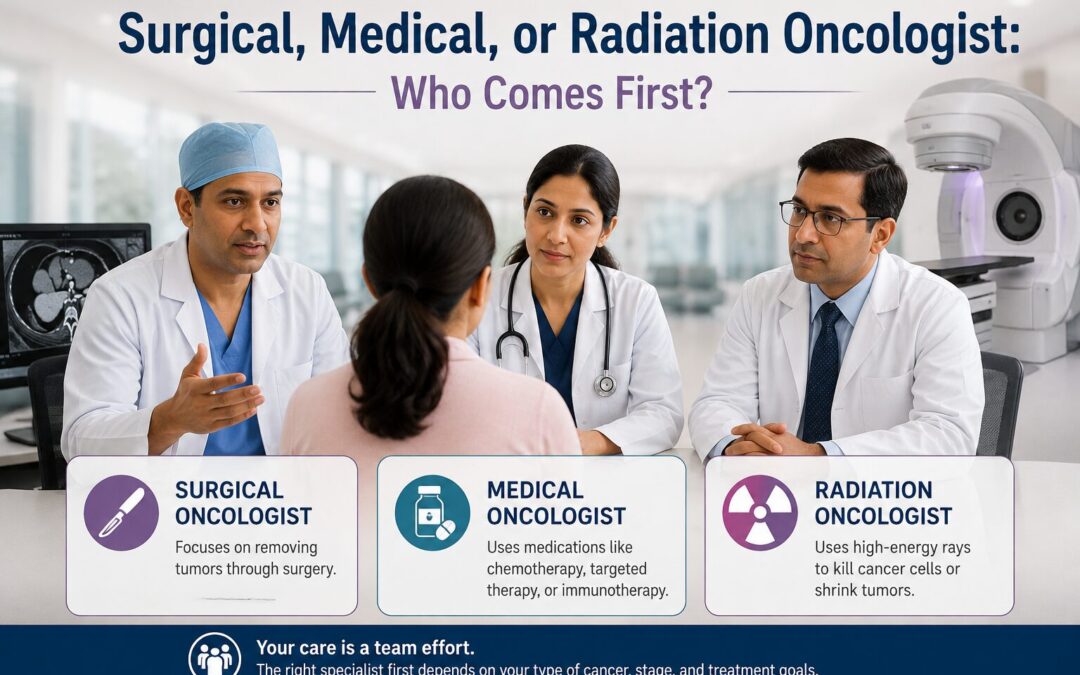
Most patients don’t realise there are three different kinds of oncologist until they’re sitting in a consultation room being referred to one of them. A surgeon who removes tumours. A physician who prescribes chemotherapy and targeted drugs. A specialist who delivers radiation. Three separate disciplines, often three separate doctors and the question of who you see first isn’t answered by a fixed rule. It’s answered by what the cancer is doing and where it’s sitting.
According to Dr. Sandeep Nayak, Best Cancer Treatment in Bangalore, “The question of who you see first matters less than whether all three are involved in the decision. A surgical oncologist who plans an operation without medical and radiation oncology input, or a medical oncologist who starts chemotherapy without knowing whether surgery is possible first, is working with half the picture. The sequence is decided together, not in separate consultations that don’t talk to each other.”
Confused About Which Oncologist You Need? Get Clear Guidance
What Each Oncologist Actually Does?
|
Surgical Oncologist |
Medical Oncologist |
Radiation Oncologist |
|
|
Primary role |
Removes tumours surgically |
Prescribes chemotherapy, targeted therapy, immunotherapy, hormone therapy |
Delivers radiation therapy to destroy cancer cells |
|
When they’re involved |
Early-stage localised disease, surgical staging, debulking |
Systemic disease, neoadjuvant chemotherapy, adjuvant treatment, metastatic cancer |
Post-surgery residual disease, definitive radiation for inoperable tumours, palliative symptom control |
|
Typical first contact |
Early-stage solid tumours where surgery is the primary treatment |
Advanced disease, haematological cancers, cancers requiring drug treatment before surgery |
Usually after surgery or alongside chemotherapy, rarely first contact |
|
Key decisions they make |
Whether the tumour is resectable, surgical approach, margin clearance |
Which drug regimen, treatment sequencing, molecular subtype assessment |
Radiation dose, field, technique, timing relative to surgery |
|
Works with |
Medical oncologist for neoadjuvant planning, radiation oncologist for post-op treatment |
Surgical oncologist for resectability, radiation oncologist for combined modality plans |
Both surgical and medical oncology for combined treatment planning |
In practice, the distinction between who you see first is less important than whether all three are reviewing your case together. A tumour board that brings all three disciplines into one discussion before treatment begins is what produces a treatment plan built on the full clinical picture rather than one specialist’s view of it.
How the Sequence Actually Gets Decided in Practice?
Early-stage, localised tumour surgical oncologist usually comes first
When imaging shows a tumour confined to one organ with no obvious spread, the first question is whether it can be removed completely. A surgical oncologist assesses resectability, margin feasibility, and whether surgery alone is sufficient or whether chemotherapy or radiation is needed alongside. For early-stage solid tumours across breast, colon, thyroid, and head and neck cancers, this is the standard opening sequence.
Advanced or borderline resectable disease — medical oncologist may come first
When the tumour is too large to remove safely, has spread to nearby lymph nodes, or sits close to major blood vessels, chemotherapy or targeted therapy before surgery — neoadjuvant treatment — is often the plan. Shrinking the tumour first makes a complete surgical removal more achievable. In this situation, the medical oncologist drives the first phase of treatment while the surgical oncologist waits to reassess after the response is measured. The blog on Surgery vs Chemotherapy: Which Treats Cancer First covers this sequencing decision in full.
Radiation oncologist — rarely first, often essential later
Radiation is almost never the opening move in solid tumour management. It most commonly follows surgery to treat residual microscopic disease, or runs concurrently with chemotherapy for cancers where combined modality treatment outperforms either alone. For inoperable tumours where surgery isn’t possible, radiation can become the primary treatment but that decision itself is made after a surgical oncologist has assessed and confirmed inoperability.
Why Choose MACS Clinic for Cancer Treatment?
Dr. Sandeep Nayak’s team at MACS Clinic runs every new case through a tumour board that brings surgical, medical, and radiation oncology input together before any treatment is confirmed. The sequence of who goes first and why is decided in that room, not in three separate consultations that may or may not communicate with each other afterward.
Patients here don’t get a plan based on which specialist they happened to see first. They get a plan built on staging, molecular profile, and the combined input of all three disciplines. Those who want to discuss their diagnosis can reach the team at +91 8035740000 or through the contact page.
FAQs
Do I need to see all three oncologists?
Not always it depends on the cancer and treatment plan. But all three should review the case together before treatment begins, even if only one or two are actively treating.
Can I choose which oncologist to see first?
You can, but the more useful question is whether the centre you’re going to runs a multidisciplinary tumour board. That’s what ensures all three perspectives inform the plan.
What if my oncologists disagree on the sequence?
That’s exactly what a tumour board is for. Disagreement between disciplines is resolved in that setting with all the clinical information on the table, not through separate opinions that the patient has to reconcile themselves.
Is a surgical oncologist the same as a general surgeon?
No. A surgical oncologist has specific training in cancer surgery oncological principles, margin clearance, lymph node management, and minimally invasive techniques for cancer cases. A general surgeon operates across a broader range of conditions without that cancer-specific focus.
Disclaimer: This content is published for educational and informational purposes only.