
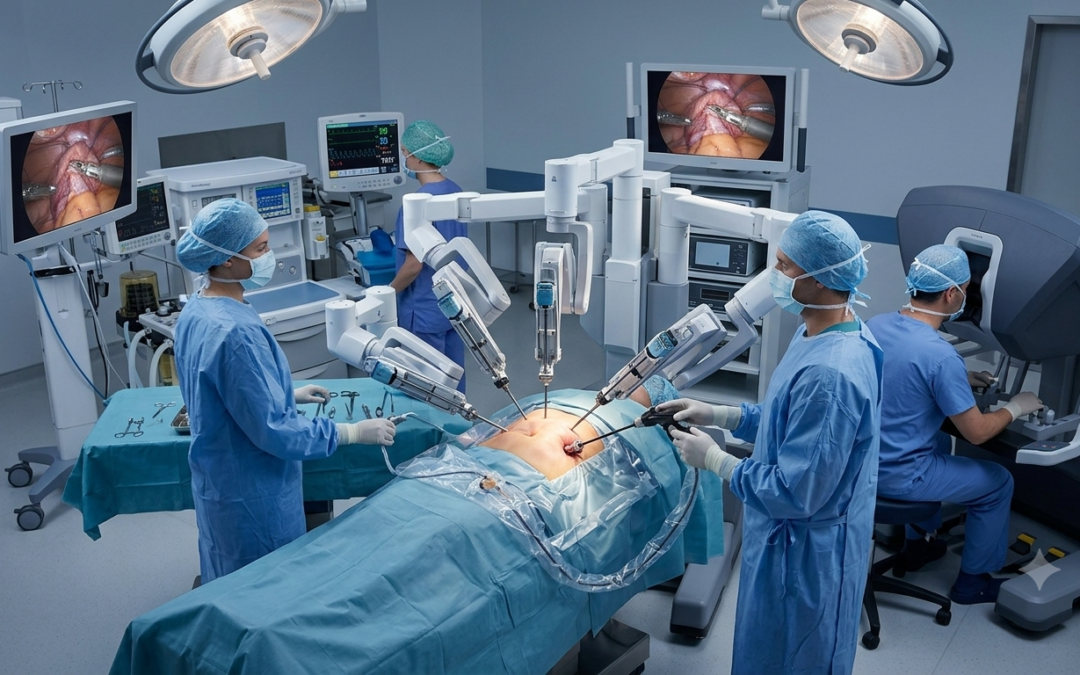
The number that gets quoted most often is somewhere between 94% and 100%, and that’s accurate for what it’s measuring. Technical surgical success in robotic cancer surgery, meaning the operation was completed as planned without conversion to open surgery and without intraoperative complications, consistently hits that range across most solid tumour types in published data, colon, rectal, prostate, kidney, and gynaecological cancers among them. But technical success and overall success are two different things. A surgeon who completes a robotic prostatectomy without a single intraoperative complication hasn’t guaranteed the patient a cure. What happens after surgery, whether margins are clear, whether all the right lymph nodes were removed, whether the cancer returns, is what most patients actually mean when they ask about success, and those numbers depend on the cancer type, the stage, the surgeon’s volume, and how thoroughly the pre-operative plan was built.
Dr. Sandeep Nayak, Best Cancer Treatment in Bangalore, explains it this way: “Success rate is a term that needs unpacking. Technically completing the operation without conversion is one measure. Clear margins are another. Five-year survival is another. Robotic surgery improves the first two meaningfully in the right hands. The third depends on the biology of the cancer and what treatment comes alongside surgery, not just the platform used to operate.”
Considering robotic cancer surgery for your treatment plan?
What the Numbers Actually Show by Cancer Type?
The evidence base for robotic cancer surgery is strongest for the cancers where it’s been used longest.
Colorectal cancer
A meta-analysis of 15 randomised controlled trials and 11 prospective studies covering nearly 7,000 patients found robotic rectal surgery associated with lower blood loss, lower conversion rates, lower reoperation rates, and higher rates of negative circumferential resection margins compared to laparoscopic surgery. That last point matters — a positive circumferential margin in rectal cancer surgery is one of the strongest predictors of local recurrence. Achieving clear margins more consistently is a clinically meaningful difference, not just a technical footnote. For a full comparison of robotic versus laparoscopic surgery and where the real differences lie, that breakdown covers the key distinctions.
Prostate cancer
Robotic-assisted radical prostatectomy is now the dominant surgical approach for localised prostate cancer in most high-volume centres globally. Positive margin rates in experienced robotic hands run consistently lower than open surgery, and nerve-sparing capability — which directly affects post-operative urinary and sexual function — is significantly better with the robotic platform’s 3D magnification and tremor-filtered articulation.
Kidney cancer
Robotic partial nephrectomy — removing the tumour while preserving the remaining kidney — achieves comparable oncological outcomes to open partial nephrectomy with meaningfully less blood loss and shorter hospital stay. The technical precision required to stay within the tumour margin while preserving the maximum amount of healthy kidney tissue is exactly where the robotic platform earns its place.
Gynaecological cancers
For cervical and endometrial cancer, robotic hysterectomy achieves equivalent cancer clearance to open surgery with significantly less blood loss, shorter hospital stay, and faster return to normal activity. The ROBOGYN-1004 trial found no superiority for robotic over conventional laparoscopy on complication rates — same outcomes, different platform — which is the honest picture for straightforward cases. Robotic earns its advantage specifically in complex pelvic anatomy. The robotic cancer surgery page covers how this applies across different tumour types at MACS Clinic.
What Actually Drives the Success Rate?
The platform is one variable. The surgeon is a bigger one.
Surgeon volume is the strongest predictor of outcome
The complication rate for robotic cancer surgery at low-volume centres is meaningfully higher than at high-volume ones. Both approaches have learning curves, and the robotic platform’s learning curve is steep. A da Vinci system doesn’t make a low-volume surgeon into a high-volume one it gives a skilled, experienced surgeon better tools. The question worth asking before any robotic cancer operation is not whether the centre has a robot, but how many of this specific procedure the operating surgeon does each year.
Margin clearance determines long-term outcome more than the approach
Whether surgery is open, laparoscopic, or robotic, a positive margin cancer cells at the edge of the tissue removed is associated with higher local recurrence rates across almost every solid tumour type. The robotic platform improves margin clearance in specific situations, particularly narrow pelvic dissections and nerve-sparing operations where precision matters most. In straightforward resections, the margin outcomes are equivalent across approaches.
Pre-operative planning determines what surgery can achieve
The tumour board review, the staging workup, the decision on whether neoadjuvant chemotherapy is needed before surgery these determine whether the operation is being done at the right time, on the right patient, with the right intent. A technically perfect robotic operation on a patient who needed chemotherapy first is still the wrong plan. For a detailed look at how robotic surgery is shaping cancer outcomes more broadly, that blog covers the evidence across multiple tumour types.
Why Choose MACS Clinic for Robotic Cancer Surgery?
Dr. Sandeep Nayak’s team at MACS Clinic performs robotic cancer surgery across colorectal, gynaecological, urological, thyroid, and head and neck tumours. Every case goes through tumour board review before a surgical date is set. The decision to operate robotically is made based on what the anatomy and the tumour require, not on equipment availability or habit.
Where robotic precision adds genuine value complex pelvic dissection, nerve-sparing operations, narrow anatomical corridors that’s the approach taken. Where laparoscopic achieves the same oncological result with less setup time and lower cost, that’s used instead. Those who want to discuss surgical options for their specific cancer can reach the team at +91 8035740000.
FAQs
Is robotic surgery better than open surgery for cancer?
For most solid tumours, robotic and laparoscopic surgery achieve the same cancer clearance as open surgery with less blood loss, shorter hospital stay, and faster recovery. Robotic has specific advantages in narrow anatomical spaces and nerve-sparing procedures.
Does the success rate of robotic surgery depend on the surgeon?
Significantly yes. Surgeon volume for the specific procedure is the strongest predictor of outcome regardless of platform. The robot doesn’t operate — the surgeon does.
What does a 94% to 100% technical success rate actually mean?
It means the operation was completed as planned without conversion to open surgery and without major intraoperative complications. It does not mean guaranteed cure or guaranteed clear margins — those depend on the cancer biology and the completeness of resection.
Is robotic surgery available for all cancer types?
Not all, but most solid tumours can be approached robotically in experienced hands colorectal, prostate, kidney, gynaecological, thyroid, and selected gastric and liver cases. The suitability depends on tumour location, size, and patient anatomy.
Disclaimer: This content is published for educational and informational purposes only.