

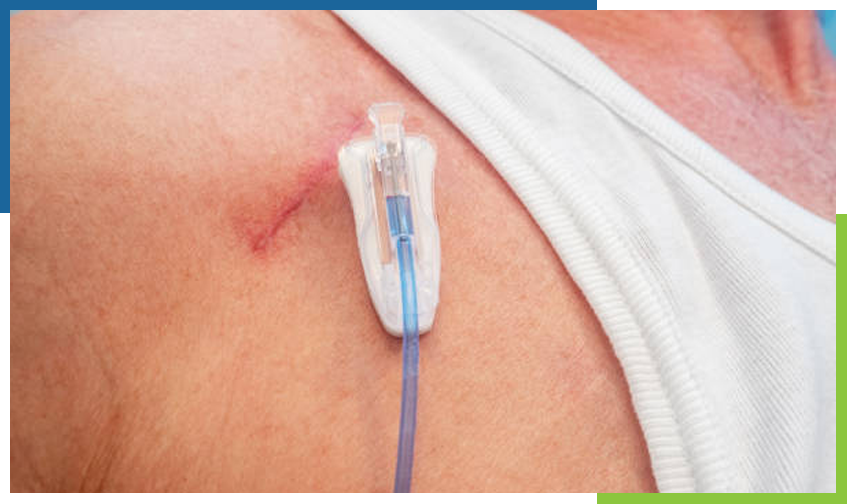
Anyone who has watched a family member go through chemotherapy knows the drill needle in the arm, vein collapses, try the other arm, bruising that takes weeks to fade. It happens because chemotherapy drugs are harsh on peripheral veins. Some drugs cause scarring over time. Some need to run slowly over hours. And blood draws on top of infusions, week after week for months, leaves most patients’ arm veins in poor shape before the treatment is even halfway done.A Port-a-Cath solves that problem. It’s a small device roughly the size of a two-rupee coin placed under the skin of the chest in a minor procedure. A thin catheter connects it directly to a large central vein near the heart, where blood flow is fast enough to dilute drugs quickly and handle repeated access without damage. The port sits invisibly under the skin between sessions. When treatment is needed, a single needle through the skin accesses it. No hunting for a vein. No repeated sticks. No collapsed access after a few cycles.
According to Dr. Sandeep Nayak, Best Cancer Treatment in Bangalore, “A port makes chemotherapy significantly more manageable for patients who need it over months. It’s a minor procedure to insert but the difference it makes to someone going through repeated cycles of treatment is substantial. We recommend it routinely for patients starting multi-cycle regimens rather than waiting until peripheral access becomes a problem.”
Learn how a Port-a-Cath makes chemotherapy safer and more convenient.
What a Port-a-Cath Is Used for and How It Works?
Chemotherapy delivery
The main reason ports are inserted. Chemotherapy drugs go directly into a large central vein where high blood flow dilutes them fast, reducing vascular damage and allowing drugs that can’t safely go through small peripheral veins to be given without risk.
Blood draws
Most patients on chemotherapy need regular blood tests — full blood counts, liver function, tumour markers. A port handles all of these through the same access point, eliminating the need for separate arm needle sticks.
IV fluids and other medications
Hydration, antiemetics, antibiotics, blood products — anything that would otherwise need an IV line can go through the port. Patients receiving long or complex infusion regimens avoid multiple cannula insertions per session.
How it’s inserted
A minor procedure under local anaesthesia and sedation, usually taking 30 to 45 minutes. A small incision in the chest wall, the port placed in a pocket under the skin, and the catheter threaded into the subclavian or internal jugular vein. Most patients go home the same day. There’s a small scar at the insertion site that fades over time.
How it’s accessed
A special non-coring Huber needle is used — regular needles damage the port membrane. The skin over the port is cleaned, the needle inserted through the skin into the port, and treatment delivered. The needle is removed after each session. Between sessions, the port is flushed with heparinised saline to keep it clear.
How long it stays in
For as long as treatment requires — months, sometimes longer. When treatment is complete and the port is no longer needed, it’s removed in a procedure as straightforward as the insertion. It doesn’t need to come out immediately after the last cycle. Most teams wait a few months to confirm treatment is finished before removing it.
What to Watch for Once a Port Is in Place?
Most ports work without issue for the full treatment course. A handful of things are worth knowing about.
Signs of infection at the port site
Redness, warmth, swelling, or discharge around the port site, or fever without another obvious cause, needs to be reported promptly. Port infections are the most common complication and are managed with antibiotics, or removal if the infection doesn’t clear.
Signs of a blood clot
Swelling or pain in the arm, neck, or shoulder on the side of the port can indicate a clot around the catheter. This needs assessment the same day — not something to monitor at home for a few days.
Pain or resistance when flushing
If the port feels resistant when being flushed or causes burning, the catheter position may need checking. A well-positioned port should flush without resistance.
Port doesn’t restrict normal activity
Bathing, swimming, and most physical activity are fine once the insertion site has healed. The port sits under the skin and isn’t affected by surface contact.
For a detailed look at how chemotherapy drugs are delivered and how treatment sessions are structured, the previous blog on What Is Enhanced Recovery After Cancer Surgery covers the broader treatment and recovery context.
Why Choose MACS Clinic for Chemotherapy and Cancer Treatment?
Dr. Sandeep Nayak’s team at MACS Clinic recommends port insertion upfront for patients starting multi-cycle chemotherapy rather than waiting for peripheral access to fail. The procedure is done as a planned step in treatment preparation, not as a rescue after veins are already damaged.
Port care guidance, flushing protocol, and what to watch for between cycles are covered before the first treatment session, not handed to patients as a leaflet on the way out. Those who want to discuss chemotherapy planning or port insertion for their specific treatment can reach the team at +91 8035740000.
FAQs
Does port insertion hurt?
The procedure is done under local anaesthesia and sedation. Most patients describe it as pressure rather than pain. The site is sore for a few days after insertion, managed with standard pain relief.
Can I feel the port under the skin?
You can feel it if you press the area — it sits just under the surface. It isn’t visible through clothing and doesn’t protrude enough to be noticeable in everyday life.
How often does the port need to be flushed?
After every use, and once a month when not in active use, to prevent clotting inside the catheter.
When is a port removed after chemotherapy ends?
Usually a few months after the last treatment cycle, once the team confirms treatment is complete. Removal is a straightforward procedure similar to insertion..
Disclaimer: This content is published for educational and informational purposes only.