
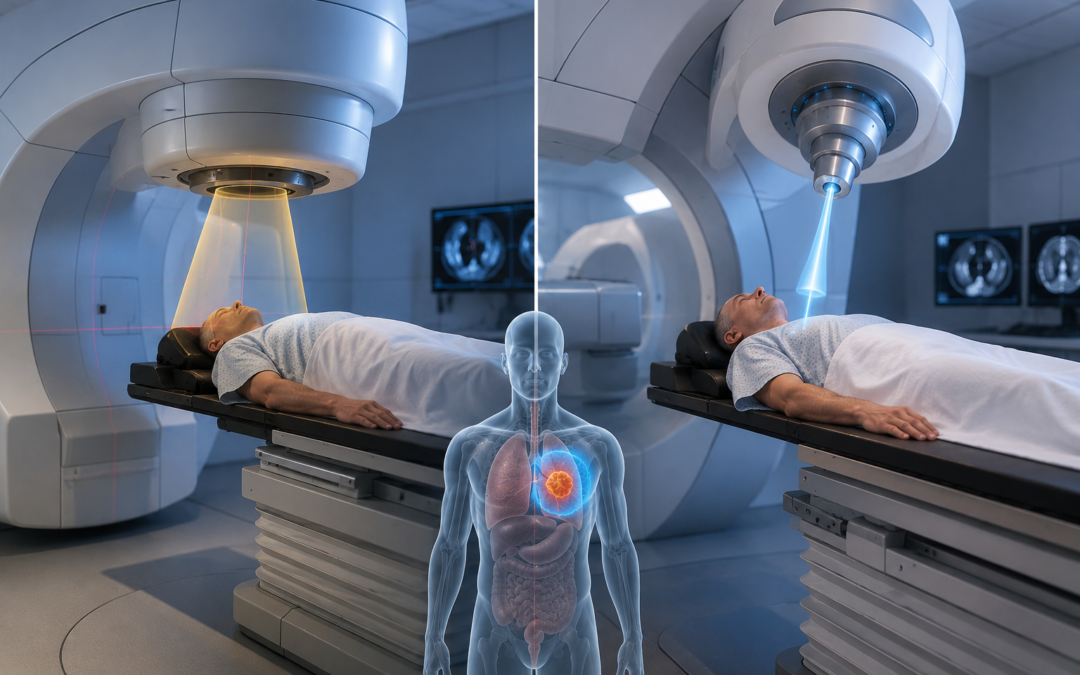
According to Dr. Sandeep Nayak, Best Cancer Treatment in Bangalore, “Proton therapy is a genuinely better option for specific tumours in specific locations paediatric brain tumours, skull base tumours, cancers sitting next to the spinal cord or optic nerves. For most other solid tumours, standard radiation delivered well achieves the same cancer control with far lower cost and far better accessibility. The question is always whether the precision of protons changes the outcome for that specific patient, not whether proton is newer.”
Find Out Which Radiation Option Is Right for You?
Proton Therapy vs Standard Radiation — Side by Side?
|
Standard Radiation |
Proton Therapy |
|
|
How it works |
X-rays pass through the body, depositing dose along the entire beam path |
Protons deposit most energy at a precise depth then stop — the Bragg peak |
|
Healthy tissue exposure |
Some exit dose to tissue beyond the tumour |
Minimal to no exit dose beyond the tumour |
|
Precision |
High — especially with modern IMRT and VMAT techniques |
Higher in anatomically complex locations near critical structures |
|
Best for |
Most solid tumours, post-operative radiation, palliative treatment |
Paediatric cancers, skull base tumours, brain tumours, spinal cord proximity, reirradiation |
|
Side effect profile |
Well-documented, manageable, technique-dependent |
Lower dose to surrounding organs in the right cases — not universally lower side effects |
|
Availability |
Widely available across India |
Very limited — few centres in India |
|
Cost |
Significantly lower |
Significantly higher — 3 to 5 times the cost of standard radiation |
|
Evidence base |
Decades of randomised trial data |
Growing but less mature for most tumour types |
Both approaches are used in conjunction with surgery and chemotherapy in the same combined modality frameworks. The radiation modality changes. The overall treatment strategy doesn’t.
When Standard Radiation Is the Right Call?
Dr. Sandeep Nayak’s team at MACS Clinic reviews every case through a tumour board that includes radiation oncology input before any treatment plan is confirmed. The decision on radiation modality whether standard photon radiation is appropriate or whether proton therapy should be sought at a specialist centre is made based on tumour location, proximity to critical structures, patient age, and treatment intent.
Patients here aren’t directed toward the more expensive option because it exists. They’re directed toward the option that changes their outcome. Those who want to discuss their case can reach the team at +91 8035740000
Why Choose MACS Clinic for Tumour Board Review?
Dr. Sandeep Nayak’s team at MACS Clinic runs every new cancer case through a formal tumour board before any treatment is confirmed. Surgical, medical, and radiation oncology input alongside pathology and radiology review — all in the same sitting, before the patient commits to a plan.
Patients here don’t get a treatment plan based on the opinion of whichever specialist they happened to see first. They get a plan built on staging, molecular profile, fitness assessment, and the combined input of every discipline relevant to their case. Those who want their case reviewed through a tumour board can reach the team at +91 8035740000
FAQs
Is proton therapy available in India?
Very limited. A small number of centres in India have proton facilities. Most patients who need it travel to specialised centres within India or abroad.
Does proton therapy cure cancer better than standard radiation?
For most tumours, no the cancer control rates are equivalent. Proton therapy reduces dose to surrounding healthy tissue in specific anatomical situations, which reduces certain side effects. It isn’t more effective at killing cancer cells.
Is proton therapy worth the extra cost?
For paediatric cancers, skull base tumours, and cases where critical structures are directly adjacent to the tumour yes. For most adult solid tumours treated with modern photon techniques usually not.
Who decides whether proton therapy is needed?
The radiation oncologist, in discussion with the full tumour board. It’s a clinical decision based on anatomy, age, tumour type, and what the treatment is trying to achieve.
Disclaimer: This content is published for educational and informational purposes only.