

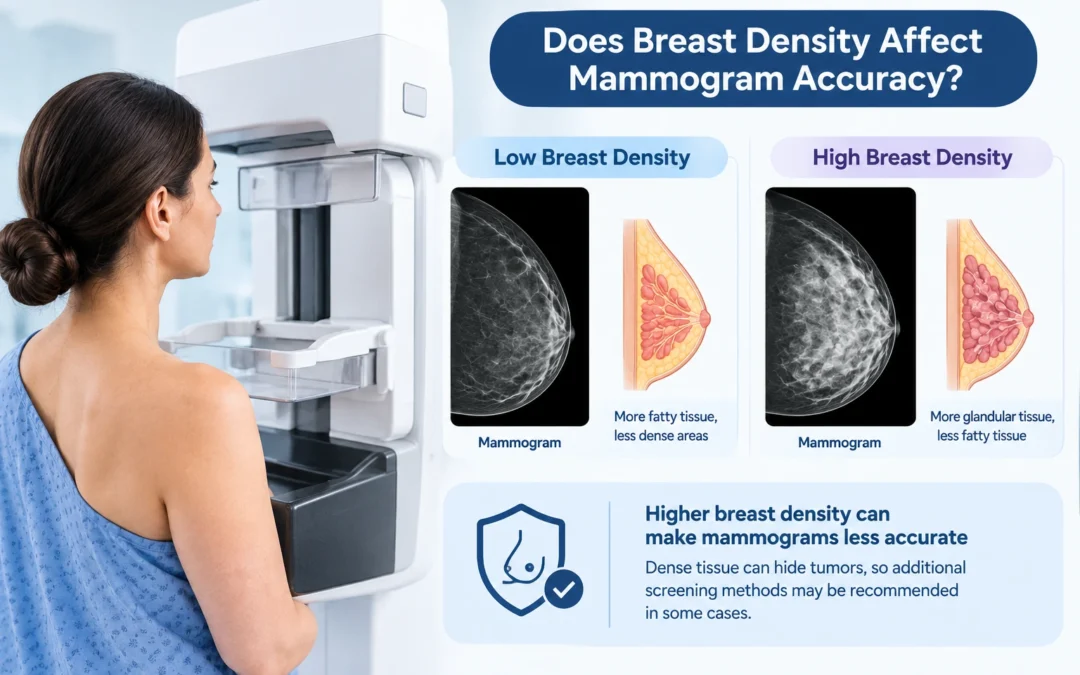
Yes, and it comes down to something almost mechanical about how a mammogram actually renders tissue. Dense breast tissue shows up white on the image. So do tumors, calcifications, anything abnormal really. Cram enough white tissue into one picture and something genuinely can hide inside it. Doctors call this the masking effect, and it makes a standard mammogram noticeably worse at catching a real tumor once density gets high enough. So if roughly half of women walk around with some degree of dense tissue, why does nobody really talk about this at a normal checkup? Mostly because density reporting on mammograms has only recently become required or even routine in a lot of places, so plenty of women get handed a result without anyone ever mentioning which density bucket they actually fall into
Dr. Sandeep Nayak, known for the Best Cancer Treatment in Bangalore, sees the gap between a “clear” mammogram and actual peace of mind play out constantly. “A normal mammogram doesn’t mean the same thing for every woman. If you’ve got dense tissue, the machine’s literally struggling to see through it as well. People deserve to know their density, not just their result, because that number changes whether extra screening actually makes sense for them.”
Recently found out you have dense breast tissue?
What Breast Density Actually Does to Screening Accuracy?
This isn’t some minor technical footnote, it genuinely changes how much a mammogram can catch:
|
Density Category |
Approximate Prevalence |
Effect on Mammogram Sensitivity |
|
Mostly fatty |
About 10 percent of women |
Highest sensitivity, tumors stand out clearly against fatty tissue |
|
Scattered fibroglandular |
About 40 percent of women |
Decent sensitivity, though some spots are still harder to read |
|
Heterogeneously dense |
About 40 percent of women |
Sensitivity drops, masking becomes a genuine concern |
|
Extremely dense |
About 10 percent of women |
Sensitivity drops a lot, extra imaging usually earns its keep here |
Density isn’t just about detection either, it’s its own risk factor on top of that. Women with dense tissue carry a somewhat higher baseline chance of developing breast cancer in the first place, before you even factor in the reduced ability to catch it.
What This Actually Means for Your Own Screening Plan?
Why Choose MACS Clinic for Breast Cancer Screening Tailored to Your Density?
Dr. Sandeep Nayak’s team treats breast density as a normal part of reading every mammogram, not something buried in a report nobody actually walks a patient through. For women with dense tissue, that means an actual conversation about whether ultrasound or MRI adds real value given their specific density and overall risk, rather than a one-size-fits-all recommendation handed out regardless of who’s sitting across the table. Screening plans get revisited as density shifts with age too, since it’s not something to check once and forget about for the next decade.
Want your own density category and screening plan reviewed properly? Reach the team at +91 9482202240.
FAQs
Dense breasts basically mean I need more than a mammogram, right?
Not necessarily, it really depends on the specific category and other risk factors in the mix. Worth an actual conversation rather than assuming one way or the other.
Does breast density stay the same forever, or does it shift?
It shifts, usually downward with age, especially after menopause, though how much and how fast varies a lot from woman to woman.
Can I feel dense tissue myself, or tell by how my breasts feel?
Nope, density only shows up on imaging. It’s got nothing to do with how firm or lumpy things feel to the touch
My mammogram report never mentioned density, should I bring it up?
Yes, absolutely. A lot of places require this info now, and if it got left out or wasn’t explained, it’s worth asking for directly.
Reference
- Dense Breast Tissue, Wikipedia
- InforMD: A New Initiative to Raise Public Awareness About Breast Density, PMC
- MRI vs Ultrasound: Which Is Better for Breast Cancer, MACS Clinic
Disclaimer:This content is published for educational and informational purposes only.