

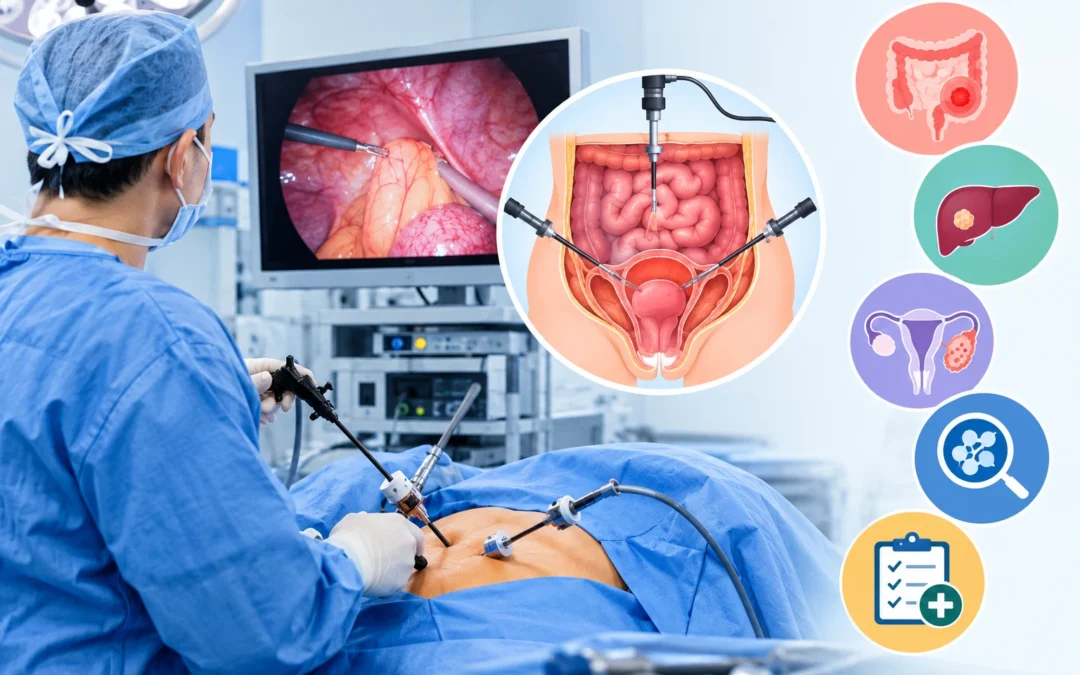
It’s a keyhole operation done under general anaesthesia. The surgeon makes a few small cuts in your belly, passes in a thin tube with a camera on the tip, and looks straight at your organs and the lining of the abdomen. Why bother? Because scans can miss tiny cancer deposits, and a camera usually doesn’t. The procedure shows how far the cancer has really spread, before anyone commits you to a big operation that wouldn’t have helped.
Dr. Sandeep Nayak, who provides cancer treatment in Bangalore , explains it like this. “A scan is a picture taken from outside. Spots a few millimetres wide on the lining of the abdomen often don’t show on it. When we look with the camera, we see them, and the whole plan can change. I’d much rather find that out in a short keyhole procedure than halfway through a major operation.”
Wondering whether staging laparoscopy is needed for your cancer diagnosis? Learn how this minimally invasive procedure helps assess cancer spread and guides treatment planning.
How Does Staging Laparoscopy Work?
- You’re asleep. It’s done under general anaesthesia, so you feel nothing during it.
- A few small cuts. Each is usually about a centimetre or less. Gas is gently pumped into the belly to make room, and the camera goes in through one of the cuts.
- The surgeon looks, then samples. The liver surface, the abdominal lining, the diaphragm and the pelvis all get checked. Anything suspicious is biopsied, and the abdomen may be rinsed with fluid that’s sent to the lab for cancer cells.
- It’s short. Many people go home within a day or so, though your team will tell you what to expect.
It often sits at the start of a bigger plan. You can read how we use it on our diagnostic staging laparoscopy page.
When Is Diagnostic Laparoscopy for Cancer Needed?
- Stomach cancer that looks advanced on scans. This cancer likes to spread to the lining of the abdomen, and CT is poor at spotting small deposits there. In some studies, up to about one in five people who looked operable on scans turned out to have such spread. Our post on whether stomach cancer can be cured if found early covers the early end of the story.
- Pancreas, liver, bile duct and gallbladder cancers. When the scans say surgery is possible but there’s doubt about hidden spread, the camera settles it.
- Ovarian cancer. The team needs to know how widely it has spread and whether it can be removed completely. See our page on ovarian cancer treatment in Bangalore.
- Before a very big operation or HIPEC. If the abdomen can’t be treated, you’d want to know first. Here’s what HIPEC involves.
Plenty of people don’t need it. A small early cancer that rarely spreads to the abdominal lining usually goes straight to treatment. And if scans already show clear spread, there’s nothing left to stage.
What Determines the Right Treatment Approach?
Whether you need staging laparoscopy is a decision for the whole team, based on a few things.
- The type and site of the cancer. Some cancers spread to the abdominal lining early, others almost never do.
- What the scans show. CT, MRI and PET-CT results, including any fluid in the abdomen or spots that look unclear.
- The planned treatment. If you’re heading for major surgery or chemotherapy first, knowing the true stage matters more.
- Your general health. You need to be fit enough for a short general anaesthetic.
- What the result would change. If the answer won’t alter the plan, there’s little reason to do it.
The call comes after the scans, the biopsy report and an honest talk about the options
Key Takeaways
- It’s a camera look inside your abdomen, done through a few tiny cuts.
- Scans miss small deposits. The camera catches many of them.
- It’s most useful in stomach, pancreas, liver, bile duct and ovarian cancers.
- It can spare you a big operation that wouldn’t have worked.
- Not everyone needs one. Your team decides after your scans and biopsy.
Unsure whether it applies to you? Call us on +91 9482202240 or book a consultation.
FAQs
Is staging laparoscopy a major surgery?
It’s keyhole, so the cuts are small, but you’re still under general anaesthesia and it’s a real procedure. Serious problems such as bleeding, infection or injury to a nearby organ are uncommon. Most people recover quickly.
How is it different from a CT or PET scan?
A scan takes pictures from the outside. Laparoscopy lets the surgeon actually see inside and take a biopsy on the spot. That’s how it picks up tiny deposits that scans often miss.
How long does recovery take?
Usually short. Many people feel fairly comfortable within a day or two, and some get a bit of shoulder-tip ache from the gas. Most are back to normal activity in about a week, but everyone heals at their own pace.
What happens if it finds the cancer has spread?
The plan changes. You may skip a major operation that wouldn’t have helped and move to other treatment, such as chemotherapy. In selected cases, options like HIPEC or PIPAC may also be discussed.
Reference
Staging Laparoscopy for Gastric Cancer: European Consensus — British Journal of Surgery, 2025 Read the full article on PubMed Central
National Cancer Institute (NCI) — Cancer Staging Read the cancer staging overview
Disclaimer
This content is published for educational and informational purposes only. It is not a substitute for medical advice, diagnosis or treatment. Please consult a qualified doctor about your own condition.