
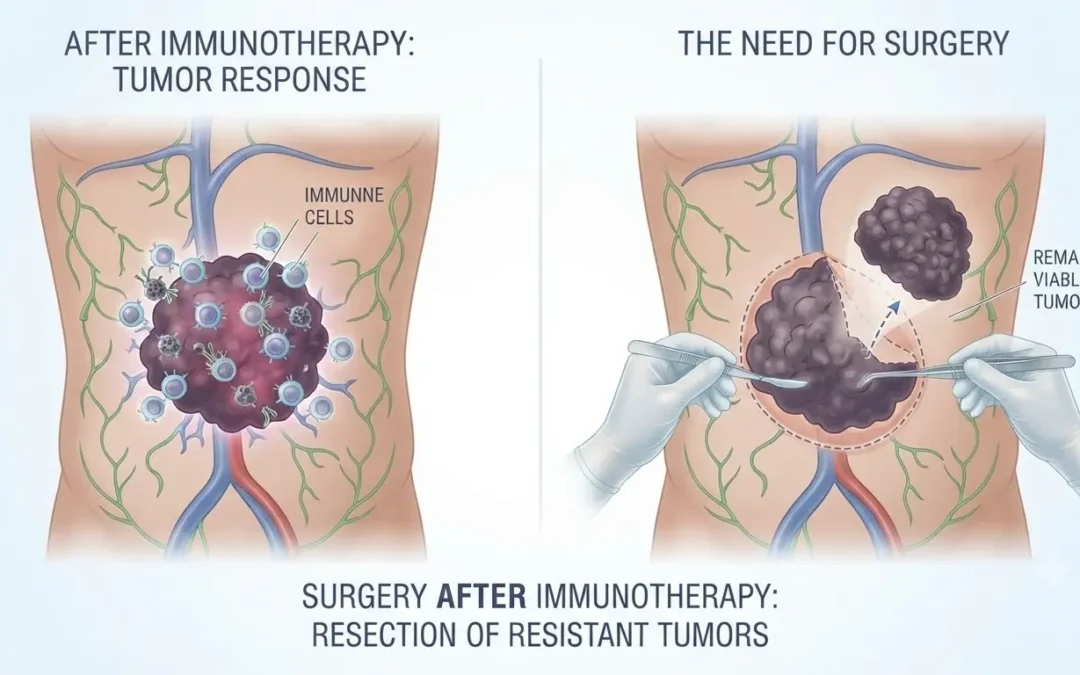
Because scans can show that a tumour has shrunk or even vanished, but only the removed tissue can show what is truly left. Surgery after immunotherapy takes out any remaining tumour cells, lets the pathologist confirm under the microscope whether the cancer was fully eliminated, and lowers the chance of it coming back in the same place. Doctors call immunotherapy given before an operation neoadjuvant, or induction, treatment. So if the scans look good, why operate at all? Because imaging cannot reliably tell a tumour that has been wiped out from one that has simply gone quiet, and the surgical specimen answers that question in a way nothing else does.
Dr. Sandeep Nayak, who provides the Best Cancer Treatment in Bangalore, hears this question from almost every patient who responds well. “They have been told the tumour has shrunk a lot, and then we say we still want to operate, which sounds like a contradiction. It is not. A great response is exactly what makes the operation worthwhile, because we can now remove what remains with a smaller procedure, and we get a precise answer on how well the treatment worked. That answer then guides everything afterwards.”
Responding well to immunotherapy and wondering about the next step?
Why Is Surgery Needed After Immunotherapy?

Why is surgery needed after immunotherapy when the response looks excellent? Four reasons come up again and again.
- It removes what is left. Even a strong response can leave small pockets of living cancer cells that no scan can see. Taking out the tumour site and the nearby lymph nodes remains the most dependable way to protect against the cancer returning locally.
- It confirms the result. The pathologist examines the specimen and reports a pathological complete response when no viable tumour is found, or a major pathological response when very little is left. Scans cannot separate dead tumour, scar tissue and immune inflammation from living cancer, and immunotherapy can even make a tumour look larger on a scan for a time because immune cells crowd into it. Our post on immunotherapy versus chemotherapy for cancer explains how that response works.
- It guides what comes next. A complete response may mean follow up with or without further immunotherapy, while a partial response can call for added treatment. The thinking behind that choice is covered in our post on adjuvant versus neoadjuvant treatment.
- It corrects the picture. Lymph nodes and the surrounding tissue are examined directly, and sometimes the findings are different from what the scans suggested, a situation described in our post on what happens if surgery finds more cancer than the scans showed.
How Does Immunotherapy Before Cancer Surgery Work in Practice?

Immunotherapy before cancer surgery is now part of standard care for some cancers, and still being tested in others.
- Where it is used. Trials have shown benefit in several settings, including melanoma, non small cell lung cancer, triple negative breast cancer and colorectal cancer with a mismatch repair deficient, or MSI high, tumour. The evidence is strongest where large studies have been completed, and it varies between cancers.
- Why give it first. The tumour is still in the body, so the immune system meets the cancer while it is there to be recognised. In some trials, giving immunotherapy before the operation has done better than giving the same drugs only afterwards.
- How the timing works. A few cycles are given over several weeks, and surgery usually follows a few weeks after the last dose, once the patient has recovered. How that sequence is decided is explained in our post on whether chemotherapy comes before or after surgery.
- Is the operation ever skipped? Early research in a small group, such as MSI high rectal cancer, is asking whether some patients with a complete response could avoid surgery. That is still being studied and is not standard practice.
- Planning the operation. Surgery after cancer treatment of any kind calls for some extra preparation, since earlier drugs can affect healing and blood counts. With immunotherapy, the team also checks for inflammation of organs such as the lungs, bowel and thyroid before the operation, and our post on recovery after cancer surgery describes what follows.
What Determines the Right Treatment Approach?
Not everyone gets immunotherapy before surgery, and not everyone who does has the same operation.
- The type of cancer. Whether immunotherapy before surgery is proven, standard or experimental depends on the cancer.
- The stage and whether the tumour can be removed. Doctors weigh how advanced it is, and whether starting with drugs makes a later operation smaller or safer.
- Biomarker results. Markers such as PD-L1, MSI status and mismatch repair findings help predict who is likely to respond, which is where precision oncology comes in.
- How the tumour responds. Scans and blood tests during treatment tell the team whether to continue, adjust or move to surgery earlier.
- The patient’s health and tolerance. Side effects from immunotherapy and the person’s general fitness both shape the timing.
- A joint review. At MACS Clinic surgical, medical and radiation oncology discuss the case together, much as described in our post on what a tumour board is.
Key Takeaway
- Immunotherapy given before an operation can shrink or clear a tumour, but scans cannot confirm that no living cancer cells remain.
- Surgery removes what is left, shows the pathologist exactly how well the treatment worked, and helps guide what comes next.
- Some patients may eventually be able to avoid surgery after a complete response, but that is still under study.
- For questions about your own plan, you can contact the clinic at +91 9482202240.
FAQs
Does needing surgery mean the immunotherapy did not work?
No. Surgery is part of the plan from the start, and it is usually most effective after a good response. The operation removes what is left and shows how well the treatment actually worked.
How long after immunotherapy is surgery done?
Usually a few weeks after the last dose, once the patient has recovered and any side effects have been checked. The exact timing depends on the cancer and the treatment schedule.
Can some patients skip surgery after immunotherapy?
In certain rare situations, such as some MSI high rectal cancers, research is exploring this for patients with a complete response. It is not yet standard, and decisions like that are made case by case within a specialist team.
Is surgery harder after immunotherapy?
It can need more careful planning, since immune related side effects and changes around the tumour have to be taken into account. In experienced hands, surgery after immunotherapy is generally feasible and often smaller than it would have been without the earlier response.
Disclaimer
This content is published for educational and informational purposes only.
References:
2. Pembrolizumab for Early Triple Negative Breast Cancer (KEYNOTE 522), New England Journal of Medicine
3. Immunotherapy vs Chemotherapy for the Cancer, MACS Clinic