

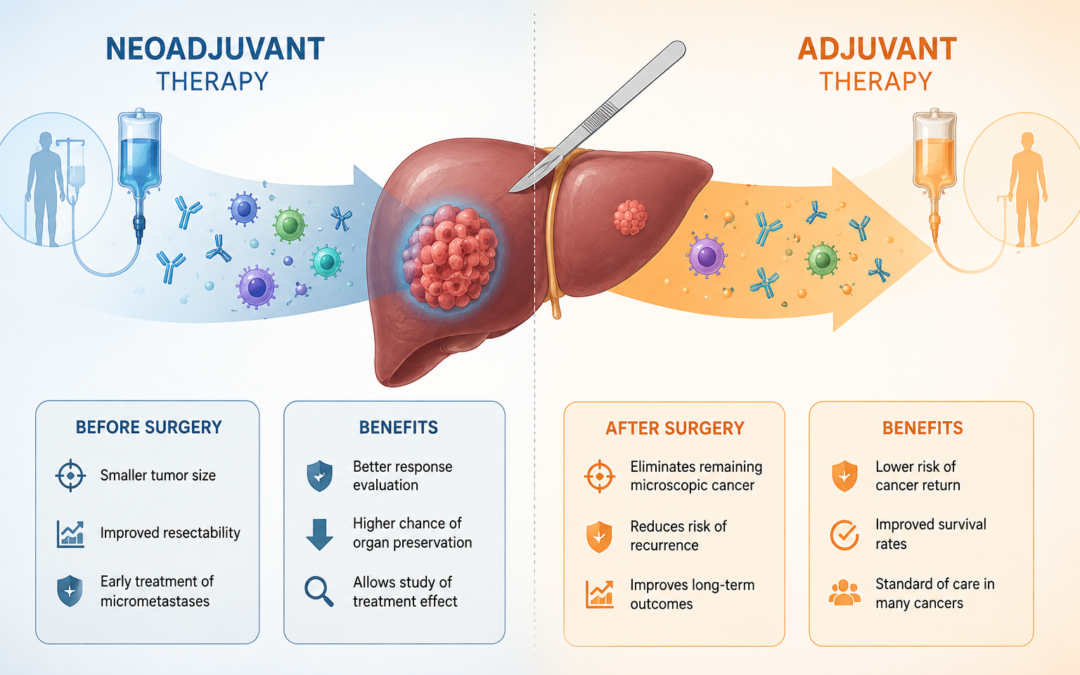
that timing decision has real consequences for what surgery can achieve and what the long-term outcome looks like.
Neoadjuvant chemotherapy goes in before surgery. The goal is to shrink the tumour, reduce its stage, and make a complete surgical removal more achievable, sometimes converting a tumour that couldn’t be fully removed into one that can. Adjuvant chemotherapy comes after surgery. The tumour is already out. The goal now is mopping up, killing any cancer cells that may have spread beyond what the surgeon removed, reducing the chance of recurrence before it declares itself.
According to Dr. Sandeep Nayak, Best Cancer Treatment in Bangalore, “The sequence isn’t an arbitrary preference. Neoadjuvant chemo is chosen when shrinking the tumour first genuinely changes what surgery can achieve. Adjuvant chemo is chosen when surgery has done its job and the biology of the cancer tells us microscopic disease is likely still present. The tumour board makes that call not the oncologist alone and not the surgeon alone.”
Understand Which Chemotherapy Approach May Be Right for You?
When Neoadjuvant Chemo Is the Right Starting Point?
Tumour is too large or too close to critical structures for clean removal
Breast cancers above 3 to 4 cm, rectal cancers invading beyond the muscle wall, bulky gastric tumours — shrinking these first gives the surgeon wider margins and less collateral damage. Chemotherapy before surgery directly changes what the operation can safely achieve.
Borderline resectable disease
Some tumours sit close enough to major vessels that surgery today would leave positive margins. Chemotherapy first can convert borderline resectable disease into clearly resectable, changing the surgical outcome entirely rather than simply treating microscopic residual disease afterward.
Pathological complete response is a prognostic marker
In breast and rectal cancers, achieving pathological complete response after neoadjuvant chemotherapy no viable cancer cells in the surgical specimen is one of the strongest long-term survival predictors available. Giving chemotherapy first turns the tumour into a live biological test of how it responds before surgery commits to a final plan.
Molecular profile guides the neoadjuvant decision
EGFR-mutant lung cancer, HER2-positive breast cancer, MSI-high colorectal cancer the molecular subtype determines whether neoadjuvant chemotherapy, targeted therapy, or immunotherapy is the right pre-surgical agent. Testing first, treating based on the result, is how this works at a tumour board that reviews pathology before sequencing is confirmed.
When Adjuvant Chemo Comes After Surgery?
Early-stage tumours where surgery is the primary treatment
Stage 1 and 2 colon, breast, and thyroid cancers where the tumour is contained and clean margins are achievable go to surgery first. Cancer treatment with chemotherapy before surgery in these cases adds toxicity without improving outcome.
Pathology from surgery determines whether chemo is needed at all
Surgery first gives the team actual tumour tissue — nodal status, margin assessment, full molecular profiling. That pathology then decides whether adjuvant chemotherapy is needed and which drugs to use. Some patients who appeared to need chemotherapy don’t, based on what the pathology shows. Some who appeared low-risk turn out to have nodal involvement that changes the decision.
Residual disease after neoadjuvant treatment
Patients who received neoadjuvant chemotherapy and didn’t achieve complete pathological response still have viable cancer in the surgical specimen. Adjuvant treatment follows sometimes with the same drugs, sometimes escalated. In breast cancer, adjuvant capecitabine after incomplete neoadjuvant response is now standard. In rectal cancer, adjuvant chemotherapy is determined by what the pathology shows after neoadjuvant chemoradiation and surgery.
Reducing recurrence risk in high-risk early disease
Some early-stage cancers carry molecular features high grade, lymphovascular invasion, specific mutation profiles that predict a meaningful recurrence risk even after complete surgical removal. Adjuvant chemotherapy in these cases is about reducing that risk before it materialises, not treating disease that’s already visible.
For a detailed look at how the decision between surgery first and chemotherapy first is made across different cancer types, the previous blog on Surgery vs Chemotherapy: Which Treats Cancer First covers the full decision-making process.
Why Choose MACS Clinic for Chemotherapy and Cancer Treatment?
Dr. Sandeep Nayak’s team at MACS Clinic decides on neoadjuvant versus adjuvant sequencing through tumour board review before any treatment starts. Surgical, medical, and radiation oncology input alongside pathology and molecular profiling all reviewed together before the first drug is prescribed or the first incision is planned.
Patients here don’t get chemotherapy before or after surgery based on habit or a standard template applied to every case. They get a sequence built on what the staging, the molecular profile, and the surgical assessment actually indicate. Those who want to discuss their treatment plan can reach the team at +91 8035740000
FAQs
Can a patient receive both neoadjuvant and adjuvant chemotherapy?
Yes, and it’s common. Rectal cancer, gastric cancer, and breast cancer frequently involve chemotherapy before surgery and additional chemotherapy after, depending on the pathological response.
Does neoadjuvant chemo always shrink the tumour?
Not always. Response varies by tumour type, molecular subtype, and the drugs used. That’s partly why pathological complete response when it occurs carries such prognostic weight.
Is adjuvant chemo always given after cancer surgery?
No. Whether it’s needed depends on the cancer type, stage, nodal status, and molecular features from the surgical pathology. Some patients need it. Some don’t.
How long does adjuvant chemotherapy last?
Typically three to six months depending on the cancer type and regimen. Some targeted adjuvant therapies run for a year or more osimertinib for EGFR-mutant lung cancer, for example, runs three years.
Disclaimer: This content is published for educational and informational purposes only.