

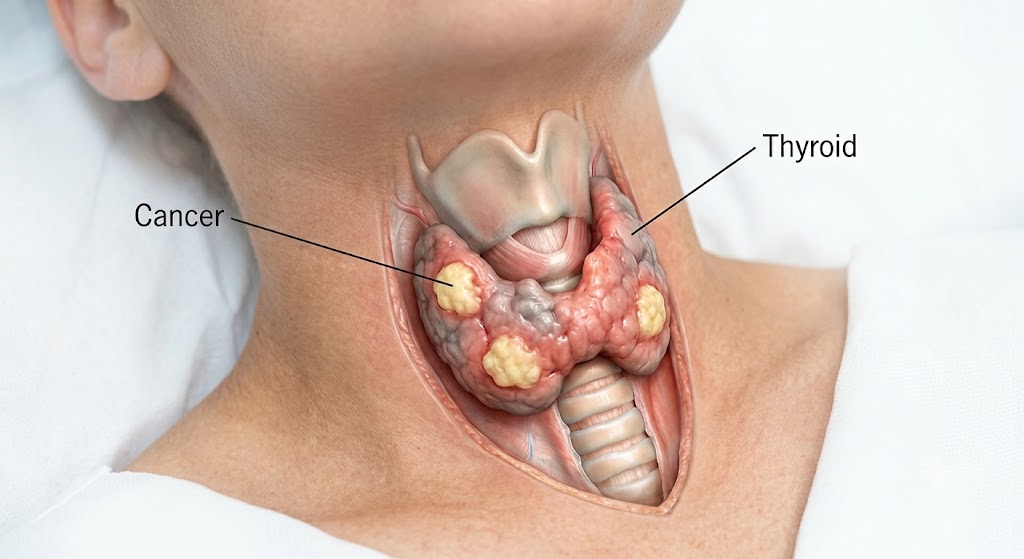
Yes, thyroid cancer frequently spreads to nearby lymph nodes in the neck, and papillary thyroid cancer does this more often than any other type. Studies show lymph node involvement in 30% to 80% of papillary cases depending on how carefully the nodes are examined. But here’s what makes thyroid cancer different from most others. Lymph node spread in papillary thyroid cancer is classified as regional disease and doesn’t dramatically change survival the way it does in most other solid tumours. Most patients with nodal involvement are still cured.
According to Dr. Sandeep Nayak, Best cancer treatment in Bangalore, “Lymph node involvement in papillary thyroid cancer is common and patients understandably panic when they hear that the cancer has spread to their neck nodes. But the biology here is different from breast cancer or colon cancer. Nodal spread in papillary thyroid cancer is managed surgically and the long-term prognosis remains excellent in the vast majority of cases.”
Found out your thyroid cancer has spread to neck nodes and want to understand what that actually means for your treatment? The prognosis is better than you probably think
Which Thyroid Cancers Spread to Lymph Nodes and How?
Not all thyroid cancers behave the same way when it comes to lymph node involvement.
- Papillary Thyroid Cancer:
The most common spreader to cervical lymph nodes. Central compartment nodes in the paratracheal region go first, then lateral neck nodes. Up to 80% of papillary cases show micrometastases on careful pathological examination of dissected nodes, though clinical nodal spread on imaging sits closer to 30% to 40%. - Follicular Thyroid Cancer:
Lymph node spread is less common than in papillary cancer. Follicular cancer tends to invade blood vessels rather than lymphatics, which is why its distant spread pattern favours lung and bone over neck nodes. So nodal involvement in follicular disease is actually a flag worth taking seriously, unlike in papillary where it’s expected. - Medullary Thyroid Cancer:
Spreads to lymph nodes early and aggressively. Up to 50% of medullary cases have nodal disease at diagnosis. And unlike differentiated thyroid cancer, nodal involvement in medullary disease does affect prognosis meaningfully. This is why central and lateral neck dissection is performed more aggressively in medullary cases. - Anaplastic Thyroid Cancer:
Almost universally involves local structures and nodes at presentation. But this is the rarest and most aggressive type, accounting for under 2% of thyroid cancers.
Thyroid Cancer Treatment decisions at MACS Clinic include pre-operative neck ultrasound and CT to map nodal disease before the operation so the surgical plan covers what’s actually there.
Does Lymph Node Spread Change Treatment and Prognosis?
For papillary thyroid cancer specifically, the answer to both questions is nuanced and different from what most patients expect.
- Surgical Management of Nodes:
When central neck nodes are involved in papillary thyroid cancer, central compartment dissection is performed at the same time as thyroidectomy. If lateral neck nodes are confirmed positive on pre-operative imaging or biopsy, lateral neck dissection is added. These are planned steps, not emergency additions. - Radioactive Iodine After Nodal Disease:
Confirmed lymph node involvement places a papillary thyroid cancer patient in an intermediate to high-risk category, which typically means total thyroidectomy followed by radioactive iodine ablation. RAI reaches residual microscopic disease in nodes that weren’t surgically cleared. - Prognosis With Nodal Disease:
In papillary thyroid cancer under 55 years of age, lymph node involvement doesn’t change the staging from low-risk in the AJCC eighth edition classification because outcome data doesn’t support it as a prognostic factor at that age. Above 55, nodal disease contributes to staging but 10-year survival remains high with proper treatment. - Surveillance After Nodal Involvement:
Patients with nodal disease need more frequent neck ultrasound after treatment than those without it. Thyroglobulin monitoring after total thyroidectomy and RAI ablation catches biochemical recurrence. Rising thyroglobulin with a suppressed TSH prompts imaging to look for nodal recurrence specifically.
Our previous blog on Papillary Follicular Thyroid Cancer is worth a read for understanding how the biology of each thyroid cancer type shapes the likelihood and pattern of lymph node spread from the outset.
Why Choose MACS Clinic for UC-Associated Colon Cancer?
Dr. Sandeep Nayak’s team at MACS Clinic maps nodal disease with ultrasound and CT before every thyroidectomy. Central compartment dissection is performed when nodes are involved or suspicious. Lateral neck dissection is added when lateral nodes are confirmed positive rather than prophylactically in all cases. The surgical plan is based on what the imaging and biopsy show, not on a blanket protocol applied to every patient.
Nodal involvement in thyroid cancer is manageable. But it requires a pre-operative plan that accounts for exactly which nodes are involved and which compartments need clearing. Those who want to discuss their specific case can reach the team at +91 8035740000.
FAQs
Does thyroid cancer spreading to lymph nodes mean it's incurable?
No. Lymph node spread in papillary thyroid cancer is common and doesn’t dramatically worsen prognosis in most patients. Most are still cured with surgery and radioactive iodine.
Which thyroid cancer is most likely to spread to lymph nodes?
Papillary thyroid cancer. Up to 80% show nodal micrometastases on careful pathological examination. Medullary thyroid cancer also spreads to nodes early and more aggressively.
What surgery is done when thyroid cancer spreads to neck nodes?
Central compartment neck dissection for paratracheal nodes. Lateral neck dissection when lateral compartment nodes are confirmed positive on imaging or biopsy.
Does radioactive iodine treat thyroid cancer in lymph nodes?
Yes, for papillary and follicular cancer. Radioactive iodine is taken up by differentiated thyroid cancer cells including those in lymph nodes and destroys residual disease after surgery.
Disclaimer: This content is published for educational and informational purposes only.