
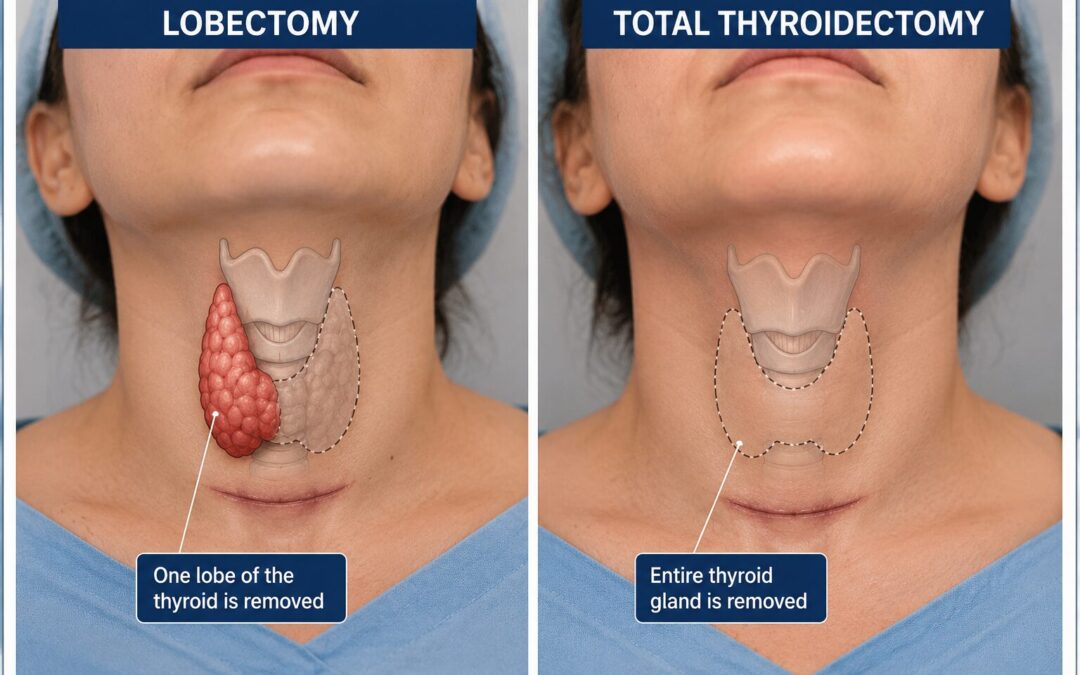
Which one applies to you? It comes down to a few things, mostly. How big the problem is, where exactly it’s sitting, what kind of thyroid cancer it turns out to be if cancer is even involved, and whether both sides of the gland show issues or just one. A total thyroidectomy takes out the whole gland, both lobes. A partial, sometimes called a lobectomy, removes just one lobe or a section, leaving the rest to keep working. Neither is automatically the right call. It genuinely depends on what’s going on inside that specific gland.
Dr. Sandeep Nayak, who provides Best Cancer Treatment in Bangalore, breaks down how the call actually gets made: “Patients assume total removal is always safer when cancer’s involved, and sometimes it is. But a small, low-risk papillary cancer confined to one lobe, with no signs on the other side, that’s a genuine candidate for lobectomy. Meanwhile a nodule that looks suspicious on both sides, or a cancer type with higher recurrence risk, pushes toward taking the whole gland. It’s never a blanket rule.”
Facing thyroid surgery and unsure which approach fits your case?
Total vs Partial Thyroidectomy: What's the Difference?
|
Total Thyroidectomy |
Partial Thyroidectomy (Lobectomy) |
|
|
What’s Removed |
Entire thyroid gland |
One lobe or isthmus section |
|
Best For |
Bilateral disease, larger cancers, higher-risk subtypes |
Small, unilateral, low-risk nodules or cancer |
|
Thyroid Function After |
Lost entirely, lifelong medication needed |
Often preserved, medication sometimes not needed |
|
Recurrence Monitoring |
Simpler, thyroglobulin tracking straightforward |
Requires monitoring remaining lobe for new issues |
|
Radioactive Iodine Option |
Available if needed |
Not typically an option with a lobe still present |
|
Recovery |
Similar surgical recovery either way |
Similar surgical recovery either way |
|
Voice Nerve Risk |
Present on both sides during surgery |
Present on one side only |
The table lays out the mechanics, but the real decision hinges on what imaging and biopsy actually show before anyone commits to an approach. More on how thyroid cancer is diagnosed and treated at MACS Clinic is on the thyroid cancer treatment page.
What Actually Determines Which Surgery Fits?
The gland itself, mostly, tells the surgeon what’s needed. Not preference, not habit.
Size and Location of the Nodule or Tumour: A small growth confined to one lobe, away from the midline, keeps lobectomy on the table. Something larger, or sitting close to structures on both sides, tends to push toward total removal instead.
Type of Thyroid Cancer, If Present: Papillary thyroid cancer, especially the low-risk kind, often allows for lobectomy when it’s small and isolated. More aggressive subtypes, or cancers with a track record of recurring, usually call for taking the whole gland to reduce that risk upfront.
Bilateral Disease: If nodules or suspicious tissue show up on both lobes, partial removal doesn’t really solve the underlying problem. Total thyroidectomy becomes the more sensible route in that situation.
Family History and Genetic Risk: Some inherited conditions raise the odds of thyroid cancer recurring or developing in the remaining tissue. In those cases, even a small, seemingly isolated tumour might warrant total removal rather than leaving healthy-looking tissue behind that carries elevated future risk.
Why Choose MACS Clinic for Thyroid Surgery?
Dr. Sandeep Nayak’s team at MACS Clinic evaluates each thyroid case individually rather than defaulting to whichever surgery feels more routine. Imaging, biopsy results, and where exactly the disease sits all factor into whether total or partial removal makes sense, so patients aren’t pushed toward losing more thyroid tissue than necessary, and aren’t left with residual risk where total removal would serve them better.
For patients who qualify, RABIT scarless thyroid surgery offers a minimally invasive approach that avoids a visible neck scar entirely, whether the procedure is total or partial. Those who want their specific case reviewed can reach the team at +91 9482202240.
FAQs
Will I need lifelong medication after a total thyroidectomy?
Yes. Without any thyroid tissue left, the body can’t produce its own thyroid hormone, so daily replacement medication becomes permanent. It’s a manageable routine for most people once the right dose is found.
Can the remaining lobe be enough after a partial thyroidectomy?
Often, yes. A single healthy lobe can produce sufficient thyroid hormone for many patients, meaning some avoid needing replacement medication altogether. This varies person to person though, and blood tests after surgery confirm how well the remaining lobe is functioning.
Is there a risk the other lobe develops problems later after a lobectomy?
There’s a small possibility, which is why monitoring continues after partial removal. Regular ultrasounds and blood work catch any new changes early if they occur.
Does total thyroidectomy always mean radioactive iodine treatment afterward?
Not always. Radioactive iodine is an option for certain thyroid cancer cases after total removal, but not every patient needs it. That decision depends on the cancer’s specific characteristics and risk of recurrence.
Disclaimer: This content is published for educational and informational purposes only.