

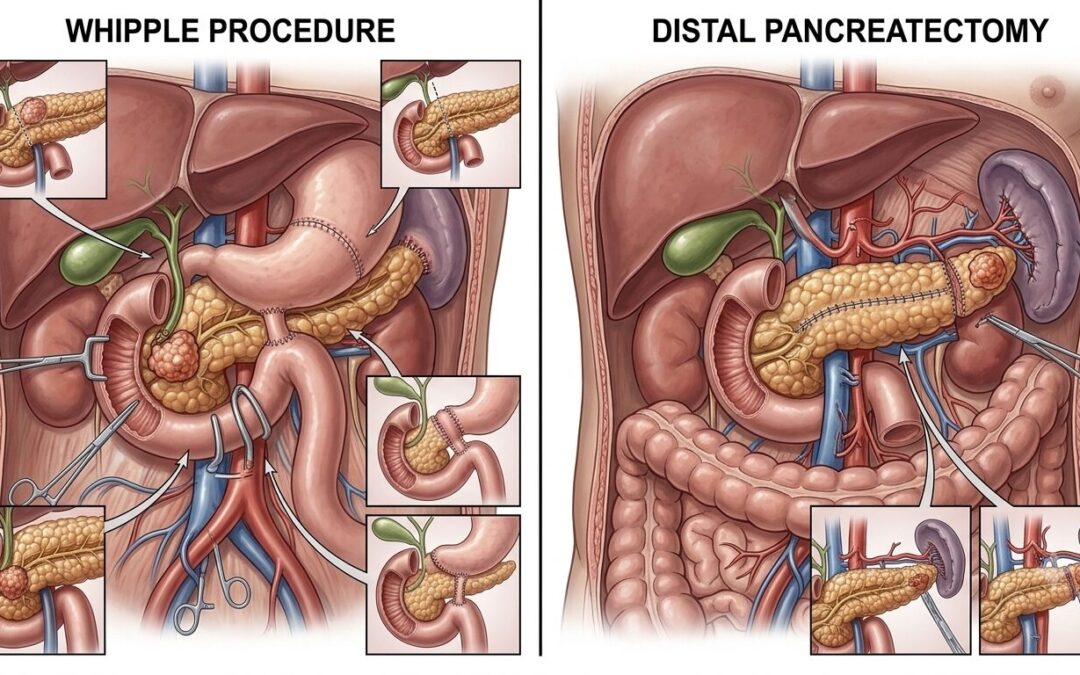
The pancreas sits tucked behind the stomach, divided loosely into three sections: head, body, and tail. Which section the tumour is in decides everything about the operation. A tumour in the head of the pancreas means a Whipple procedure removal of the head along with the duodenum, gallbladder, bile duct, and sometimes part of the stomach, followed by a complex reconstruction to reconnect the digestive tract. A tumour in the body or tail means a distal pancreatectomy removal of that section, usually with the spleen, through a comparatively simpler operation with a faster recovery.
According to Dr. Sandeep Nayak,who provides Best Cancer Treatment in Bangalore, “These aren’t two versions of the same surgery. They’re completely different operations for tumours in completely different locations. The Whipple is technically one of the most complex abdominal procedures a surgeon performs. Distal pancreatectomy is more straightforward but both require a team that does enough of them to keep complication rates where they should be.”
Want to know whether a Whipple or distal pancreatectomy is relevant to your diagnosis?
Whipple vs Distal Pancreatectomy — Side by Side?
|
Whipple Procedure |
Distal Pancreatectomy |
|
|
Tumour location |
Head of pancreas |
Body or tail of pancreas |
|
What is removed |
Head, duodenum, gallbladder, bile duct, sometimes part of stomach |
Body/tail of pancreas, usually with spleen |
|
Reconstruction |
Yes — three connections rebuilt |
Not needed |
|
Hospital stay |
7 to 14 days |
4 to 7 days |
|
Recovery |
6 to 8 weeks |
3 to 5 weeks |
|
Main risks |
Delayed gastric emptying, pancreatic fistula |
Pancreatic fistula, diabetes risk |
|
Minimally invasive |
Yes — laparoscopic and robotic |
Yes — now standard approach |
Both procedures can now be performed laparoscopically, which significantly reduces blood loss, hospital stay, and recovery time compared to open surgery — with the same oncological outcome. The pancreas and bile duct surgery page covers what each operation involves in more detail.
How Surgeons Decide Which Operation Is Needed?
Tumour location is the first and most important factor
The pancreatic head accounts for roughly 70% of pancreatic cancers — which is why the Whipple is performed more often than distal pancreatectomy. Once imaging confirms where the tumour sits, the operation is largely decided. There’s no choosing between them based on preference.
Staging determines whether surgery is possible at all
Only around 15% to 20% of pancreatic cancer patients are candidates for surgery at the time of diagnosis. CT staging, endoscopic ultrasound, and CA 19-9 levels together assess whether the tumour has invaded major blood vessels or spread beyond the pancreas. Borderline resectable cases may receive neoadjuvant chemotherapy first to shrink the tumour before surgery is attempted.
Spleen preservation in distal pancreatectomy
When the tumour is in the body or tail and hasn’t involved the splenic vessels, some surgeons can preserve the spleen reducing the long-term infection risk that comes with splenectomy. Whether this is possible depends on how closely the tumour sits to the splenic artery and vein.
Minimally invasive vs open — the surgeon’s experience decides
Laparoscopic Whipple and robotic distal pancreatectomy require significant surgical volume to be performed safely. The complication rate at low-volume centres is meaningfully higher than at experienced centres. This is one operation where where you have it done matters as much as the operation itself.
For a detailed look at the warning signs that bring patients to pancreatic surgery in the first place, the previous blog on Warning Signs of Pancreatic Cancer covers the full diagnostic pathway.
Why Choose MACS Clinic for Pancreatic Cancer Surgery?
Dr. Sandeep Nayak’s team at MACS Clinic performs both Whipple procedures and distal pancreatectomies laparoscopically and robotically. Pancreatic surgery at low volume carries higher complication rates — delayed gastric emptying, pancreatic fistula, bile leak — and managing those complications requires a team that sees them regularly enough to catch and correct them early.
Every pancreatic case goes through CT staging, endoscopic ultrasound assessment, and tumour board review before the operation is planned. Borderline resectable cases are assessed for neoadjuvant chemotherapy before surgery is committed to. The window for curative surgery in pancreatic cancer is narrow — and the team here doesn’t treat it like there’s time to spare. Reach them at +91 8035740000.
FAQs
Which is more serious — Whipple or distal pancreatectomy?
The Whipple is significantly more complex. It involves removing five structures and rebuilding three connections in the digestive tract. Distal pancreatectomy removes fewer structures, requires no reconstruction, and carries a shorter recovery. Both are major operations, but the Whipple carries higher short-term complication risk.
Can both surgeries be done laparoscopically?
Yes — both are now routinely performed laparoscopically and robotically at experienced centres. Minimally invasive pancreatic surgery reduces blood loss, hospital stay, and recovery time without compromising cancer clearance.
Will I get diabetes after pancreatic surgery?
It depends on how much functioning pancreatic tissue remains. Distal pancreatectomy removes the insulin-producing cells in the tail — new or worsened diabetes is a known long-term risk. After a Whipple, the remaining pancreatic tissue usually maintains enough function, though close monitoring is needed.
How soon after diagnosis does surgery happen?
For clearly resectable tumours, surgery is planned as soon as the patient is fit and staging is complete — usually within weeks. For borderline resectable cases, neoadjuvant chemotherapy runs for two to four months first, followed by restaging before a surgical decision is made.
Disclaimer: This content is published for educational and informational purposes only.