
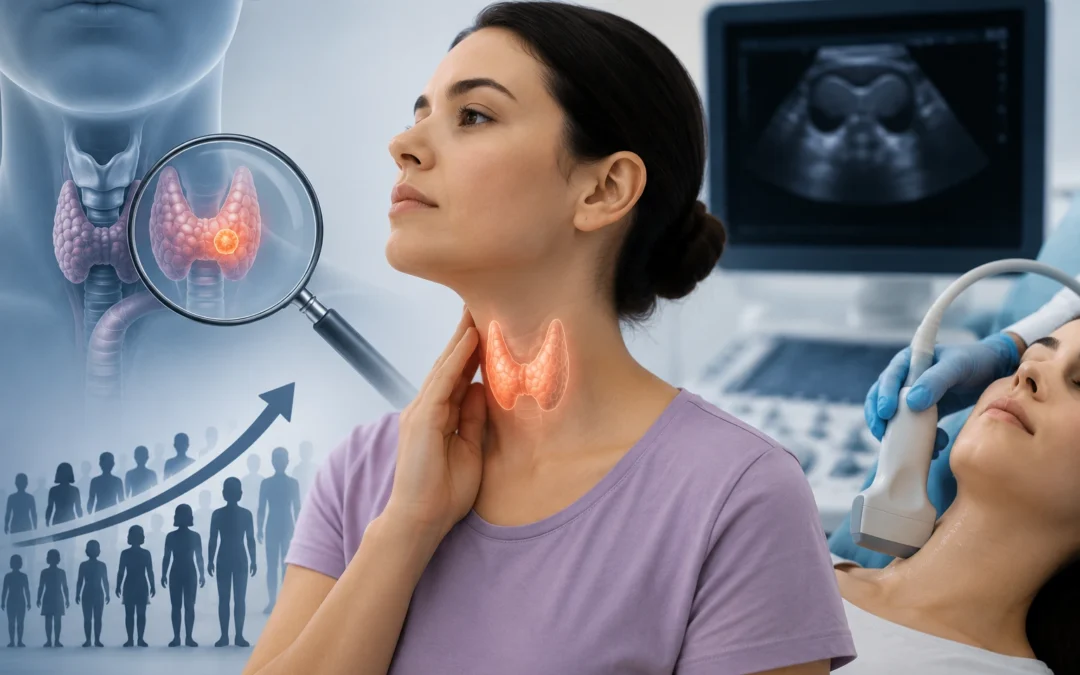
Thyroid cancer is being diagnosed more often mainly because doctors now use better and more frequent imaging tests, such as ultrasounds. These tests can find very small cancers that may never have caused problems. However, some larger and more serious thyroid cancers are also becoming more common.
According to Dr. Sandeep Nayak, Best Cancer Treatment in Bangalore, “The rise in thyroid cancer incidence is real, but what’s driving it matters enormously for how we respond to a diagnosis. A 5mm papillary microcarcinoma found incidentally on a neck ultrasound done for something else entirely is a very different clinical situation from a 3cm tumour with lymph node involvement. Both are called thyroid cancer. They are not the same problem.”
Concerned about your thyroid health? Learn the warning signs and speak with a doctor for the right evaluation.
What Is Driving the Rise in Thyroid Cancer Diagnoses?
- Better imaging & detection: More ultrasounds and scans are finding small, previously unnoticed thyroid tumours.
- Overdiagnosis: Many papillary microcarcinomas may never cause symptoms or harm, yet are diagnosed and treated.
- Some cancers are genuinely increasing: Larger tumours and certain types are rising, but the causes remain unclear. Possible factors include radiation, iodine imbalance, obesity, and insulin resistance.
- Genetic factors: Rare inherited conditions such as MEN2, familial medullary thyroid cancer, and PTEN syndromes increase individual risk.
What a Thyroid Cancer Diagnosis Actually Means for Treatment?
Most thyroid cancers are genuinely low risk
Papillary thyroid cancer, which accounts for around 85% of all thyroid cancers, is one of the most treatable cancers in oncology when caught before it has spread beyond the thyroid. Five-year survival for localised papillary thyroid cancer runs above 99%. For most patients with a small, low-risk papillary thyroid cancer, the question is not whether they will survive it. It’s whether they need surgery at all, or whether active surveillance is the right approach.
Active surveillance is now a recognised option for low-risk microcarcinomas
Papillary microcarcinomas under 1cm with no high-risk features can be monitored rather than operated on immediately in selected patients. This is not the same as ignoring cancer. It’s a deliberate evidence-based decision that avoids surgical risk and lifetime thyroid hormone replacement in patients whose tumour is unlikely to grow or spread.
Surgery remains the primary treatment for most thyroid cancers that warrant treatment
For tumours above 1cm, high-risk features including extrathyroidal extension or lymph node involvement, or patient preference, surgery is the standard approach. At MACS Clinic, Dr. Sandeep Nayak performs the RABIT technique — robotic scarless thyroid surgery through an armpit incision — which removes the thyroid without a visible neck scar. For a detailed look at what the procedure involves and what recovery looks like, the previous blog on Cost of Robotic Thyroid Surgery in Bangalore covers both the surgical approach and the financial planning in full.
Why Choose MACS Clinic for Thyroid Cancer Assessment and Surgery?
Dr. Sandeep Nayak’s team at MACS Clinic doesn’t treat every thyroid nodule finding as a surgical emergency. Nodule size, ultrasound characteristics, FNAC result, and the patient’s overall clinical picture are reviewed before any recommendation is made. Low-risk microcarcinomas get the active surveillance conversation. Tumours that genuinely need surgery get operated on through the RABIT technique where the patient is eligible, avoiding a permanent neck scar.
Every thyroid cancer case goes through a proper workup before a plan is confirmed. Those who want to discuss a thyroid nodule finding or a new thyroid cancer diagnosis can reach the team at +91 8035740000
FAQs
Is the rise in thyroid cancer diagnoses real or just better detection?
Both. Most of the increase is imaging finding small low-risk tumours that were always there. But a genuine rise in clinically significant larger thyroid cancers is also occurring, with causes that are not fully established.
Does every thyroid cancer need surgery?
No. Small papillary microcarcinomas under 1cm with no high-risk features can be managed with active surveillance in selected patients. The decision depends on tumour size, imaging features, and patient preference.
Is thyroid cancer dangerous?
Most thyroid cancers, particularly papillary type, have excellent long-term survival. Five-year survival for localised papillary thyroid cancer exceeds 99%. Anaplastic thyroid cancer is the exception, carrying a much worse prognosis.
What causes thyroid cancer?
No single cause is established. Known risk factors include radiation exposure, iodine imbalance, obesity, and certain hereditary syndromes. Most patients have no clearly identifiable risk factor.
References
- Vaccarella S et al. Worldwide thyroid-cancer epidemic? The increasing impact of overdiagnosis. New England Journal of Medicine, 2016. https://www.nejm.org/doi/full/10.1056/NEJMp1604412
- National Cancer Institute. Thyroid Cancer Treatment. https://www.cancer.gov/types/thyroid/patient/thyroid-treatment-pdq
Disclaimer:This content is published for educational and informational purposes only.