
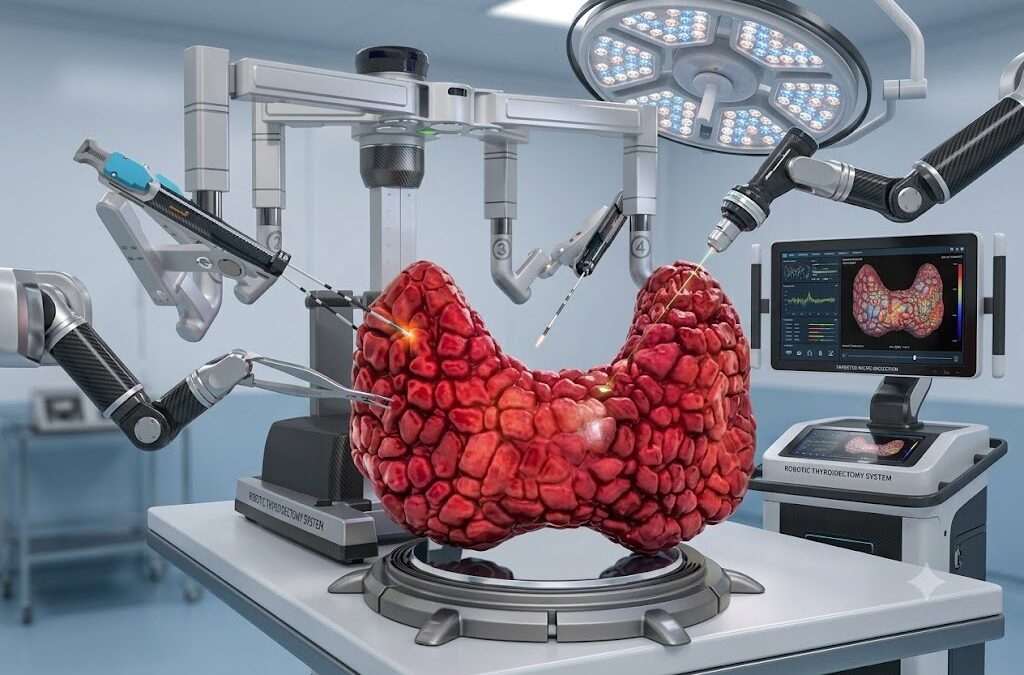
Scarless thyroid surgery removes all or part of the thyroid gland without making any incision on the front of the neck. RABIT, which stands for Robotic Assisted Breast-Axillo Insufflated Thyroidectomy, is a specific technique that accesses the thyroid through small cuts in the armpit skin fold, leaving no visible mark on the neck. It was invented and developed by Dr. Sandeep Nayak and uses the da Vinci robotic system to perform the operation with 3D magnification and articulated instruments that standard laparoscopic tools can’t replicate in that anatomical space.
According to Dr. Sandeep Nayak,who provides Best cancer treatment in Bangalore, “The neck is cosmetically sensitive. Any scar in front of the neck is visible and permanent. RABIT was developed to give patients the same oncological outcome as open surgery without that visible consequence. The robotic system’s 3D vision and wristed instruments actually improve the quality of dissection around the recurrent laryngeal nerve compared to what’s possible with standard laparoscopic tools through the same remote access approach.”
Need thyroid surgery but worried about a permanent visible neck scar? RABIT was specifically designed to solve that problem without compromising the cancer operation
How Does RABIT Surgery Actually Work?
The technique reaches the thyroid from the side rather than directly through the neck.
- Access Through the Armpit:
Three small incisions are placed in the armpit skin fold and near the breast area. These are in regions that clothing covers and that heal with minimal visible scarring. A working space is created between the chest wall and the skin using gas insufflation, which is where the “insufflated” part of RABIT comes from. - da Vinci Robotic System:
The robotic instruments are passed through the axillary incisions and navigate to the thyroid. The surgeon controls the robot from a console with magnified 3D vision that shows the thyroid, the recurrent laryngeal nerve, and the parathyroid glands more clearly than the naked eye view in open surgery. Instrument tremor is filtered out electronically. - Same Operation, Different Route:
Total thyroidectomy, hemithyroidectomy, and central compartment lymph node dissection can all be performed through the RABIT approach. The cancer operation itself follows the same oncological principles as open surgery. What changes is where the incision is, not what’s removed or how carefully it’s done. - What the Patient Experiences:
No neck scar. The small armpit incisions heal and become almost invisible within weeks. Hospital stay is typically one to two days, similar to open thyroid surgery. Voice monitoring with nerve monitoring during the operation protects the recurrent laryngeal nerve throughout. Patients go back to normal activity within two to three weeks.
Robotic Thyroidectomy through the RABIT technique is available for both benign and malignant thyroid conditions in eligible patients at MACS Clinic, Bangalore.
Who Is the Right Candidate for RABIT Surgery?
Not every thyroid patient qualifies. The technique has specific patient selection criteria that determine whether it’s appropriate.
- Tumour Size and Location:
RABIT works well for thyroid nodules and cancers that haven’t extended significantly beyond the thyroid capsule. Tumours under 4 to 5 cm that are well-defined and confined to the thyroid or with limited central nodal disease are the best candidates. Large bulky tumours with extrathyroidal extension or extensive lateral nodal disease are better managed through conventional approaches. - Body Habitus Considerations:
The technique works best in patients with a lean to average build. Significant obesity increases the distance between the axillary incision and the thyroid, making instrument reach and tissue handling technically more difficult. Surgeons who perform RABIT regularly assess this at the pre-operative consultation. - Patient Motivation for Scar Avoidance:
Many patients specifically present asking about scarless thyroid surgery because a visible neck scar affects them professionally or personally. Teachers, performers, television professionals, and young patients in particular are frequent candidates. That motivation matters because they understand and accept the slightly longer operating time the remote access approach requires. - When Open Surgery Is Still the Right Choice:
Prior neck surgery, radiation to the neck, and large cancers with vascular invasion or extensive nodal disease make RABIT technically unsuitable. Medullary thyroid cancer requiring bilateral central and lateral dissection is generally better approached through open surgery where both sides of the neck can be accessed simultaneously without repositioning.
Our previous blog on Medullary Thyroid Cancer is worth a read for understanding which thyroid cancers benefit from robotic scarless approaches and which ones are better served by conventional open thyroidectomy.
Why Choose MACS Clinic for RABIT Scarless Thyroid Surgery?
Dr. Sandeep Nayak at MACS Clinic invented the RABIT technique and has performed it in more patients than any other surgeon in India. The assessment at MACS Clinic starts with ultrasound, FNAC, and CT to confirm whether the tumour’s size, location, and nodal status make RABIT the right approach or whether open surgery gives the patient a better oncological result.
Scarless surgery is offered when it’s technically appropriate for the specific tumour, not as a default premium option for every thyroid patient who asks for it. And when it is appropriate, the oncological result is equivalent to open surgery with none of the visible neck scar that patients were once told was unavoidable. Those who want to discuss their specific case can reach the team at +91 8035740000.
FAQs
What does RABIT stand for in thyroid surgery?
Robotic Assisted Breast-Axillo Insufflated Thyroidectomy. A scarless robotic thyroid surgery technique invented by Dr. Sandeep Nayak that accesses the thyroid through the armpit without any neck incision.
Is RABIT surgery safe for thyroid cancer?
Yes, for appropriately selected cases. Cancer control, nerve preservation, and lymph node clearance outcomes are equivalent to open surgery when the technique is performed by an experienced surgeon with adequate case volume.
Who cannot have RABIT thyroid surgery?
Patients with large tumours extending beyond the thyroid capsule, prior neck surgery, neck radiation, obesity significantly increasing the working distance, or extensive bilateral nodal disease requiring wide bilateral dissection.
How long does recovery take after RABIT scarless thyroid surgery?
Hospital stay is one to two days. Return to normal activity takes two to three weeks, similar to conventional thyroid surgery. The axillary incisions heal quickly and become barely visible within a few weeks.
Disclaimer: This content is published for educational and informational purposes only.