
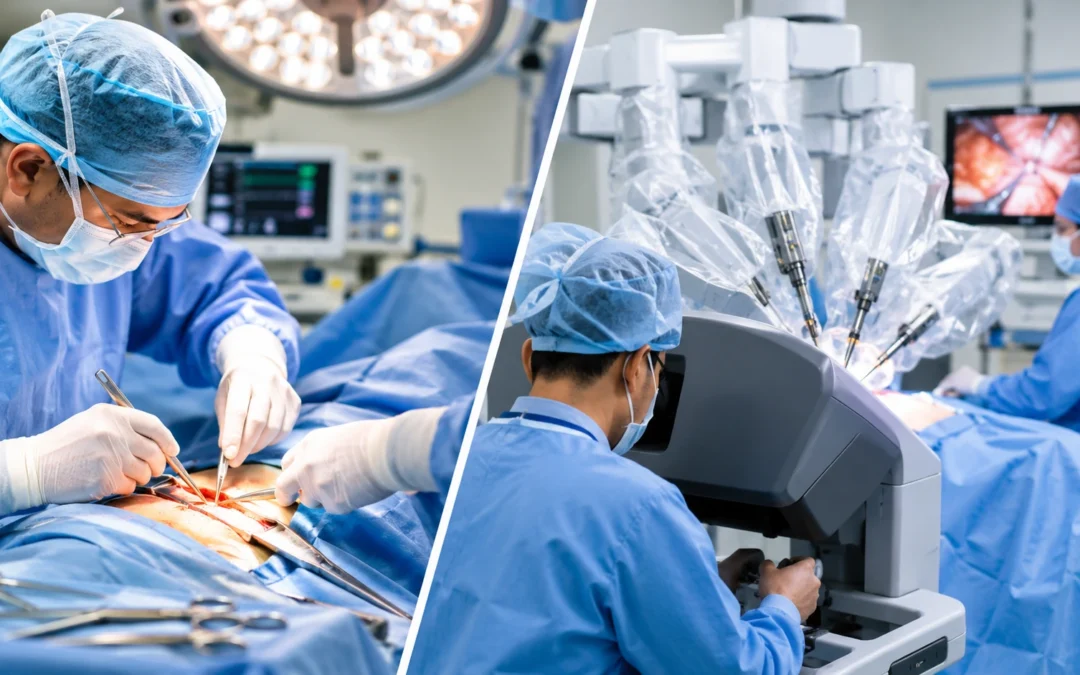
Open cancer surgery is better than robotic surgery in a few specific situations: when a tumour is very large or complex, when scar tissue or earlier treatment makes a keyhole route unsafe, when the evidence shows open surgery controls that cancer better, and when the surgeon needs direct hands-on access and a quick response to unexpected findings. For many other cancers, robotic and open surgery give similar cancer control, so the choice rests on the tumour, the patient and the surgeon’s experience.
Dr. Sandeep Nayak, who provides cancer treatment in Bangalore, at MACS Clinic, says, “Choosing open surgery isn’t a step down from robotic. For some tumours, open access gives the best chance of removing every trace of cancer, and for others the robot gives a smoother recovery with the same result. The decision rests on the size and position of the tumour, what the evidence shows for that cancer, and how much scar tissue is in the way.”
For how the two compare on recovery, see Open Surgery vs Robotic Surgery Healing
When Is Open Cancer Surgery Better Than Robotic Surgery?

- When the evidence favours open surgery. The clearest example is early cervical cancer. In the LACC trial, disease-free survival at 4.5 years was 96.5% with open radical hysterectomy and 86.0% with the keyhole approach, and many guidelines now favour open surgery for it. Some experts question details of the trial, and studies are looking at small, low-risk tumours.
- Very large or bulky tumours. A big tumour has to come out through a cut anyway, so the keyhole route can add time without adding much benefit.
- Tumours growing into nearby structures. When a tumour has invaded a blood vessel, the chest wall or a neighbouring organ, the surgeon may need direct control and room to repair or reconstruct.
- Heavy scar tissue from earlier treatment. Previous operations or radiation can fuse organs together, and freeing them through small ports is slow and riskier. The post on being a good candidate for robotic cancer surgery covers this.
- When touch and quick control matter. Open surgery lets the surgeon feel the tissue and stop bleeding fast, and extend the operation at once if the findings are worse than the scans suggested.
- Patients who can’t cope with the set-up. Keyhole surgery often needs gas in the abdomen and a steep head-down position, which some people with serious heart or lung disease may not tolerate.
When Is Robotic Surgery Still a Good Choice?

- Many cancers show similar cancer control. For several cancers, such as rectal, prostate and kidney cancer, studies generally show control similar to open surgery in experienced hands, though this varies from cancer to cancer.
- Recovery is usually quicker. Smaller cuts mean less pain and often a shorter hospital stay, as described on the page about robotic surgery for cancer.
- Less blood loss is common. This isn’t guaranteed, but it’s one of the more consistent advantages.
- Open surgery has a long track record. It leaves a bigger wound, more pain and a longer stay, but it has been used for generations and remains the standard for some operations.
- Switching to open is part of the plan. Surgeons sometimes convert mid-operation for safety, and a good surgeon tells you the likelihood beforehand.
- The surgeon’s experience counts. It’s reasonable to ask how often your surgeon performs your operation by each route.
For a lung cancer example of the same question, the previous blog on VATS vs open surgery for lung cancer is a good next read.
What Determines When Open Cancer Surgery Is Better Than Robotic Surgery?
- The cancer type and the evidence. Some cancers have trial results that favour one approach, while others show no clear difference.
- The size and position of the tumour. Large tumours, or ones close to vital structures, change which route is safest.
- Earlier surgery or radiation. Scar tissue and damaged tissue make keyhole work harder.
- The patient’s fitness. Heart and lung health affect how well the body copes with each approach.
- The surgeon’s and centre’s experience. Results depend on how often the team does the operation by that route.
- Review by the whole team. Surgery, medical oncology, radiation oncology and radiology looking at the same case before a plan is fixed.
- Risks and limits. Open surgery means more pain, a longer stay and a higher chance of wound problems and hernias. Robotic surgery can take longer and may need converting to open, and neither approach can promise a cure.
Key Takeaway
Open surgery is better in a few situations, such as early cervical cancer, very large or invasive tumours and heavy scar tissue, while for many other cancers robotic surgery gives similar cancer control with an easier recovery. The right route depends on the cancer, the evidence for it and your surgeon’s experience. Questions about your own operation are best discussed with your treating surgeon.
Frequently Asked Questions
1.Is open surgery safer than robotic surgery?
Neither is safer for every case. It depends on the tumour and the surgeon.
2.Does robotic surgery give worse cancer outcomes?
For most cancers, not in experienced hands, but early cervical cancer is a key exception.
3.Can a robotic operation turn into open surgery?
Yes, if the surgeon decides it’s safer.
4.Can I ask which approach my surgeon recommends and why?
Yes. It’s a reasonable question and a good surgeon will explain.
Disclaimer
This article is for patient education only. It is not medical advice and does not replace consultation with a qualified doctor. The best approach, risks and outcomes differ for each person.
References:
- Ramirez PT et al. Minimally Invasive versus Abdominal Radical Hysterectomy for Cervical Cancer. New England Journal of Medicine, 2018
- Comparing Survival Outcomes With Minimally Invasive and Open Surgical Approaches to Early-Stage Cervical Cancer. The ASCO Post
- National Cancer Institute. Surgery to Treat Cancer