
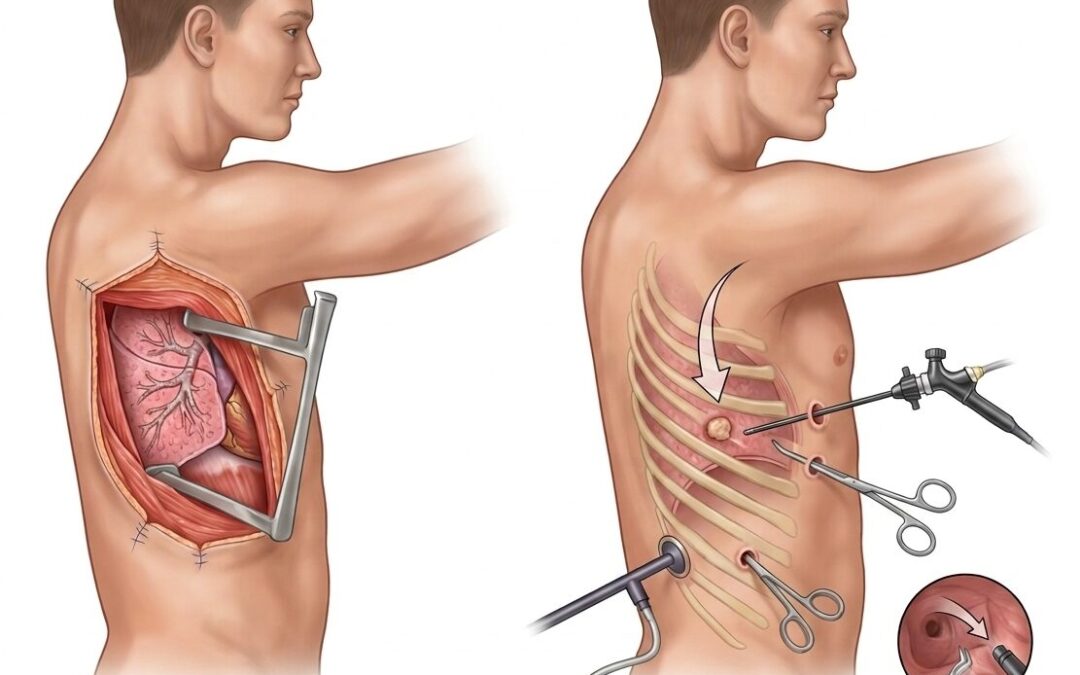
For early-stage lung cancer, VATS is generally the preferred approach and has been for a while now. The evidence on survival is clear enough outcomes are equivalent to open surgery for appropriately selected patients, and in some studies marginally better because patients recover faster and tolerate any additional treatment that follows more easily.But VATS isn’t always the answer. Tumour size, location within the lung, involvement of surrounding structures, and whether lymph nodes need to be accessed all feed into whether a minimally invasive approach is technically feasible for a particular case. Some tumours simply require open surgery to be removed adequately. The preference for VATS is real and evidence-based. It isn’t a blanket rule that applies regardless of what the CT scan shows.
Dr. Sandeep Nayak, who provides Best Cancer Treatment in Bangalore, explains how this decision actually gets made: “VATS is our starting point for resectable lung cancer. Smaller incisions, less pain, faster recovery, and patients get to any post-operative chemotherapy sooner because they’re not still recovering from a thoracotomy. But the tumour has to allow it. A centrally located tumour involving the main bronchus or major vessels isn’t a VATS case regardless of preference. The surgery has to match what the anatomy requires.”
Facing lung cancer surgery and want to understand which approach fits your case?
VATS vs Open Surgery: What's the Difference?
|
VATS |
Open Surgery (Thoracotomy) |
|
|
Incisions |
2 to 4 small ports |
Single large chest incision |
|
Rib Spreading |
None |
Required, causes significant pain |
|
Blood Loss |
Lower |
Higher |
|
Hospital Stay |
3 to 5 days |
5 to 10 days |
|
Pain After Surgery |
Significantly less |
More significant, longer lasting |
|
Recovery Time |
3 to 4 weeks |
6 to 8 weeks |
|
Cancer Control |
Equivalent for early stage |
Standard for complex or central tumours |
|
Starting Chemo After |
Sooner, within 4 to 6 weeks |
Often delayed by slower recovery |
|
Suitable For |
Early stage, peripheral tumours |
Central, large, or complex tumours |
The table captures the practical differences but the clinical decision isn’t made from a table. It’s made from the CT scan, the PET findings, the bronchoscopy results, and what the surgical team finds when they actually look. More on how lung cancer is staged and treated at MACS Clinic is on the lung cancer treatment page.
When Is VATS Used and When Is Open Surgery Needed?
The answer comes from the tumour, not the surgeon’s preference.
VATS Works Best When: The tumour is in the outer part of the lung, away from the central airways and major blood vessels. Stage 1 and Stage 2 lung cancers without major structural involvement are the clearest VATS candidates. Wedge resection of a small peripheral nodule, lobectomy for a contained lobe tumour both are routinely done with VATS at experienced centres. Patients who are older or have reduced lung function also benefit specifically from VATS because the physiological stress of a thoracotomy is simply too much for some. Our blog on can elderly patients tolerate robotic cancer surgery covers how minimally invasive approaches change what’s surgically possible for older patients.
Open Surgery Is Needed When: The tumour is centrally located near the main bronchus, pulmonary artery, or other major structures that require direct surgical access. Tumours that have grown into the chest wall or involve the pericardium need open surgery to achieve adequate resection. Sleeve resections, where a segment of the bronchus is removed and reconstructed, are technically demanding procedures that most centres still perform open. Conversions from VATS to open also happen when bleeding or anatomical difficulty requires it this is a safety measure, not a failure.
Robotic Thoracic Surgery: Worth mentioning because it sits between VATS and open in terms of capability. Robotic platforms give surgeons greater instrument articulation and a 3D magnified view that can make technically challenging resections feasible minimally invasively when standard VATS would require conversion to open. For complex hilar dissection or sleeve resections at experienced robotic centres, robotics extends the reach of minimally invasive surgery beyond what straight VATS allows.
Non-Surgical Patients: Not everyone with lung cancer is a surgical candidate. Patients with poor lung function, significant cardiovascular disease, or disease that’s too advanced for resection are treated with stereotactic ablative radiotherapy (SABR), systemic therapy, or a combination. The surgical decision only applies to patients where resection is on the table at all. Our blog on can non-smokers get lung cancer covers the range of treatment approaches relevant to different lung cancer presentations.
Why Choose MACS Clinic for Lung Cancer Surgery?
Dr. Sandeep Nayak’s team at MACS Clinic approaches lung cancer surgery with VATS and minimally invasive techniques as the default where the tumour anatomy allows. Every lung cancer case is reviewed by surgical oncology, medical oncology, and radiation oncology together before a treatment plan is made. For patients where molecular profiling identifies EGFR, ALK, or other targetable mutations, the surgical plan and any post-operative treatment are built around that biology from the start.
The goal is always the approach that gives the best cancer control with the least physiological cost to the patient. For most early-stage lung cancers, that means VATS. For tumours that require more, open surgery is performed without compromise to the oncological result. Those who want to understand which approach applies to their specific tumour can reach the team at +91 9482202240.
FAQs
Is VATS as effective as open surgery for lung cancer?
For early-stage peripheral tumours, yes. Survival data is equivalent and sometimes better because faster recovery gets patients to chemotherapy sooner. Central tumours involving major structures still need open surgery the anatomy decides, not the preference.
How long does recovery take after VATS?
Three to five days in hospital, three to four weeks to normal activity. Open thoracotomy is five to ten days in hospital and six to eight weeks to full recovery. That difference is one of the main reasons VATS is preferred when it’s an option.
Can the surgeon switch to open surgery mid-procedure?
Yes, and it happens. Unexpected bleeding or difficult anatomy makes continuing with VATS unsafe sometimes. Converting to open is the right call in that situation, not a complication.
Does lung function affect which surgery is possible?
Significantly. Poor baseline lung capacity may mean a smaller wedge resection rather than removing a full lobe, or surgery isn’t viable at all. Pulmonary function testing before any lung cancer surgery is standard.
Disclaimer: This content is published for educational and informational purposes only.