
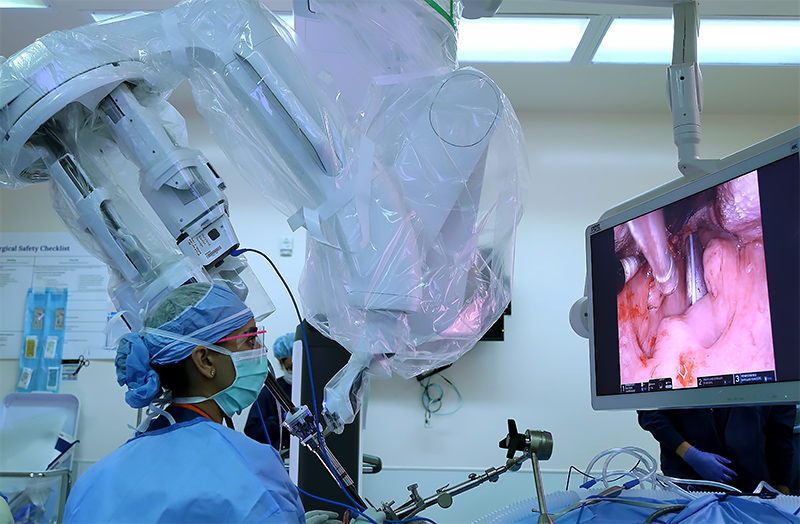
TORS stands for Transoral Robotic Surgery, a robotic technique that removes throat cancers through the mouth using Da Vinci instruments without cutting the neck or splitting the jaw. Oropharyngeal cancers including the base of tongue tumors, tonsil cancers, and selected hypopharyngeal cancers are the primary targets. Robotic arms with wristed tips and 3D camera access the tight space inside the throat where open surgery would need a mandibulotomy or pharyngotomy to reach the same tumor.
According to Dr. Sandeep Nayak, Oral Cancer Treatment in Bangalore, “Open throat surgery meant splitting the jaw to get to the tumor. TORS goes through the mouth and takes the cancer out without breaking a single bone. Patient keeps their jaw and starts eating days later instead of weeks.”
Throat cancer out through your mouth, jaw intact, swallowing preserved.
How Does TORS Work?
Open throat cancer surgery needs mandibulotomy or pharyngotomy with large neck incisions. TORS skips all of that using the mouth as the surgical corridor.
- Transoral access: Robotic arms enter through the mouth. No neck cut, no jaw split, no tracheostomy in most cases. Tumor comes out and the face looks exactly the same as it did before the operation started.
- Wristed instruments: Da Vinci tips bend and rotate inside tight oropharyngeal space where straight instruments physically can’t work. Console gives the surgeon 10x magnified 3D view separating tumor from normal tissue at margins the naked eye would miss in open surgery.
- Swallowing preserved: Only diseased tissue gets removed. Healthy muscle layers stay intact because TORS doesn’t cut through them to reach the tumor. Patients eat within days. Open surgery patients spend weeks on feeding tubes because the access wound disrupts swallowing mechanics.
- Neck dissection added: Lymph nodes need clearing, TORS handles the primary tumor while MIND technique or a small separate incision handles the neck. Both done same sitting, both minimally invasive.
Your oncologist checks TORS feasibility based on tumor size, location, and mouth opening through oral cancer treatment assessment.
Who Qualifies for TORS?
TORS fits specific throat cancers in specific locations. Not every head and neck cancer qualifies and forcing transoral access on a tumor that needs open exposure is poor judgment wearing a technology mask.
- Oropharyngeal cancers: Tonsil and base of tongue tumors are the primary candidates. T1 and T2 stage respond best. Some T3 tumors qualify depending on location and whether margins are achievable transorally without wrecking swallowing function in the process.
- HPV-positive disease: HPV-related oropharyngeal cancers tend to be smaller, well-defined, and respond well to TORS followed by reduced-dose radiation. De-escalation protocols for HPV-positive patients aim to cure while keeping long-term swallowing and voice side effects as low as possible.
- Mouth opening matters: Robotic instruments and camera need space to enter and move. Trismus from previous radiation or naturally tight jaw limits TORS feasibility. Surgeon checks this at the first visit because discovering the mouth won’t open wide enough after anesthesia is a problem nobody wants mid-operation.
- Not suitable: T4 tumors invading mandible, pterygoid muscles, or carotid space. Advanced laryngeal cancers. Total glossectomy cases. These need open access because TORS can’t achieve safe clearance in anatomy that extensive and pretending otherwise puts the patient at risk.
Knowing how RABIT surgery reaches thyroid cancer through remote access helps appreciate why TORS follows the same logic of reaching tumors through smarter routes instead of bigger cuts.
Why Choose MACS Clinic?
Dr. Sandeep Nayak has performed TORS for head and neck cancers at a volume most Indian centers haven’t matched and offers TORS, RABIT, MIND, and RIA-MIND under one surgical team. MACS Clinic picks the right technique for the right tumor instead of offering whatever the available surgeon happens to know.
Throat cancer conversation starts here with which approach saves the most function while clearing disease completely. Not what fits the hospital schedule or what equipment happens to be free that week.
Call +91 8035740000 to book your consultation.
FAQs
Does TORS require any external incision?
No, robotic instruments enter through the mouth with zero external cuts.
How long does TORS surgery take?
Typically 1-3 hours depending on tumor size and neck dissection addition.
Can I eat normally after TORS?
Most patients resume oral diet within days, much faster than open surgery.
Is TORS available for all throat cancers?
No, works best for T1-T2 oropharyngeal cancers with adequate mouth opening.
References
- Transoral robotic surgery for oropharyngeal cancer — National Cancer Institute
- Head and neck cancer surgical approaches — World Health Organization
Disclaimer: Reference links are for informational purposes only and not a substitute for professional medical advice or treatment.