

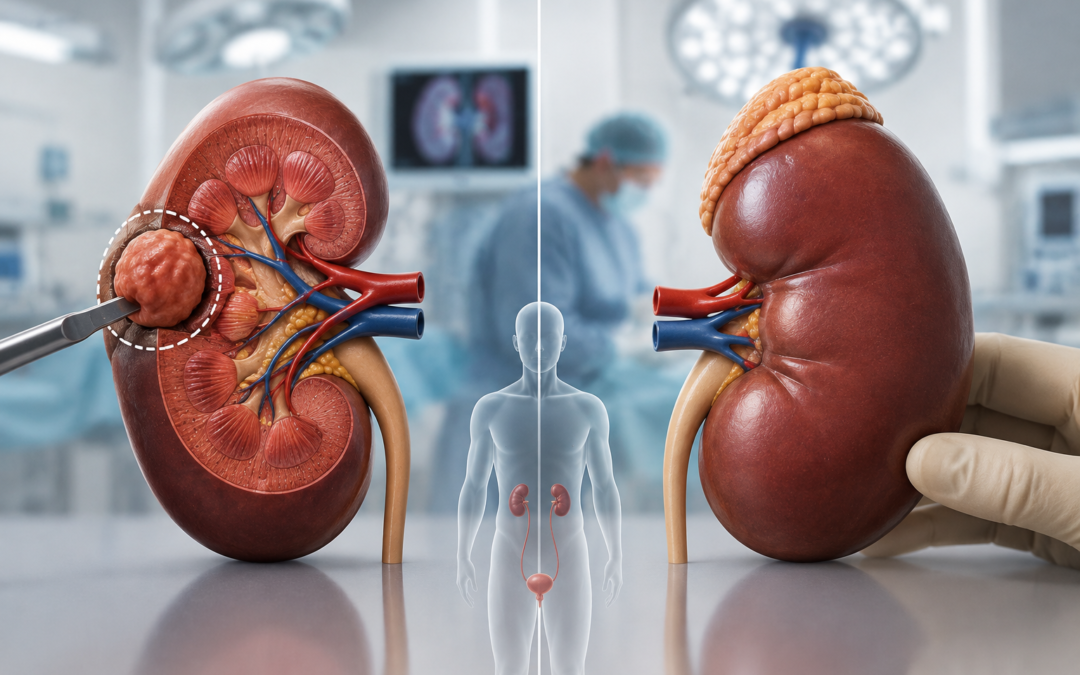
Partial nephrectomy tends to be the preferred route for small, localised kidney tumours, mainly because it leaves healthy kidney tissue behind and protects long term kidney function. But neither option is universally better, and framing it that way misses the point. The tumour’s size, where exactly it’s sitting, and how complex the case is, that’s what actually decides which surgery fits, not a general preference for keeping more tissue.
Dr. Sandeep Nayak, Best Cancer Treatment in Bangalore, puts it plainly: “Patients often come in having read that partial is the better option, and it can be, for the right tumour. But a large tumour, one wrapped around major vessels, or one that simply can’t be safely separated from healthy tissue, needs radical removal instead. The surgery follows the tumour, not the other way around.”
Trying to understand which surgery applies to your specific tumour?
Partial vs Radical Nephrectomy: A Side-by-Side Comparison?
|
Partial Nephrectomy |
Radical Nephrectomy |
|
|
What’s Removed |
Tumour plus a margin of healthy tissue |
Entire kidney |
|
Kidney Function After |
Largely preserved |
Remaining kidney takes over full function |
|
Best Suited For |
Small, localised tumours away from central structures |
Large tumours, central location, involvement of major vessels |
|
Long-Term Kidney Health |
Lower risk of chronic kidney disease later |
Higher long-term reliance on the remaining kidney |
|
Cancer Control |
Equivalent to radical for appropriate tumours |
Standard for tumours partial removal cannot safely address |
|
Recovery |
Generally faster |
Slightly longer depending on tumour size |
|
Availability |
Not every tumour qualifies |
Available regardless of tumour complexity |
The table lays out the mechanics, but it doesn’t decide anything on its own. What matters is whether a specific tumour actually meets the criteria for partial removal in the first place. Our blog on who is a candidate for partial nephrectomy covers exactly what those criteria look like in more detail.
Why Isn't Partial Always the Better Choice?
This is where the “which is better” framing tends to break down.
Tumour location rules out some cases entirely. A tumour buried near the central collecting system or wrapped around major blood vessels often can’t be removed without taking the whole kidney, regardless of how much healthy tissue a surgeon would prefer to preserve.
Size still matters, even with modern technique. Larger tumours increase the technical difficulty of achieving clear margins during partial removal, and beyond a certain point, radical removal becomes the safer, more reliable option.
Cancer control comes first, always. Preserving kidney tissue is genuinely valuable, but not at the cost of leaving cancer behind. If partial removal can’t guarantee clear margins, that preference for preservation gets set aside.
Long-term kidney health still favours partial when it’s possible. For patients where both options are genuinely viable,partial nephrectomy generally reduces the long-term risk of reduced kidney function, which matters considerably over decades, not just the immediate recovery period.
Why Choose MACS Clinic for Kidney Cancer Surgery?
Dr. Sandeep Nayak’s team at MACS Clinic makes this decision based on imaging, tumour location, and complexity, not a default preference toward one surgery over the other. Every case gets evaluated on whether partial removal can genuinely achieve complete cancer control before it’s offered as an option.
For patients where radical nephrectomy is necessary, robotic and minimally invasive techniques are still used wherever appropriate to reduce recovery time. Wondering which surgery actually applies to your specific tumour? Reach the team at +91 9482202240.
FAQs
Is partial nephrectomy always possible if the tumour is small?
Usually, but not always. Size matters, but location matters just as much. A small tumour in a difficult position can still require radical removal, while a slightly larger one in an accessible spot might still qualify for partial.
Does losing a kidney entirely mean dialysis later?
Not typically. One healthy kidney is usually sufficient for normal life, and most people do well with a single functioning kidney after radical nephrectomy.
Can a surgeon decide mid-operation to switch from partial to radical?
Yes, occasionally. If the tumour turns out more complex than imaging suggested, or margins can’t be safely achieved, the surgical team may convert to radical removal during the procedure itself.
Which option has better long-term survival outcomes?
For appropriately selected tumours, cancer control outcomes are equivalent between the two. The main long-term difference lies in kidney function, not survival from the cancer itself.
Disclaimer: This content is published for educational and informational purposes only.