

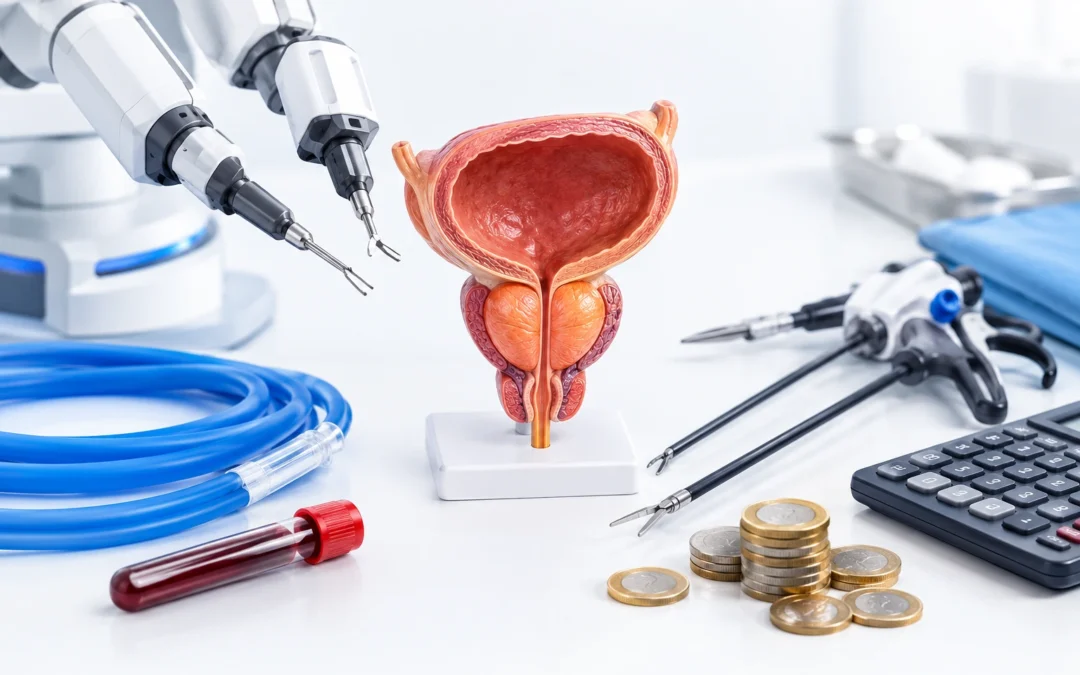
Most families asking this question have just received a diagnosis and are trying to understand what they’re looking at financially before anything else. Prostate cancer surgery in Bangalore ranges from Rs 1,87,000 for standard open radical prostatectomy to Rs 5,00,000 and above for robotic-assisted surgery. Comprehensive packages including diagnostics and follow-up run Rs 2,75,000 to Rs 9,50,000 depending on the centre and what the treatment involves.
According to Dr. Sandeep Nayak, Best Cancer Treatment in Bangalore, “The cost of prostate cancer surgery isn’t just about which hospital you choose. It’s about which approach is right for your stage, your anatomy, and your priorities around functional recovery. A robotic prostatectomy costs more. But for a man who wants the best chance of preserving continence and sexual function, that cost difference needs to be weighed against what those outcomes are worth to him over the next 20 or 30 years.”
A written cost estimate comes before the surgery date is fixed, not after admission?
What the Cost Actually Covers and What It Doesn't?
The quoted surgical cost typically includes surgeon and anaesthetist fees, operation theatre charges, robotic system usage where applicable, hospital stay of one to two days, and post-operative medications during admission.
|
Cost Component |
What It Includes |
|
Surgeon and anaesthetist fees |
Primary surgeon, assistant, and anaesthetist for the procedure |
|
Operation theatre charges |
OT usage, instruments, robotic equipment where applicable |
|
Hospital stay |
Usually one to two days for robotic or laparoscopic, two to three for open |
|
Pathology |
Surgical specimen examination, Gleason grading, margin status |
|
Consumables |
Sutures, drains, post-operative medications during admission |
What is not included in most surgical estimates: pre-operative investigations including PSA, MRI prostate, bone scan where indicated, biopsy if not already done, anaesthesia assessment, post-operative hormone therapy if required, and radiation if adjuvant treatment follows. These vary significantly by case and need to be budgeted separately.
For a broader look at how prostate cancer is staged and how the surgical decision fits into the overall treatment plan, that context matters before any cost conversation starts.
What Actually Decides Where Your Case Falls in That Range?
Why Choose MACS Clinic for Prostate Cancer Surgery?
Dr. Sandeep Nayak’s team at MACS Clinic performs robotic radical prostatectomy as the standard approach for localised prostate cancer not as a premium option offered to selected patients, but as the default where the anatomy and stage allow. Written cost estimates are provided before the surgery date is confirmed. Insurance coordination is handled before admission, not on discharge day when there’s no room to plan around what’s covered.
Every prostate cancer case goes through staging review and tumour board assessment before surgery is planned. PSA, MRI prostate, biopsy Gleason score, and the patient’s priorities around functional recovery all inform the surgical approach. Those who want a cost estimate for their specific case can reach the team at +91 8035740000.
FAQs
What is the cost of robotic prostate cancer surgery in Bangalore?
Robotic radical prostatectomy at MACS Clinic runs between Rs 3,50,000 and Rs 5,00,000. What pushes it toward the higher end is nerve-sparing complexity and whether lymph node dissection is needed alongside.
Is robotic prostatectomy covered by health insurance in India?
Depends entirely on the policy. Most insurers cover prostate cancer surgery whether robotic specifically is covered, and up to what sub-limit, varies. Worth checking before the surgery date is fixed, not after.
How long is the hospital stay after prostate cancer surgery?
Robotic or laparoscopic one to two days. Open surgery runs two to three. Most men are back to light activity within two to three weeks of robotic prostatectomy.
Does robotic surgery give better functional outcomes than open surgery?
For surgeons who do enough of them, yes. Less blood loss, faster return of continence, better nerve preservation. The difference shows up most clearly in quality of life over the months after surgery, not just the operation itself.
References
- HexaHealth – Robot-Assisted Prostatectomy Cost in Bangalore — provides an estimated Bangalore range and factors affecting cost. HexaHealth – Robot-Assisted Prostatectomy Cost in Bangalore
- Practo – Prostate Cancer Treatment Cost in Bangalore — gives an overall estimate for prostate cancer treatment in Bangalore. Practo – Prostate Cancer Treatment Cost
Disclaimer:This content is published for educational and informational purposes only.