

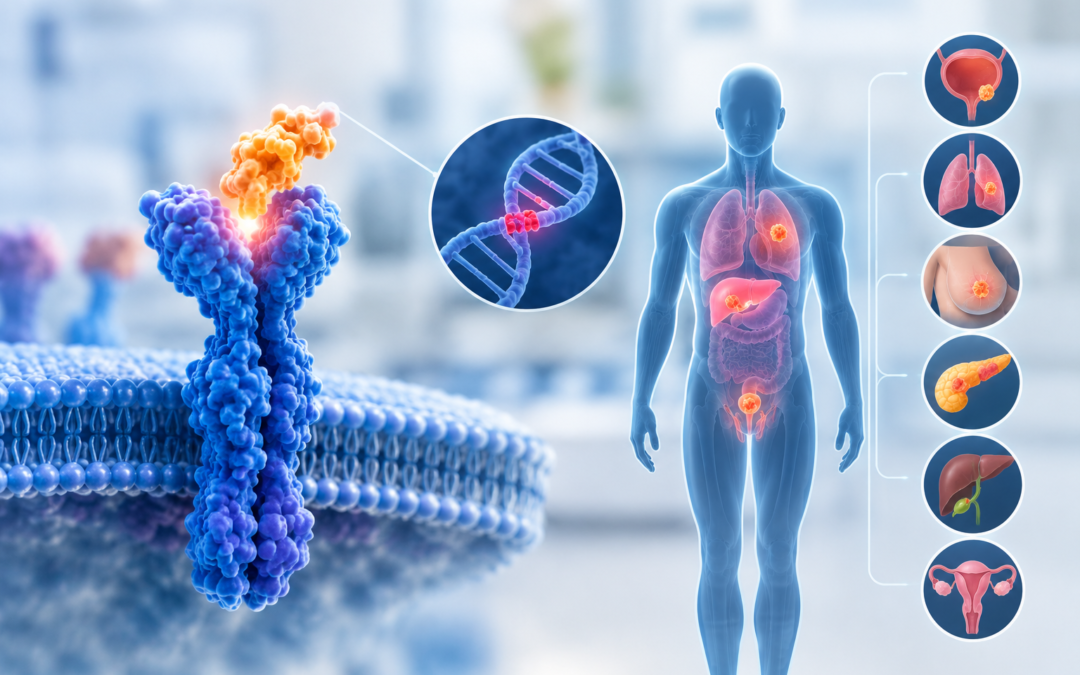
It’s a fault in a growth switch. FGFR stands for fibroblast growth factor receptor, a family of four genes, FGFR1 to FGFR4, whose job is to help control cell growth, blood vessel formation and tissue repair. When one of them is mutated, amplified or fused with another gene, the switch gets stuck on. The cell keeps getting told to grow and divide, and it never gets the message to stop. That is what turns a normal repair signal into a driver of cancer.
Dr. Sandeep Nayak, who provides cancer treatment in Bangalore, says most patients have never heard of it until the report arrives. “They see FGFR on a molecular report and have no idea whether it’s good news or bad. It’s useful news, really. It means the tumour has a specific driver, and for some cancers there are drugs built to block exactly that driver. You can only act on it if someone has looked.”
Got a molecular report with FGFR on it and unsure what it means?
Which Cancers Are Affected by FGFR Mutations in Cancer?
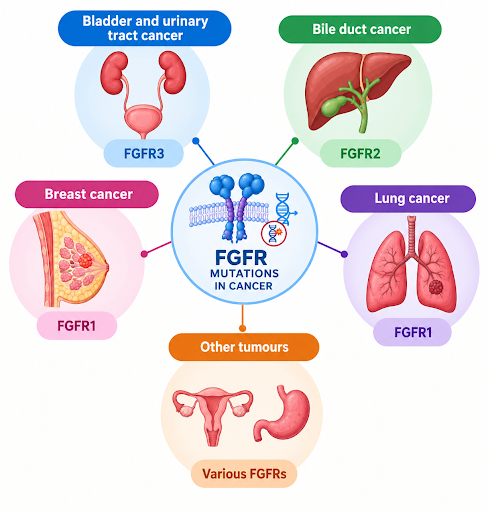
FGFR mutations in cancer turn up across several tumour types, and the gene involved differs between them.
Bladder and urinary tract cancer. FGFR3 changes are common here and are among the best known.
Bile duct cancer. FGFR2 fusions are found in a share of cholangiocarcinomas. Our blog on cholangiocarcinoma and how it is treated covers this cancer in more detail.
Breast cancer. FGFR1 amplification appears in some cases.
Lung cancer. Some squamous lung cancers carry FGFR1 changes.
Other tumours. Endometrial, stomach and a few other cancers carry them less often. How common it is depends on the cancer.
How Is an FGFR Gene Mutation Found and Treated?
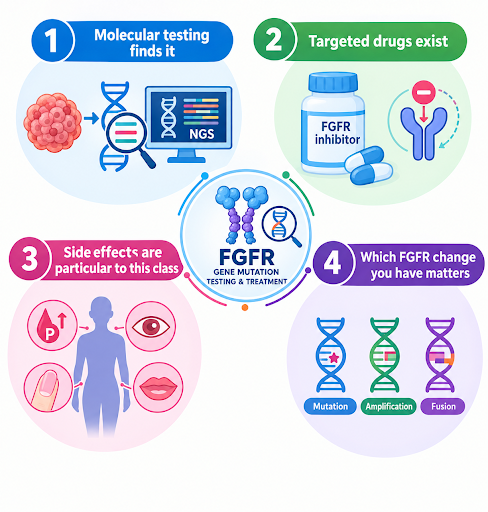
An FGFR gene mutation cannot be seen on a scan. It has to be looked for in the tumour.
Molecular testing finds it. NGS testing reads the tumour’s genes and shows which FGFR change is present, and whether it is a mutation, amplification or fusion.
Targeted drugs exist. FGFR inhibitors are approved for some cancers, such as certain bladder and bile duct tumours. They are used for specific patients, not everyone with a mutation.
Side effects are particular to this class. High phosphate levels, eye and nail problems and dry mouth are examples, so monitoring matters.
Which FGFR change you have matters. A fusion, a mutation and an amplification do not all respond the same way. Our blog on immunotherapy vs targeted therapy explains how that choice gets made.
What Determines the Right Treatment Approach?
There’s no single answer for everyone with an FGFR mutation. A few things decide what makes sense:
- The type of cancer. FGFR drugs are approved for particular cancers, such as certain bladder and bile duct tumors. Finding the same change in a cancer without an approved drug doesn’t automatically mean there’s a matching treatment.
- Exactly which FGFR change it is. A fusion, a mutation and an amplification can behave differently, and so can FGFR2 and FGFR3. Your molecular report names the exact change, and that detail matters more than the word “FGFR” alone.
- What’s been tried so far. In some cancers, FGFR inhibitors are used after earlier treatment such as chemotherapy has stopped working. How your cancer has responded already shapes what comes next.
- Your general health and tolerance. These drugs can raise phosphate levels and affect the eyes, nails and mouth, so your kidneys, eyesight and ability to attend regular monitoring all count.
- Other changes in the tumor, and trials. Other gene changes can influence the options, and a clinical trial may fit better than a standard drug. That’s part of why precision oncology testing looks at the whole molecular picture, not one gene.
Key Takeaways
- An FGFR mutation means the tumor has a specific driver, and for some cancers a drug exists to block it.
- FGFR changes can’t be seen on a scan. They have to be found by molecular testing of the tumor.
- A fusion, a mutation and an amplification don’t all respond the same way, so the exact change matters.
- FGFR inhibitors are approved only for some cancers, such as certain bladder and bile duct tumors, and they have side effects that need monitoring.
- For questions about your own molecular report, you can contact the clinic at +91 9482202240.
FAQs
Is an FGFR mutation inherited?
Usually not. Most FGFR changes in cancer develop in the tumour itself and are not passed down in families.
Does having an FGFR mutation mean a drug will work?
Not automatically. It depends on the cancer type and on which kind of FGFR change is present.
Is FGFR testing done for every cancer patient?
Not for everyone. It is done for cancers where the result can change treatment
Can an FGFR mutation be found on a blood test?
Sometimes. A liquid biopsy can pick up tumour DNA, though tissue testing is often more complete.
Reference
-
Targeting FGFR for Cancer Therapy Explains FGFR gene alterations, how they contribute to cancer development, which cancers they affect, and the role of targeted therapies. Link: https://pmc.ncbi.nlm.nih.gov/articles/PMC11149307/
2. Current Progress in Cancer Treatment by Targeting FGFR Signaling Reviews FGFR mutations and other alterations in bladder, endometrial, breast, and other cancers, along with current treatment approaches. Link: https://pmc.ncbi.nlm.nih.gov/articles/PMC10466438/
Disclaimer:This content is published for educational and informational purposes only.