
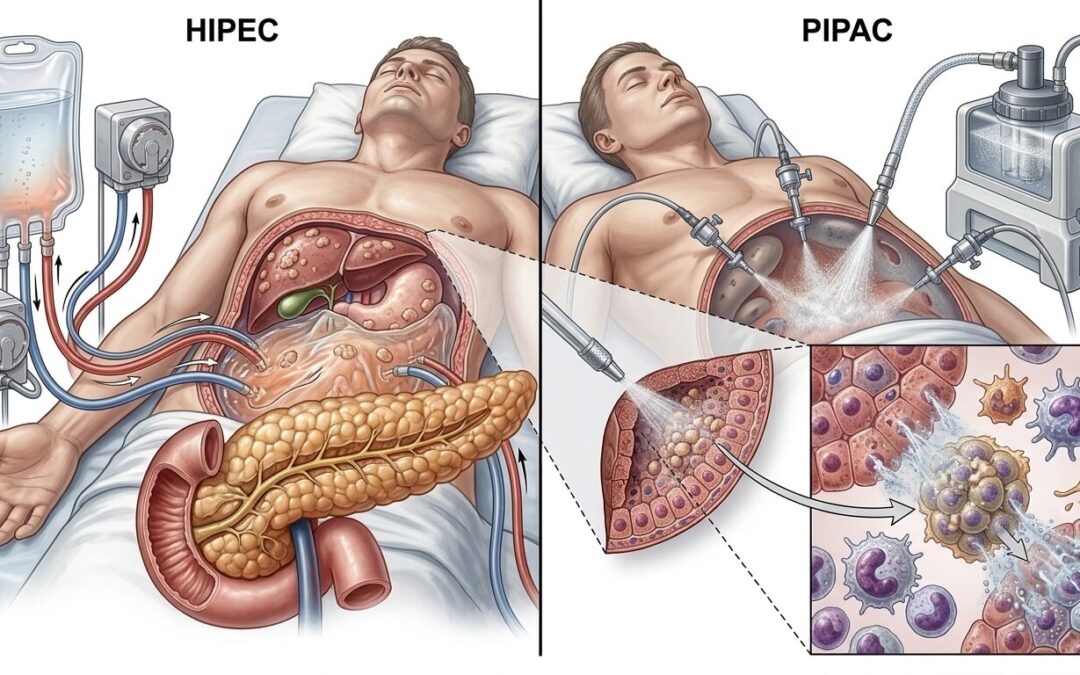
When cancer spreads to the peritoneum, two procedures come into the picture: HIPEC and PIPAC. Both deliver chemotherapy directly into the abdomen but they aren’t interchangeable. HIPEC is a one-time heated chemotherapy wash delivered during major surgery, aimed at cure in patients whose disease can be completely removed. PIPAC is a minimally invasive aerosol procedure repeated every six to eight weeks, used to control disease that surgery can’t clear.
Dr. Sandeep Nayak at MACS Clinic has hands-on experience in both: “HIPEC and PIPAC are not competing treatments. They occupy different positions on the same disease spectrum. The question isn’t which one is better, it’s which one fits where the patient is right now.”
Been told the cancer has spread to the peritoneum and want to understand which treatment applies?
How HIPEC and PIPAC Work — and Who Each One Is For?
|
HIPEC |
PIPAC |
|
|
What it is |
Heated chemotherapy wash delivered during open surgery |
Pressurised aerosol chemotherapy delivered laparoscopically |
|
Procedure type |
Major surgery — combined with cytoreductive surgery |
Minimally invasive — two small incisions |
|
Duration |
6 to 12 hours (surgery + chemo wash) |
Around 60 to 90 minutes |
|
How often |
Once — at time of surgery |
Repeated every 6 to 8 weeks |
|
Intent |
Curative or long-term remission |
Disease control, symptom relief, possible conversion to surgery |
|
Who it’s for |
Low PCI score, resectable peritoneal disease |
High PCI score, unresectable or chemo-resistant disease |
|
Recovery |
Several weeks |
Home within 1 to 2 days |
|
Drug concentration |
Direct wash after complete tumour removal |
200–600x higher local concentration than IV chemotherapy |
HIPEC and PIPAC both target what systemic chemotherapy struggles to reach — peritoneal disease sits behind the blood-peritoneum barrier, which limits how much drug actually arrives via the bloodstream. Both procedures bypass that barrier entirely by putting the drug directly where it’s needed. The HIPEC treatment page covers the full procedure in detail.
How the Decision Between Them Gets Made?
Peritoneal Cancer Index (PCI) is the starting point
The abdomen is divided into 13 regions and tumour burden is scored in each. The total PCI score determines whether the disease is resectable. Low score — surgery plus HIPEC. High score PIPAC.
Complete removal is the requirement for HIPEC
HIPEC only works when every visible tumour deposit has been cleared first. If even one area can’t be removed, the whole procedure loses its rationale. Completeness of cytoreduction is the single biggest predictor of outcome.
PIPAC is not giving up — it’s a different plan
For patients with unresectable disease, PIPAC delivers drug concentrations no IV regimen can match at the peritoneum. Some patients respond well enough after two or three cycles that their PCI score drops and surgery becomes possible. That conversion happens more often than most patients expect.
When both get used — sequentially
PIPAC first, then reassessment, then cytoreductive surgery with HIPEC if the disease has responded. The previous blog on PIPAC Treatment for Peritoneal Cancer covers this conversion pathway in detail.
Why Choose MACS Clinic for HIPEC and PIPAC?
Dr. Sandeep Nayak’s team at MACS Clinic doesn’t offer one or the other — they offer both, which matters because peritoneal cancer patients often move between them. A patient who starts on PIPAC and converts to operability needs a team that can take them straight to cytoreductive surgery and HIPEC without a referral elsewhere. That continuity affects the outcome.
Every case is reviewed through a tumour board that covers surgical oncology, medical oncology, and pathology before any procedure is planned. PCI scoring, prior systemic chemotherapy response, and patient fitness are all assessed before the first incision. Reach the team at +91 8035740000 or through the contact page.
FAQs
Can HIPEC and PIPAC be used together?
Not simultaneously, but sequentially Some patients receive PIPAC first to reduce disease burden, then move to cytoreductive surgery with HIPEC once the peritoneal spread is limited enough to be completely removed.
Is HIPEC a cure for peritoneal cancer?
For selected patients with low-volume, completely resectable peritoneal disease — particularly from colorectal, ovarian, or appendiceal primaries — HIPEC combined with cytoreductive surgery offers genuine long-term remission and in some cases cure. Patient selection is everything.
How many PIPAC sessions are needed?
Usually three cycles are given before reassessment. If the disease has responded — PCI score reduced, symptoms improved — a further decision is made about continuing PIPAC, switching to surgery, or adjusting the systemic chemotherapy alongside it.
Which cancers are treated with HIPEC or PIPAC?
Both are used for peritoneal spread from colorectal cancer, ovarian cancer, gastric cancer, appendiceal cancer, and peritoneal mesothelioma. The primary tumour type, PCI score, and operability determine which procedure is appropriate at which point.
Disclaimer: This content is published for educational and informational purposes only.