


More than half of kidney cancers are found by accident, on a scan done for something else, such as back pain, a stomach problem or a routine check. So if a scan has picked up a mass in your kidney, you’re far from alone, and it doesn’t mean the worst. The first job is to work out what it is. Most kidney findings on scans turn out to be simple fluid-filled cysts that need no treatment. Of the solid masses, many are cancer, but small ones are often slow growing, and about 1 in 5 small solid masses aren’t cancer at all. Because these are usually found early and small, the plan is typically made calmly, not as an emergency. You’ll usually be referred to a urologist, who’ll order a closer scan and, in some cases, a biopsy before recommending watching, a small operation or another treatment.
Dr. Sandeep Nayak, who provides cancer treatment in Bangalore, says the wording on the scan report matters. “A report that says ‘renal lesion’ can mean very different things. A thin-walled cyst is almost always harmless. A solid mass that lights up with contrast is suspicious and needs a proper work-up. We look at the size, the shape and whether it’s cystic or solid, and we check how well both kidneys are working before planning anything. For a small tumour, we can often remove just the tumour and keep the rest of the kidney, and some people can safely be watched.”
If a scan has shown something in your kidney and you’re waiting for answers, it helps to have the images and reports reviewed by a surgical team. Share your scan with our team, and they’ll explain what it shows and what the next steps could be.
Kidney Tumour Detected on Scan: How Doctors Find Out What It Is
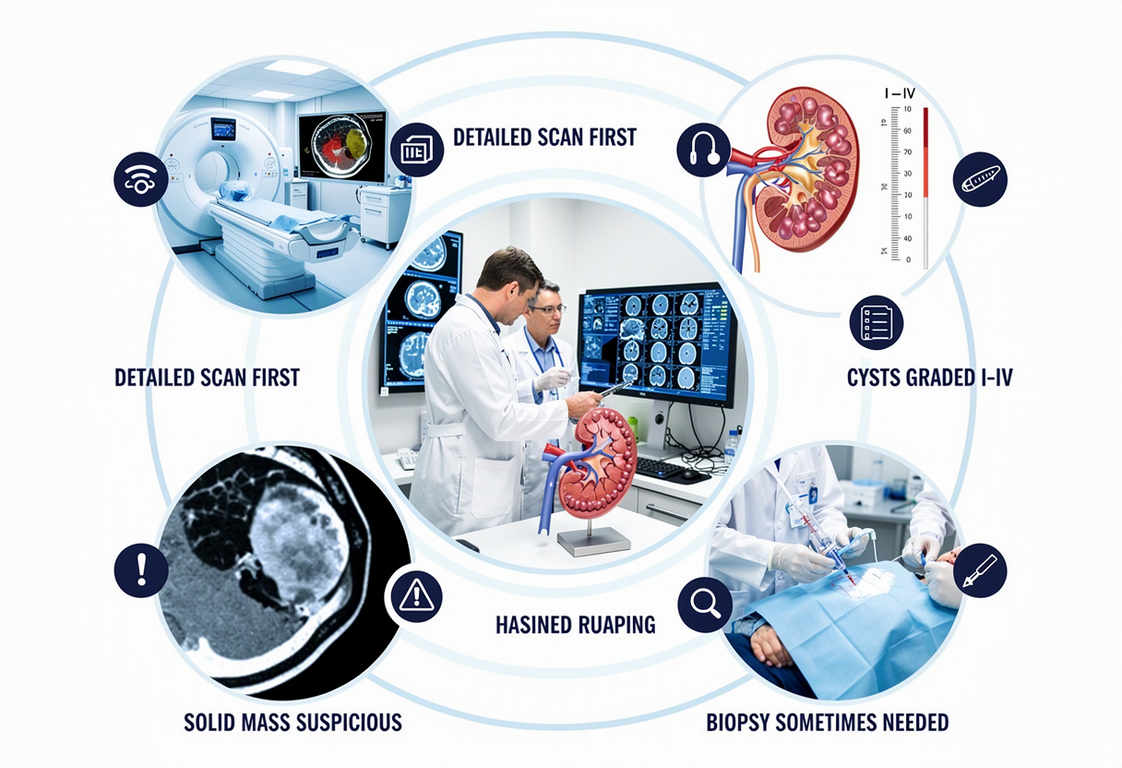
- A closer scan comes first, usually a CT or MRI with contrast, after a check of how well your kidneys work. It shows whether the mass is solid or a cyst, how big it is, and whether it takes up the contrast dye. You can read about treatment on our kidney cancer treatment page.
- Cysts are graded from I to IV on the Bosniak scale. Types I and II are benign, and most cysts found by accident need no follow-up. Types III and IV are complex cysts that need a closer look.
- A solid mass that takes up contrast is suspicious. Around 8 in 10 small solid masses (4 cm or less) turn out to be cancer, and about 2 in 10 are benign growths such as oncocytoma or angiomyolipoma.
- A biopsy isn’t always needed before surgery, but it’s usually done if watching or ablation is planned. The surgeons on Team MACS can review your scan and advise whether one would help.
Incidental Kidney Cancer: Treatment Options

- Active surveillance means repeat scans instead of immediate treatment. It’s an option for small masses, especially under 2 cm, and for people whose other health problems make an operation riskier than the tumour.
- Surgery is the usual treatment for many small tumours. A partial nephrectomy removes the tumour and keeps the rest of the kidney, and a radical nephrectomy removes the whole kidney when the tumour is larger. Keyhole and robotic approaches are used for some, as our blog on minimally invasive surgery explains.
- Ablation uses heat or freezing to destroy a small tumour, and it’s an option for selected patients. A biopsy is needed first.
- The choice is shared. Our post on the tumour board shows how surgeons, radiologists and oncologists agree on a plan.
What Decides Whether a Kidney Mass Needs Treatment?
There’s no single rule, and the team weighs several things together.
- Size and growth. Small masses grow slowly in many people, and larger or fast-growing ones are more likely to need treatment.
- Whether it’s solid or cystic, and how the cyst is graded.
- The biopsy result, if there’s one, which can show if it’s benign or a slow or aggressive type of cancer.
- How well your kidneys work, and whether keeping as much kidney as possible matters.
- Your age, general health and other illnesses, which affect whether an operation or watching is safer.
- Where the tumour sits in the kidney, and whether there are several tumours or a family history, which may call for genetic counselling.
- Your own preferences, after the options have been explained.
Key Takeaways
- More than half of kidney cancers are found by accident, usually early and small.
- Many kidney findings are harmless cysts. About 1 in 5 small solid masses are benign.
- A closer scan, and sometimes a biopsy, tells the team what it is. It’s usually a planned process, not an emergency.
- Options include watching, surgery that keeps the rest of the kidney, and ablation for selected people.
- Questions about your own scan? You can call the clinic on +91 9482202240.
Frequently Asked Questions
1. What happens if kidney cancer is found accidentally on a scan?
You’re usually referred to a urologist, who’ll order a closer scan and check your kidney function, and sometimes a biopsy. Then the team decides between watching, surgery or ablation, depending on the size, type and your health.
2. Is a kidney mass on a scan always cancer?
No. Most kidney findings are simple cysts. About 2 in 10 small solid masses are benign too. A solid mass that takes up contrast is suspicious, which is why it needs a proper work-up.
3. Does an incidental kidney tumour need urgent surgery?
Usually not as an emergency. Small kidney tumours often grow slowly, so the plan is made calmly. It still needs prompt evaluation by a urologist, so don’t leave it.
4. Can the kidney be saved if a tumour is found?
Often, yes. For many small tumours, a partial nephrectomy removes the tumour and leaves the rest of the kidney working. Whether it’s possible depends on the size and position of the tumour.
Disclaimer
This content is published for educational and informational purposes only and is not a substitute for medical advice. What a kidney mass means depends on your scan and your individual case, so please consult a urologist or surgical oncologist.
References:
- Renal Mass and Localized Renal Cancer: AUA Guideline, The Journal of Urology
- Guideline for Management of the Clinical Stage 1 Renal Mass, American Urological Association
- Active Surveillance of Small Renal Masses, Insights Into Imaging, PubMed Central
- Incidentally Detected Small Renal Masses: Investigation and Management, Australian Family Physician, RACGP
- Kidney Cancer Treatment in Bangalore, MACS Clinic
- Team MACS, MACS Clinic