

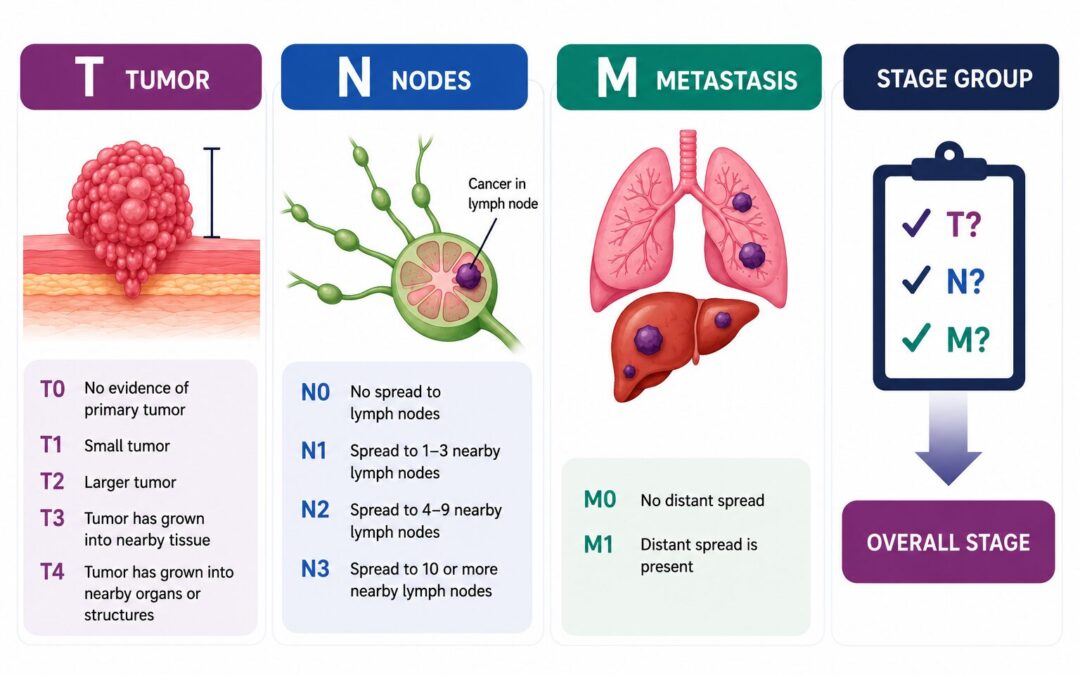
TNM is what doctors everywhere use to describe how far a cancer’s actually gotten. Sounds like code at first, but it’s really not once you break it down. T’s for tumour, the size and reach of the main growth itself. N’s for nodes, whether it made it into nearby lymph nodes. M’s for metastasis, whether it’s turned up somewhere distant in the body. Slap a number after each letter and suddenly that report that looked like gibberish starts saying something real.
Dr. Sandeep Nayak, who provides Best Cancer Treatment in Bangalore, explains why this goes beyond just labeling things. “Patients look at T2N1M0 and have zero idea what that means, and fair enough, nobody teaches this stuff. But it’s not just paperwork sitting there. That classification is literally what drives the treatment plan. Whether surgery on its own does the job, whether chemo needs to happen first, whether radiation gets stacked on, it all comes back to what these letters and numbers are telling us.”
Trying to understand your own TNM staging results?
What Do the T, N, and M Categories Actually Mean?
Each letter carries its own scale, and together they build the full picture.
T describes the tumour itself. Ranges from TX, meaning the tumour can’t be assessed, through T0, no evidence of a primary tumour, up to T1 through T4, with higher numbers generally indicating a larger tumour or one that’s grown deeper into surrounding tissue.
N describes lymph node involvement. N0 means no cancer found in nearby lymph nodes. N1 through N3 indicate increasing numbers of nodes affected, or nodes located further from the original tumour site, both of which generally signal more advanced disease.
M describes distant spread. M0 means no distant metastasis detected. M1 means the cancer has spread to another part of the body entirely, a lung, the liver, bone, wherever it’s landed beyond the original site and nearby nodes.
These combine into an overall stage. A specific TNM combination, say T2N1M0, typically maps to an overall stage, commonly Stage 1 through Stage 4, which is the shorthand most patients actually hear used in conversation. Our blog on stage 1 vs stage 2 cancer covers what that jump in overall staging actually means practically.
Why Does This Classification System Actually Matter?
Beyond just labeling the disease, TNM shapes nearly every decision that follows.
It determines the treatment approach. Early T stages with N0 and M0 often mean surgery alone can be curative. Higher T or N categories frequently mean chemotherapy or radiation gets added before or after surgery, and M1 changes the entire treatment strategy toward systemic therapy.
It provides a consistent language across doctors and hospitals. A T2N1M0 breast cancer means roughly the same thing whether it’s diagnosed in Bangalore, London, or anywhere else, which matters enormously for consulting specialists, getting second opinions, or transferring care.
It helps predict prognosis, though never with certainty. Statistically, lower TNM categories generally correlate with better outcomes, but staging describes the disease at diagnosis, it doesn’t predict any individual patient’s specific outcome on its own.
It gets reassessed if disease changes. If cancer progresses or responds to treatment, restaging sometimes happens, and this updated TNM classification can shift the treatment plan going forward. Our blog on can cancer return after complete remission covers how staging concepts apply even after initial treatment ends.
Why Choose MACS Clinic for Cancer Staging and Treatment Planning?
Dr. Sandeep Nayak’s team at MACS Clinic uses TNM staging as the foundation for every treatment plan, reviewed alongside imaging, pathology, and molecular profiling before any recommendation is made. Patients get a clear explanation of what their specific staging actually means, not just the numbers themselves.
For patients where treatment decisions depend heavily on accurate staging, precision oncology adds another layer of detail beyond TNM alone, helping build a treatment plan around the tumour’s full biology. Trying to understand what your specific staging report means? Reach the team at +91 9482202240.
FAQs
Does a bigger number automatically mean things are worse?
Generally speaking, yes, higher T, N, or M values line up with more advanced disease and often a tougher treatment road. But that’s a snapshot from diagnosis, it doesn’t tell you how any one patient is actually going to respond once treatment starts.
Does TNM work the same way for every cancer type?
The T, N, M idea holds across the board, sure. But what actually counts as T1 versus T2, or N1 versus N2, shifts depending on the cancer. Different cancers just don’t behave the same way.
Can this staging shift once treatment's underway?
It can, yeah. If restaging happens down the line, that gets tracked as its own separate thing, since the original TNM number is really about where things stood at diagnosis.
What's it mean if the report shows TX or NX?
Just means that piece couldn’t be pinned down, maybe a test wasn’t run or information was missing. On its own, that’s not something to read too much into.
Disclaimer: This content is published for educational and informational purposes only.