
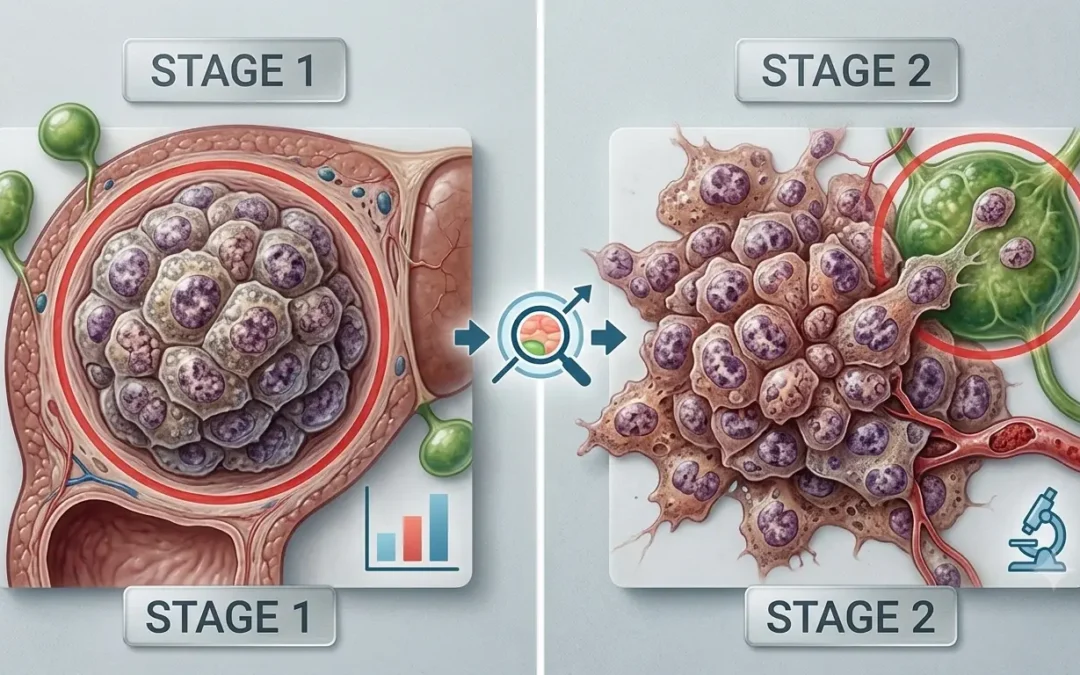
Both are early-stage cancers. Both are highly treatable. But they’re not the same thing, and the difference between them matters more than most patients realise when they first hear a stage number. Stage 1 means the tumour is small and completely contained within the original organ, no lymph node involvement, no spread anywhere. Stage 2 means the tumour has grown larger, or has started pushing into nearby tissue, or has reached nearby lymph nodes. The cancer is still localised in the broad sense, but it’s further along than Stage 1 in meaningful ways.
Dr. Sandeep Nayak,who provides Best Cancer Treatment in Bangalore, explains what the staging actually tells you: “Staging gives us a common language for describing how far a cancer has progressed. Stage 1 and Stage 2 are both early-stage by definition, but the treatment plan for each can look quite different. A Stage 1 tumour caught cleanly with surgery alone may need nothing further. A Stage 2 tumour with lymph node involvement almost always needs additional treatment after surgery. The number isn’t just a label it’s a clinical decision-making tool.”
Just been told your cancer is Stage 1 or Stage 2 and want to understand what comes next?
Stage 1 vs Stage 2: What's the Difference?
|
Stage 1 |
Stage 2 |
|
|
Tumour Size |
Small, limited to origin site |
Larger or grown deeper into tissue |
|
Lymph Nodes |
Not involved |
May be involved in some cancer types |
|
Spread |
Completely localised |
Still localised but more advanced locally |
|
Surgery |
Often curative on its own |
Usually needed, often with additional treatment |
|
Additional Treatment |
May not be required |
Chemotherapy, radiation, or targeted therapy often added |
|
Survival Rates |
Very high across most cancer types |
High, but lower than Stage 1 in most cancers |
|
Recurrence Risk |
Lower |
Moderate, depends on cancer type and subtype |
|
Monitoring After |
Regular follow-up |
More intensive follow-up in most cases |
The table gives the general picture, but staging is cancer-specific. Stage 2 breast cancer is a different clinical situation from Stage 2 colon cancer or Stage 2 lung cancer. The number is the starting point, not the full story. More on how specific cancers are staged and treated at MACS Clinic is covered across the relevant service pages, including the blog on Stage 1 vs Stage 2 cancer differences for further reading.
What Does the Stage Actually Determine?
Staging isn’t just classification. It drives every clinical decision that follows.
Surgery Planning: A Stage 1 tumour caught cleanly within its organ is usually removed with a margin of healthy tissue and that’s the end of the main treatment. Stage 2 changes the surgical conversation — wider margins, lymph node assessment, and sometimes more extensive removal depending on the cancer type.
Whether Additional Treatment Is Needed: This is where Stage 1 and Stage 2 diverge most practically. A Stage 1 cancer removed with clear margins often needs no further treatment beyond monitoring. Stage 2, particularly with lymph node involvement, almost always brings chemotherapy, radiation, targeted therapy, or hormone therapy into the plan. Our blog on what is metastatic cancer explains how staging connects to spread and why keeping disease at Stage 1 or 2 changes what’s possible.
Surveillance Schedule: After treatment, Stage 1 patients typically follow a standard monitoring schedule. Stage 2 patients, especially those with lymph node involvement, are watched more closely and for longer because the recurrence risk, while still manageable, is meaningfully higher.
Molecular Profiling: At both stages, precision oncology and molecular testing add a layer that pure staging doesn’t capture. Two Stage 2 breast cancers with different molecular profiles — one HER2-positive, one triple negative — need completely different treatment plans despite sharing the same stage number. Stage tells you how far. Molecular profile tells you what you’re dealing with and what will work against it.
Prognosis: Five-year survival rates for Stage 1 cancers across most types run above 80% to 90%. Stage 2 rates are lower but still strong for most cancers — typically 60% to 80% depending on type and subtype. These are population-level statistics, not individual predictions, but they give a realistic sense of what early detection actually changes.
Why Choose MACS Clinic for Early-Stage Cancer?
Dr. Sandeep Nayak’s team at MACS Clinic treats Stage 1 and Stage 2 cancers with the same multidisciplinary rigour as advanced disease surgical oncology, medical oncology, and radiation oncology reviewing every case together before a plan is made. For early-stage cancers where surgery is the primary treatment, robotic and minimally invasive techniques mean smaller incisions, less blood loss, and significantly faster recovery without compromising the extent of tumour removal or lymph node assessment.
Molecular profiling is part of how treatment is planned even at Stage 1 and 2, because the biology of the tumour shapes what surveillance and additional treatment are needed, not just the stage number. Those diagnosed at an early stage who want to understand their full treatment picture can reach the team at +91 9482202240.
FAQs
Is Stage 2 cancer serious?
Serious enough to treat properly, yes. But it hasn’t spread to distant organs and most Stage 2 cancers are treated with curative intent. The odds at this stage are genuinely good with the right treatment plan in place.
Can Stage 1 cancer come back?
It can. Lower risk than later stages, but not zero. Hormone receptor-positive breast cancer is a good example it can show up again years or even decades later. Staying on top of follow-up appointments is what catches these things early if they do return.
Does Stage 2 always need chemotherapy?
Not automatically. It depends on the cancer type, molecular profile, lymph node status, and whether surgical margins were clear. Some Stage 2 cases are handled with surgery and radiation. Others need systemic treatment on top. No single rule covers all of them.
What's the difference between Stage 2A and Stage 2B?
Sub-stages break things down further within Stage 2 — slightly different tumour sizes, how many lymph nodes are involved, or how deep the invasion goes. They exist because two Stage 2 patients can have meaningfully different situations, and the sub-stage helps sharpen the treatment and follow-up plan.
Disclaimer: This content is published for educational and informational purposes only.