

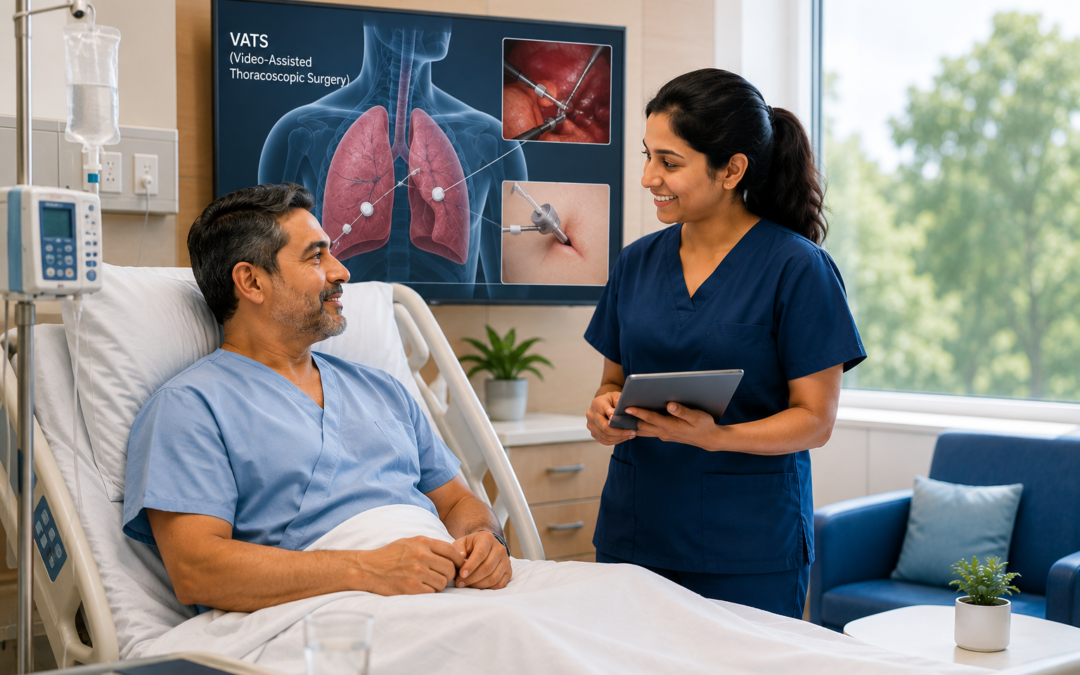
Two to four days is the honest answer for most patients. That’s the range after a VATS lobectomy or wedge resection done through small keyhole incisions and it’s a lot shorter than the week or more that open chest surgery typically requires. Smaller incisions, less disruption to the chest wall, less post-operative pain. All of that adds up to a faster road home.But the discharge date isn’t decided by a calendar. It’s decided by the chest tube.
According to Dr. Sandeep Nayak,who provides Best Cancer Treatment in Bangalore, “VATS patients recover faster than open surgery patients in almost every measurable way. Most are ready to go home by day three or four. What holds someone longer isn’t the surgery itself it’s the chest tube. When that’s out and the lung is fully expanded, the patient goes home.”
What Actually Decides When You Go Home?
The chest tube is the gating factor
After lung surgery, a chest tube drains air and fluid from the pleural space while the lung re-expands. It stays until drainage slows to a safe level and imaging confirms full expansion. This typically happens between day one and day three after VATS. A patient whose lung expands cleanly goes home sooner. One with a persistent air leak stays until it resolves — most settle within a few days, occasionally longer.
The type of resection
A wedge resection removes a small piece of lung tissue. A lobectomy removes an entire lobe. Wedge resections mean shorter chest tube duration, less pain, faster discharge. A lobectomy for lung cancer typically runs two to four days. A wedge resection can sometimes mean a day two discharge.
Lung function going into surgery
Good pre-operative lung function means the remaining tissue handles the extra workload more easily. Patients with reduced baseline function COPD, reduced FEV1 take longer to stabilise before discharge is safe.
Pain control and mobility
A patient who is walking comfortably, managing pain on oral medication rather than IV, and tolerating food and fluids is ready to leave. Most VATS patients reach that point by day two or three.
What Recovery Looks Like After Discharge?

Going home on day three doesn’t mean being back to normal on day three.
For a full picture of what the surgical options for lung cancer involve and how the procedure is planned, the previous blog on Surgical Management of Lung Cancer covers the decision-making process in detail.
Why Choose MACS Clinic for VATS Lung Surgery?
Dr. Sandeep Nayak’s team at MACS Clinic performs VATS lobectomy and wedge resection as the default approach for operable lung cancer — not as a selected alternative offered to certain patients, but as the standard where anatomy allows. Most patients are discharged by day four. Chest tube management, pain protocol, and early mobilisation are built into the plan from the day of surgery.
Every lung cancer case goes through tumour board review before a surgical date is set. Staging, lung function assessment, and the specific resection required are confirmed before the patient goes to theatre. Those who want to discuss surgical options for their specific case can reach the team at +91 8035740000
FAQs
Can I go home the same day after VATS lung surgery?
Rarely. The chest tube stays in overnight at minimum. Same-day discharge after VATS lobectomy is not standard.
What if the chest tube needs to stay in longer?
The hospital stay extends until the air leak resolves and drainage is at a safe level. The tube comes out when it is clinically safe, not on a fixed schedule.
How long before I can drive after VATS lung surgery?
Usually two to three weeks, once pain medication is stopped and the surgical team has cleared it.
Is VATS suitable for all lung cancers?
Not all. Most suitable for early-stage non-small cell lung cancer where the tumour is accessible and lung function is adequate. Advanced or centrally located tumours may need open surgery.
Disclaimer: This content is published for educational and informational purposes only.