

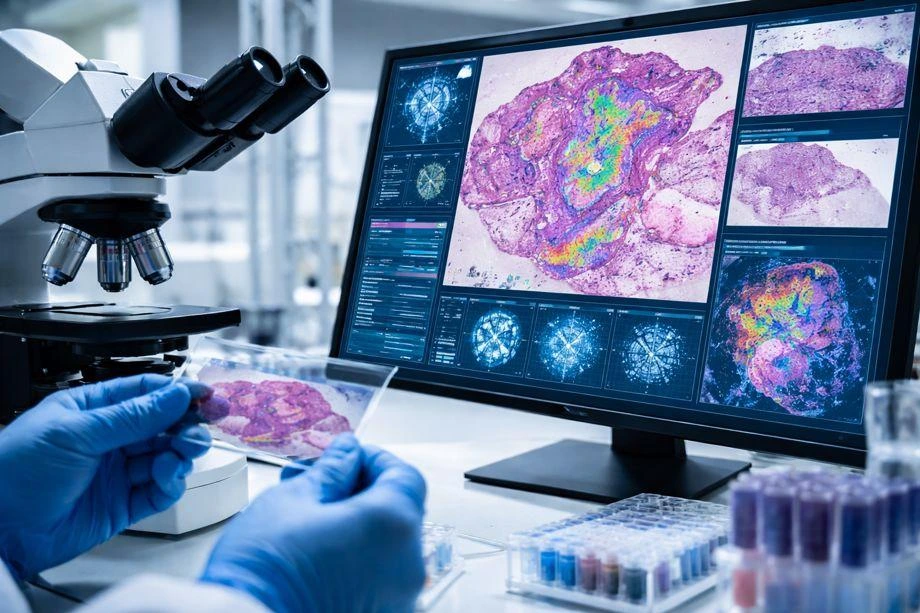
It’s the process of turning physical glass tissue slides into high-resolution digital images that a pathologist can view, manage, and analyze right on a computer screen instead of hunched over a microscope. It sounds like a simple format change, scan a slide instead of looking at it directly, but it’s actually reshaping how fast and how accurately a cancer diagnosis gets made.
Dr. Sandeep Nayak, known for the Best Cancer Treatment in Bangalore, has watched this shift change the pace of his own team’s work. “A pathologist used to be tied to a physical slide and a physical microscope in one room. Now that same slide can be pulled up instantly by a specialist somewhere else entirely, a second opinion that used to take days can happen the same afternoon. For a patient waiting on results, that difference is enormous.”
Curious how this affects your own diagnosis or treatment timeline?
How Digital Pathology Actually Works?
The shift starts at the slide itself and changes what happens after:
- High-resolution scanners capture the tissue sample at a level of detail that matches, and in some cases exceeds, what a pathologist sees under a physical microscope
- Digital slides can be shared instantly across locations, which speeds up second opinions and specialist consultations that used to depend on physically shipping glass slides
- AI-assisted image analysis can flag areas of concern for the pathologist to review first, without replacing the pathologist’s own judgment
- Digital archives make it far easier to pull up and compare a patient’s prior slides during follow-up care, instead of tracking down physical slides in storage
None of this changes what a pathologist is actually looking for. It changes how quickly and how widely that expertise can be applied to a single case.
Why This Actually Matters for Patients?
The practical benefit shows up most clearly when time and access to the right expertise matter:
- Faster turnaround on results, since digital slides don’t need to be physically transported between labs or specialists
- Easier access to subspecialists for rare or unusual cancers, since a slide can reach the right expert regardless of location
- Fewer diagnostic delays tied to lost, damaged, or misplaced physical slides
- Better integration with diagnostic staging and treatment planning, since pathology results can be reviewed alongside imaging and other data more easily
It’s not replacing the pathologist’s expertise, it’s removing a lot of the friction that used to sit between a tissue sample and a confident diagnosis.
Why Choose MACS Clinic for Diagnostic Precision?
Dr. Sandeep Nayak’s team treats pathology review as part of a connected diagnostic process, alongside precision oncology testing and staging, rather than a separate step that happens in isolation and gets reported back later. Imaging findings, biopsy results, and molecular markers are reviewed together before any conclusion is finalized, so nothing gets missed by looking at one piece without the others. For patients seeking clarity on a confusing or conflicting diagnosis, that same connected approach applies to second opinions too, not just new cases coming in.
Want to understand how your diagnosis was reached, or want a second opinion? Reach the team at +91 9482202240.
FAQs
Is a digital slide really as good as looking through the actual microscope?
Pretty much, yes, according to most of the studies comparing them. Digital review has even caught things a physical microscope missed in some cases, so it holds up.
Does this replace the pathologist's job?
Not even close. Software might point out a spot worth a second look, but the actual diagnosis still comes from a trained specialist reading the case.
Would this make it easier to get a second opinion somewhere else?
Usually, yes. Sending a digital file takes minutes. Shipping an actual glass slide used to eat up days before another specialist even got to look at it.
Does going digital make diagnosis more expensive?
Depends on where you go. A lot of clinics have folded the cost into standard care by now, but it’s a fair thing to just ask about upfront.
Reference Links
- CAP — Validating Whole Slide Imaging for Diagnostic Purposes
A strong clinical reference explaining how digital whole-slide imaging is validated for diagnostic use and its equivalence with conventional microscopy.
CAP: Whole Slide Imaging Diagnostic Guideline - Nature Reviews Clinical Oncology — AI in Digital Pathology
Reviews how digitized tissue slides and AI can support cancer diagnosis, biomarker analysis, and precision oncology.
Nature Reviews Clinical Oncology: AI in Digital Pathology
Disclaimer:This content is published for educational and informational purposes only.