
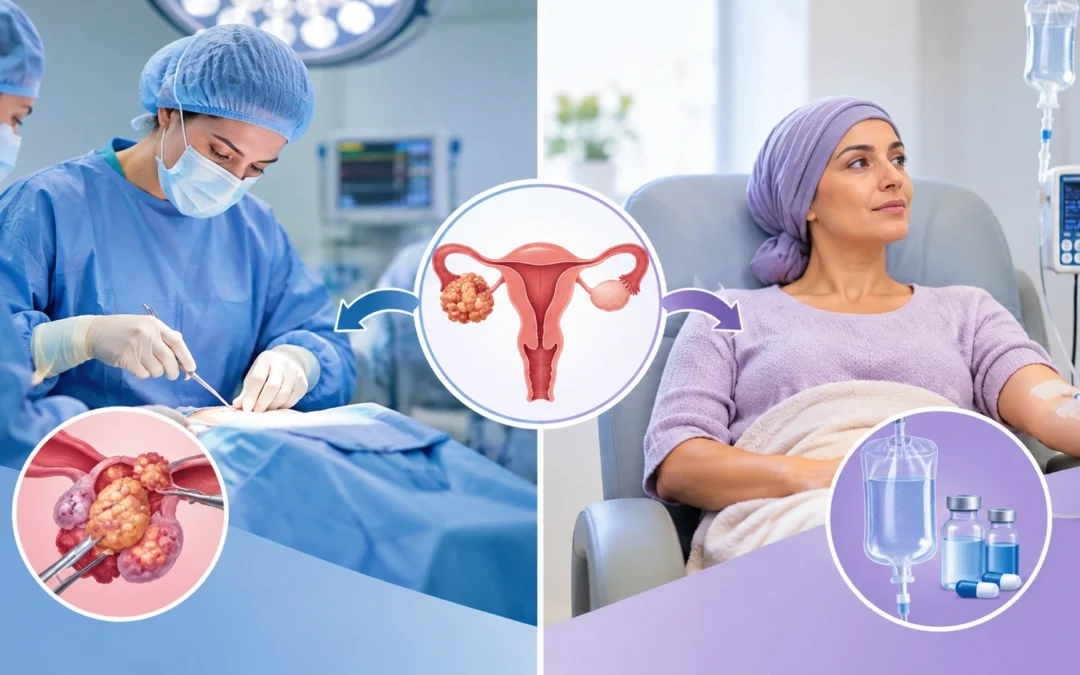
For advanced ovarian cancer, there’s no fixed rule about which comes first, surgery or chemo. It really comes down to how far the disease has spread and whether a patient can handle a major operation right out of the gate. Some women go straight into debulking surgery, removing as much visible tumor as possible before starting chemotherapy. Others start with chemo first, shrinking things down, then have surgery once the disease is more manageable. Neither path is the “backup” option. Both are legitimate, and which one fits depends entirely on the specifics of that case.
Dr. Sandeep Nayak, known for the Best Cancer Treatment in Bangalore, says this decision often only gets made after a proper look inside, not from a scan alone. “Imaging gives us a starting picture, but the real extent of disease sometimes only becomes clear during a diagnostic staging procedure. If a genuinely complete resection looks achievable up front, surgery first is usually the better call. If the disease is too spread out for that without taking on excessive risk, shrinking it with chemo first tends to make more sense.”
Trying to understand which path fits your own diagnosis?
What Actually Decides the Order?
What Actually Decides the Order
The choice comes down to a specific combination of disease extent and patient health, not a general preference either way:
| Factor | Surgery First (Primary Debulking) | Chemotherapy First (Neoadjuvant) |
| Disease extent | Favored when complete or near-complete resection looks achievable | Favored when disease is too widespread for safe complete resection upfront |
| Patient health | Requires tolerating a major operation right away | Lets chemotherapy start while overall condition is assessed |
| Surgical goal | Remove all visible tumor before chemotherapy begins | Shrink the tumor first, so later surgery is less extensive |
| Timing | Happens upfront, before any chemotherapy | Happens partway through, after several chemo cycles |
| Best suited for | More contained, potentially fully resectable disease | Extensive disease involving multiple organs or hard-to-reach areas |
Neither path wins across the board. Large studies have generally landed on comparable survival between the two, when patients are matched to the approach that actually fits their disease.Read our blog on Debulking
What This Actually Means Day to Day for the Patient?
Why Choose MACS Clinic for Advanced Ovarian Cancer Treatment?
Dr. Sandeep Nayak’s team bases this decision on a genuine assessment of resectability rather than defaulting to one sequence for every case, using diagnostic staging to figure out which approach actually gives a patient the best shot at a full response. For patients whose symptoms went unnoticed for months before diagnosis, that same careful evaluation still applies no matter how advanced things look on the first scan.Want your own case reviewed to understand which path fits? Reach the team at
+91 9482202240.
FAQs
If I'm starting with chemo, does that mean surgery's off the table?
Not at all. It usually just means surgery’s being planned strategically for after the tumor shrinks, not that it’s been ruled out.
Does one path actually lead to better survival long term?
Not really, based on the bigger studies out there. They’ve landed on roughly the same outcomes for both, as long as the patient was matched to the right approach in the first place.
How does anyone actually decide which order to use?
Imaging plays a role, but a lot of the time it comes down to a diagnostic staging procedure that shows the real extent of disease better than a scan ever could.
Can the plan change once treatment's already underway?
Yeah, it happens. If chemo shrinks things more or less than expected, the surgical timing and plan can shift to match.
References
- ASCO Guideline Update – 2025
The most useful current guideline. It explains when doctors may recommend primary debulking surgery versus neoadjuvant chemotherapy, based on surgical fitness and the likelihood of completely removing visible disease.
ASCO Guideline Update – Neoadjuvant Chemotherapy for Advanced Ovarian Cancer - ASCO/SGO Clinical Practice Guideline – Full Text
Useful for explaining why surgery is preferred when complete tumor removal is likely, while chemotherapy first can be preferable when surgery would be difficult or carry high risk.
ASCO/SGO Guideline – Full Text
Disclaimer:This content is published for educational and informational purposes only.