
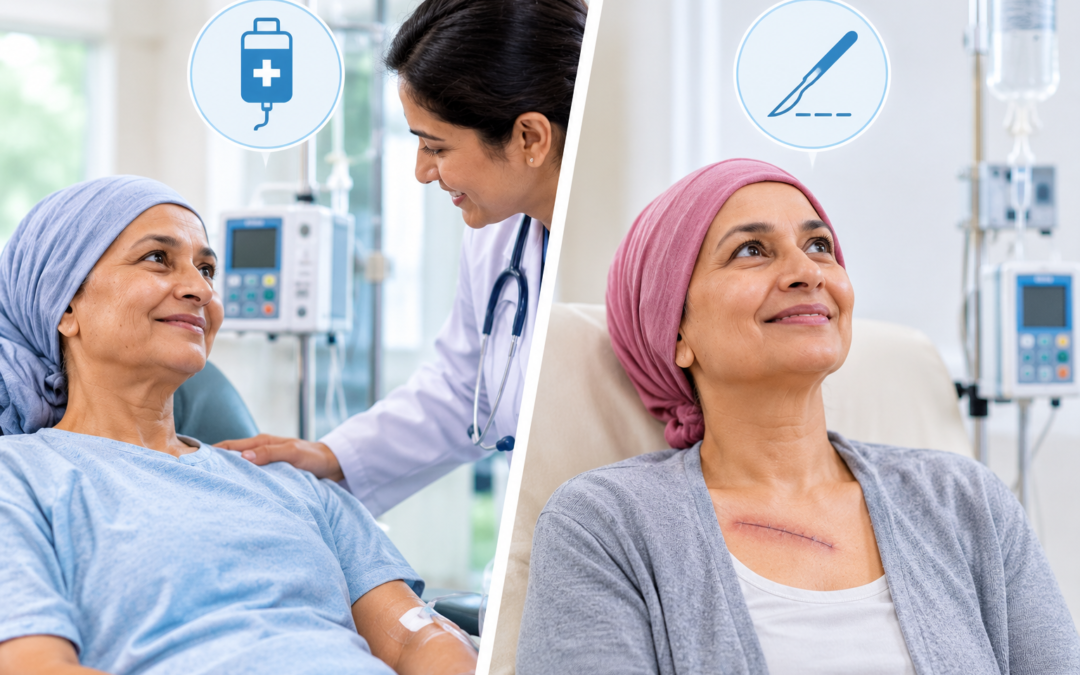
Chemo before surgery is meant to shrink the tumour and show whether the drugs are working. Chemo after surgery is there for the cancer cells too small to see, so the cancer is less likely to come back. Often it’s the same drugs doing a different job. Doctors call these neoadjuvant and adjuvant chemotherapy, and you’ll hear both words in the clinic. Take a large breast lump. Starting with chemo can shrink it enough that a smaller operation becomes possible. Now take a colon tumour that has been removed, where the report shows the lymph nodes were involved. Chemo afterwards is there to mop up. Plenty of people hear “chemo first” and think something has gone wrong. It hasn’t. For some cancers that’s just the better order. For others, surgery comes first, and the report on what was removed decides whether chemo is needed at all. Some people get both.
Dr. Sandeep Nayak, who provides cancer treatment in Bangalore, says the drugs are often the same either way. “What changes is the question we’re asking. Before surgery, it’s whether we can shrink the tumour, make the operation smaller, and see if the drugs work. After surgery, it’s what might be left behind, and the pathology report on the removed tumour guides that. In breast cancer, studies comparing the two orders have found similar survival. Which one suits you depends on the cancer, its size and where it sits.”
Whether chemotherapy comes before or after surgery depends on your cancer type, your scans and the biopsy. If you’ve been told chemo will come first, or you’re unsure about the order, our team can go through your reports and explain the plan.
Chemo Before Surgery vs After Surgery: Side by Side?
| Chemotherapy before surgery (neoadjuvant) | Chemotherapy after surgery (adjuvant) | |
| Also called | Neoadjuvant or preoperative chemotherapy | Adjuvant or postoperative chemotherapy |
| When it’s given | Before the operation, usually finishing a few weeks earlier | After the operation, once you’ve healed |
| Main aim | Shrink the tumour, start treating possible spread early, see how it responds | Clear cancer cells too small to see and lower the risk of recurrence |
| Effect on the operation | Can make surgery smaller, or possible at all, such as breast-conserving surgery instead of mastectomy | The operation is done first, as planned |
| What the team learns | How the tumour reacts to the drugs, and how much cancer is left in the removed tissue | The pathology report on the removed tumour shows the stage and guides which drugs, if any, are needed |
| Can the plan change midway? | Yes, drugs can be changed if the tumour isn’t responding | Less so, because the tumour is already out and response can’t be watched |
| Cancers where it’s common | Selected breast cancers, rectal, esophageal, stomach, bladder and some bone cancers | Breast, colon with nodes involved, lung and others, depending on what surgery shows |
| Survival in breast cancer trials | Similar to chemo after surgery | Similar to chemo before surgery |
| Main drawback | Surgery is delayed, and a tumour that doesn’t respond may keep growing | Treatment starts after recovery, and long delays in starting can reduce its benefit |
Which order is used varies by cancer, and the team decides case by case. You can see how this plays out in breast cancer treatment and rectal cancer treatment.
Chemotherapy Before or After Surgery: What to Ask?

- Who decides the order? In many centres it’s a tumour board, where surgeons, oncologists and radiologists review your case together. Our blog on the tumour board explains how it works.
- Ask what the chemo is meant to do in your case: shrink the tumour, test the drugs, or clear what’s left. The answer tells you what success looks like.
- Ask what happens if the tumour doesn’t respond, and whether the drugs can be changed.
- Ask about access. If a course of IV chemo is planned, find out whether a port or PICC line makes sense.
What Decides Whether Chemo Comes Before or After Surgery?
There’s no single rule, and the same before-or-after thinking applies to radiation and hormone therapy too. The team looks at a few things together.
- The type of cancer. Some cancers have a well-tested order, and others are decided case by case.
- The size and position of the tumour. A large tumour, or one close to important structures, may be easier to operate on after shrinking.
- Whether the aim is to save the organ. Chemo first can make breast-conserving surgery possible for some women.
- How likely the drugs are to work. Tumour type and markers help predict this, and the team may use testing like precision oncology to guide it.
- Whether the report from surgery is needed. For some cancers, the stage found after surgery decides whether chemo is needed at all.
- Your general health. You need to be fit enough to take chemo before an operation, as well as after it.
FAQs
Is chemo before surgery more effective than chemo after surgery?
Not necessarily. In breast cancer trials, survival was similar either way. What chemo first adds is a chance to shrink the tumour and see how it responds.
Why would a doctor give chemotherapy before surgery?
To shrink the tumour so the operation is smaller or possible, to start treating hidden spread early, and to see whether the drugs are working.
How long after chemo is the surgery done?
Usually a few weeks after the last cycle, once your blood counts have recovered. Your team will give you a date.
Can I have chemotherapy both before and after surgery?
Yes. In some cancers, people have it both before and after, and what follows surgery often depends on the pathology report.
Reference Links:
- Neoadjuvant Versus Adjuvant Chemotherapy in Breast Cancer (Review), PubMed Central
- Neoadjuvant Chemotherapy in Breast Cancer (Review), PubMed Central
Disclaimer
This content is published for educational and informational purposes only and is not a substitute for medical advice. Please speak to your oncologist before changing or stopping any treatment.