
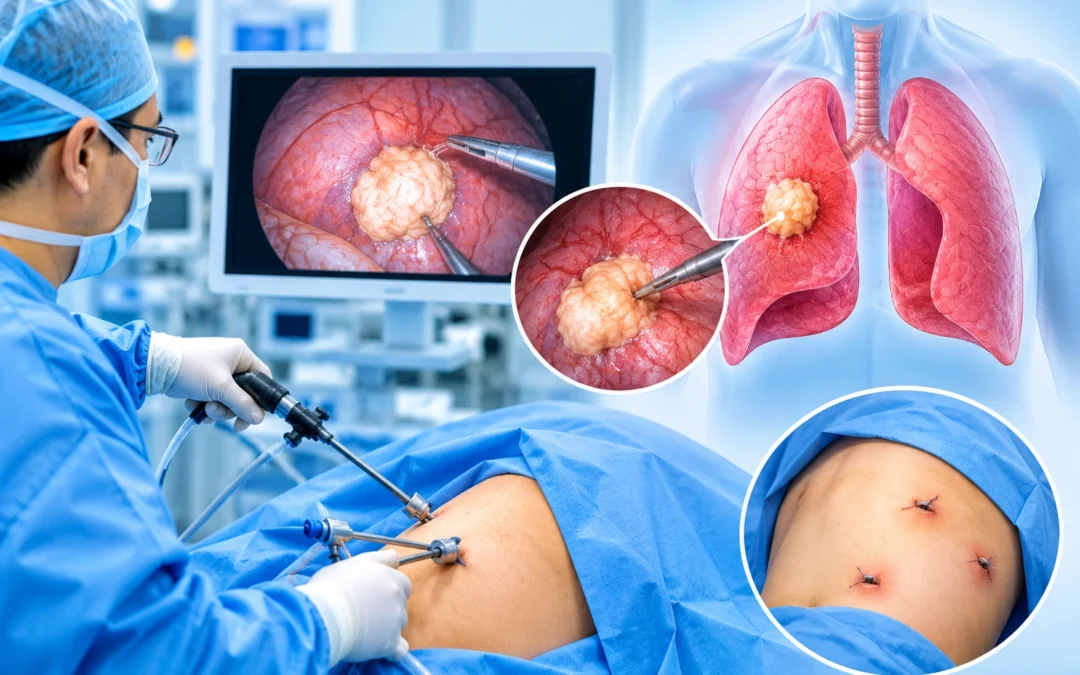
VATS stands for video-assisted thoracoscopic surgery. It is keyhole surgery on the chest, used to diagnose, stage and treat early-stage lung cancer. The surgeon works through two to four small cuts of one to four centimetres, watching on a screen as a tiny camera shows the inside of the chest, and the ribs are never spread apart.
According to Dr. Sandeep Nayak at MACS Clinic, who provides cancer treatment in Bangalore, “VATS removes the same lung tissue and lymph nodes that an open operation would. What differs is the route used to reach them. So the decision rests on the tumour’s stage and position and on how well the lungs work, not on which technique sounds more modern.”
Understand how VATS surgery treats lung cancer, its benefits, and what to expect during recovery.
What Happens During VATS Lung Cancer Surgery?
General anaesthesia, one lung at a time
The lung on the operated side is deflated to give the surgeon room, while the other lung does the breathing.
Two to four small cuts
The camera goes in through one and instruments through the others. One cut is slightly larger so the removed tissue can be lifted out in a bag.
What gets removed
Most often a lobectomy, the whole lobe holding the tumour. Smaller tumours or weaker lungs may call for a segmentectomy or wedge resection. Lymph nodes are sampled too, because they decide the final stage. This is a standard route for lung cancer surgery when the tumour is early and accessible.
A chest tube at the end
It drains air and fluid while the lung re-expands, and usually comes out within one to three days.
Switching to open surgery
If bleeding or unexpected anatomy makes the keyhole route unsafe, the surgeon opens the chest. That is a safety decision. Keyhole methods are used in other cancers too, as described in this overview of robotic and laparoscopic cancer surgery.
Who Is Suited to VATS Surgery for Lung Cancer?
Early stage disease
Stage 1 and 2 non-small cell lung cancer suits VATS best. A few carefully selected stage 3A cases qualify too.
Tumour size and position
Smaller tumours away from the large blood vessels and the main airway are easiest to remove this way.
Enough lung reserve
Breathing tests come first. The lung that stays must handle the work of the part that goes.
Lymph nodes checked beforehand
PET-CT, and often a needle biopsy of the chest nodes, show whether the cancer has spread before surgery is planned.
When open surgery is safer
Tumours growing into the chest wall, wrapped around major vessels or involving bulky nodes usually need a larger incision.
Many early tumours are first found on a scan done for another reason, which is why low-dose CT screening matters for high-risk smokers. For what the hospital stay looks like afterwards, the previous blog on how many days in hospital after VATS lung surgery covers it step by step.
What Determines Whether VATS Surgery Is Suitable for Lung Cancer?
Stage, size and position of the tumour
These decide whether keyhole surgery is safe and how much lung has to come out.
Lung function and general fitness
Weak lungs may do better with a smaller resection than a full lobectomy.
The tumour’s molecular profile
EGFR, ALK and PD-L1 testing does not change the operation, but it guides what follows. It is also part of why lung cancer is not only a smokers’ disease, as the blog on whether non-smokers can get lung cancer explains.
Surgeon experience
Experience affects outcomes, so it is reasonable to ask how often the surgeon performs VATS lobectomies.
Review by the whole team
Surgery, medical oncology, radiology and pathology reviewing the same case before a date is fixed.
Risks and limits
Air leaks that keep the chest tube in longer, bleeding, infection, pneumonia, and chest wall pain that can linger. Some operations are converted to open surgery for safety. Recovery varies from person to person, and no technique guarantees a cure.
FAQs
Is VATS as effective as open surgery for lung cancer?
For early-stage disease, cancer control is comparable, with less pain and a quicker recovery.
How long does VATS lung surgery take?
Usually two to four hours, depending on whether it is a wedge, segment or full lobe.
Is VATS painful?
Less than open surgery. Most people manage on regular pain medication within a day or two.
Can VATS be used to diagnose lung cancer, not just treat it?
Yes. It is also used to biopsy suspicious nodules and sample chest lymph nodes.
Reference Links:
- National Cancer Institute. Non-Small Cell Lung Cancer Treatment (PDQ). https://www.cancer.gov/types/lung/patient/non-small-cell-lung-treatment-pdq
- American Cancer Society. Surgery for Non-Small Cell Lung Cancer. https://www.cancer.org/cancer/types/lung-cancer/treating-non-small-cell/surgery.html
Disclaimer
This content is published for educational and informational purposes only and is not a substitute for medical advice. Please speak to your oncologist before changing or stopping any treatment.