

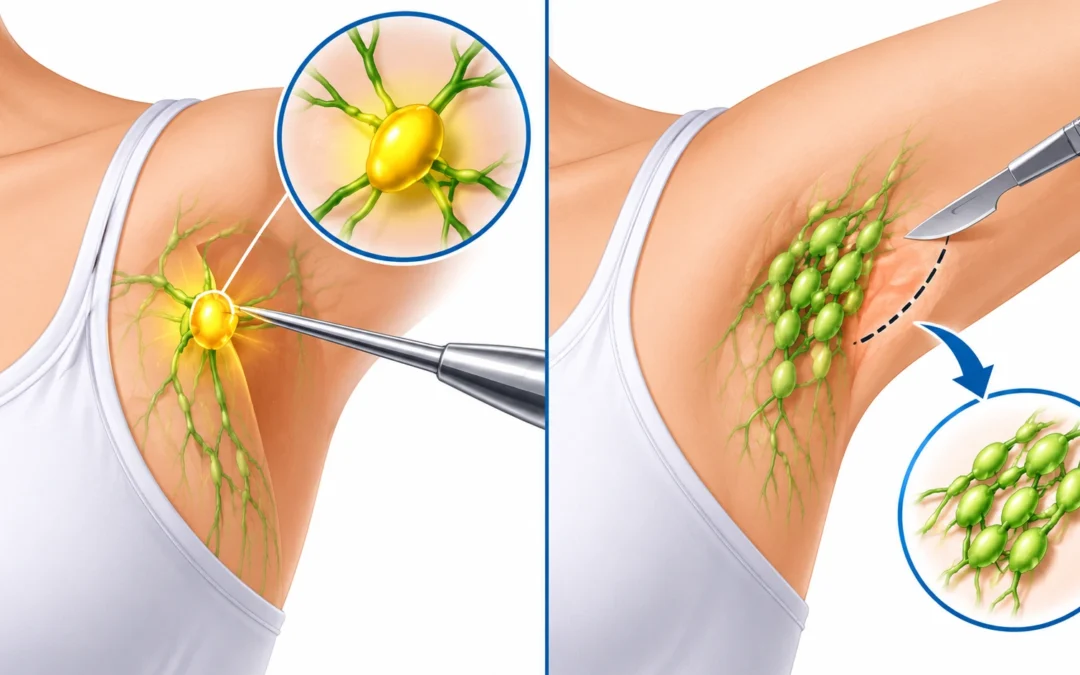
Both operations answer one question: has the cancer reached the lymph nodes in your armpit? A sentinel lymph node biopsy answers it by taking out only the first few nodes that drain the breast, usually one to three. Full lymph node removal, called axillary clearance, takes out most of the nodes in the armpit, often ten or more. These days the sentinel biopsy is the usual first step in early breast cancer, because it removes fewer nodes and brings less risk of arm swelling. Full removal is kept for cases where the nodes clearly need it.
Dr. Sandeep Nayak, who provides cancer treatment in Bangalore, explains the idea simply. “Think of the sentinel node as the first checkpoint on the route out of the breast. A blue dye, a tiny amount of radioactive tracer, or both, shows us which node that is. If it’s clear, the nodes beyond it are very unlikely to hold cancer, so we leave them alone. If it shows cancer, we then decide whether more nodes need to come out, or whether radiation and medicines can do that job.”
Which operation you need depends on your scans, the tumour and what’s found in the nodes. If you’ve been told you need surgery on the armpit and want to understand your options, o
Sentinel Node Biopsy vs Lymph Node Dissection: Side by Side?
| Question | Sentinel node biopsy | Full lymph node removal (axillary clearance) |
| What it does | Removes the first nodes that drain the breast, to check for spread | Removes most of the nodes in the armpit |
| Nodes removed | Usually 1 to 3 | Often 10 or more |
| How the nodes are found | Blue dye, radioactive tracer, or both, injected near the tumour | The surgeon clears the armpit area; no mapping needed |
| Main purpose | Staging: shows whether the cancer has spread | Staging and treatment: removes nodes already involved |
| When it’s used | Early breast cancer when the armpit looks and feels normal | When nodes are known to have cancer, or after certain positive sentinel results |
| Hospital stay | Often short, and can be day care when done on its own | Usually longer, and a drain tube is often needed for a few days |
| Arm swelling (lymphedema) | Lower. About 8 in 100 at 5 years in one large study | Higher. About 25 in 100 at 5 years in the same study |
| Other side effects | Soreness, mild numbness, rarely a fluid collection | More numbness in the inner arm, shoulder stiffness, fluid collection |
| Recovery | Usually quicker | Slower, and physiotherapy is often needed |
| Main limitation | A small chance of a false negative | Bigger surgery with more complications |
Percentages vary between studies. Both procedures sit within modern breast surgery, and you can read more in our overview of breast cancer surgeries and our page on breast cancer treatment in Bangalore.
After Lymph Node Surgery: What Else to Expect?
- Gentle arm and shoulder exercises usually start early. Your team will tell you when, and how far to go.
- Look after the arm on the operated side. Infections and injuries are linked to swelling, so even small cuts and burns are worth treating promptly.
- If radiation is planned, the skin on the treated side needs some care. Our blog on skin care during radiation therapy covers it.
- If chemotherapy is part of the plan, it helps to know what’s normal. Read about the common chemotherapy side effects.
What Decides Whether You Need Sentinel Biopsy or Full Removal?
There’s no single rule. The team weighs a few things together.
- What the armpit looks like before surgery. If nodes look or feel abnormal on examination or scans, the plan may differ from the start.
- The sentinel result. A clear node usually means nothing more comes out. A positive node doesn’t automatically mean full removal.
- How many nodes are positive. For selected women with one or two positive sentinel nodes who are having a lumpectomy and radiation, full removal can often be skipped. More than two usually leads to further removal.
- The type of breast surgery. The evidence for skipping full removal is strongest after lumpectomy with radiation, and it’s less settled after mastectomy.
- Treatment before surgery. If you’ve had chemotherapy first, the approach to the nodes may change, so it’s decided case by case.
- Your own risk of swelling. Higher body weight, past infection or injury in that arm all matter.
FAQs
What’s the difference between sentinel node biopsy and axillary lymph node dissection?
A sentinel node biopsy removes only the first one to three nodes that drain the breast, to check for spread. Axillary dissection removes most of the nodes in the armpit, often ten or more.
Can I still get lymphedema after a sentinel node biopsy?
Yes, though the risk is lower than after full removal. In one large study, about 8 in 100 people had it five years after a sentinel biopsy alone. Higher body weight, infection and injury to the arm raise the risk.
What happens if the sentinel node has cancer?
It doesn’t automatically mean full removal. For some people with one or two positive nodes who have a lumpectomy and radiation, doctors may skip it. More positive nodes usually mean further removal. Your team decides.
Can a sentinel node biopsy miss cancer?
Rarely, yes. A false negative is possible, which is why the procedure should be done by an experienced surgeon.
Reference Links:
https://pubmed.ncbi.nlm.nih.gov/32789459/
https://pmc.ncbi.nlm.nih.gov/articles/PMC6092031/
Disclaimer
This content is published for educational and informational purposes only and is not a substitute for medical advice. Please speak to your oncologist before changing or stopping any treatment.